• → European Space Agency

      • Space for Europe
      • Space News
      • Space in Images
      • Space in Videos
    • About Us

      • Welcome to ESA
      • DG's News and Views
      • For Member State Delegations
      • Business with ESA
      • ESA Exhibitions
      • ESA Publications
      • Careers at ESA
    • Our Activities

      • Space News
      • Observing the Earth
      • Human Spaceflight
      • Launchers
      • Navigation
      • Space Science
      • Space Engineering
      • Operations
      • Technology
      • Telecommunications & Integrated Applications
    • For Public

    • For Media

    • For Educators

    • For Kids

    • ESA

    • Space Science

    • Our Universe
    • About Space Science
    • ESA's 'Cosmic Vision'
    • Science missions
    • Mission navigator
    • Target groups
    • For Media
    • For Scientists
    • For Kids
    • Multimedia
    • Science images
    • Science videos
    • Animations
    • Downloads
    • Sounds from space
    • Resources
    • Reference section
    • Services
    • FAQs
    • Glossary
    • Help
    • Portal terms of use
    • Comments
    • Follow us
    • RSS feeds
    • ESA Sci on Twitter
    • ESA Space Science Images on Flickr
    • ESA 3D on Flickr

    ESA > Our Activities > Space Science

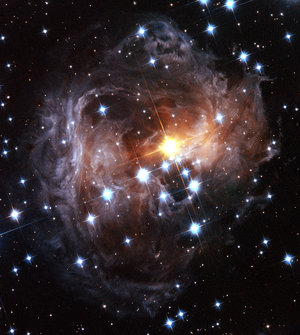
    Latest views of the V838 Monocerotis light echo from Hubble

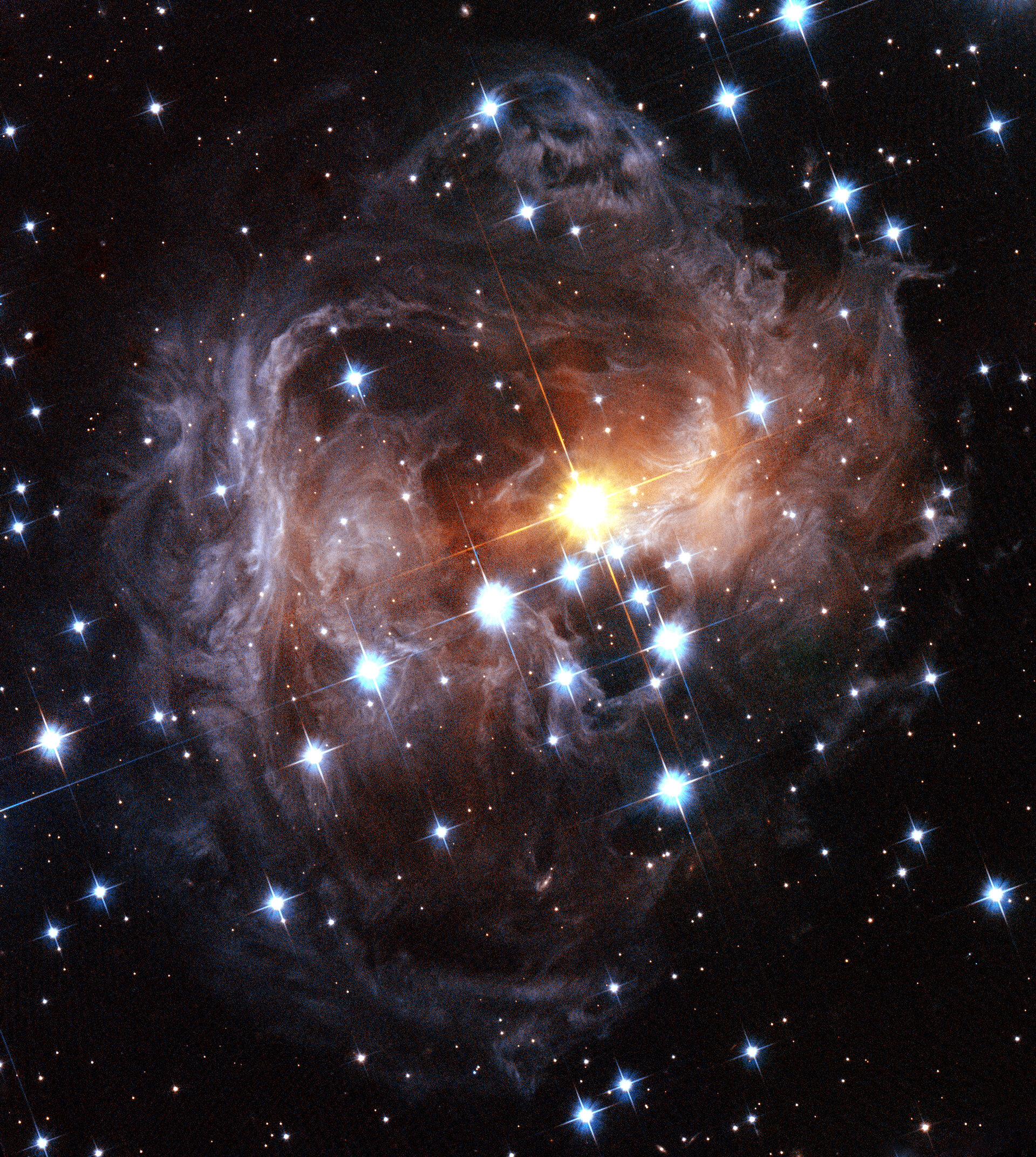
    Spectacular view of V838 Monocerotis light echo
    27 October 2006

    Hubble has returned to the intriguing variable star V838 Monocerotis many times since its initial outburst in 2002, to follow the evolution of its light echo. Two new images provide the most astonishing views of V838 to date.

    The unusual variable star V838 Monocerotis (V838 Mon) continues to puzzle astronomers. This previously inconspicuous star underwent an outburst early in 2002, during which it temporarily increased in brightness to become 600 000 times more luminous than our Sun. Light from this sudden eruption is illuminating the interstellar dust surrounding the star, producing the most spectacular ‘light echo’ in the history of astronomy.

    Evolution of the light echo around V838 Monocerotis
    Evolution of the light echo around V838 Monocerotis

    As light from the eruption propagates outward into the dust, it is scattered by the dust and travels to the Earth. The scattered light has travelled an extra distance in comparison to light that reaches Earth directly from the stellar outburst. Such a light echo is the optical analogue of the sound echo produced when an Alpine yodel is reflected from the surrounding mountainsides.


    Hubble’s views of V838 Monocerotis light echo

    The NASA/ESA Hubble Space Telescope has been observing the V838 Monocerotis light echo since 2002. Each new observation of the light echo reveals a new and unique 'thin-section' through the interstellar dust around the star.

    This release shows new images of the light echo from the Hubble Advanced Camera for Surveys taken in November 2005 (left) and again in September 2006 (right). The numerous whorls and eddies in the interstellar dust are particularly noticeable. Possibly they have been produced by the effects of magnetic fields in the space between the stars.

    The Hubble observations have been used to determine the distance to V838 Mon, using a technique based on the polarisation of the reflected light. Hubble has polarising filters that only pass light that vibrates at certain angles. This method yields a distance of 20 000 light-years for V838 Monocerotis, suggesting that, during its outburst, it was one of the brightest stars in the entire Milky Way. Although the reason for the eruption is still unclear, some astronomers have suggested it might have resulted from the collision of two stars.

    Notes for editors

    The Hubble Space Telescope is a project of international cooperation between ESA and NASA.

    For more information, please contact

    Howard Bond, Space Telescope Science Institute, Baltimore, USA
    Email: bond @ stsci.edu

    Lars Lindberg Christensen, Hubble/ESA, Garching, Germany
    Email: lars @ eso.org

    Ray Villard, Space Telescope Science Institute, Baltimore, USA
    Email: villard @ stsci.edu

    Rate this

    Views

    Share

    • Currently 0 out of 5 Stars.
    • 1
    • 2
    • 3
    • 4
    • 5
    Rating: 0/5 (0 votes cast)

    Thank you for rating!

    You have already rated this page, you can only rate it once!

    Your rating has been changed, thanks for rating!

    128
    Tweet
    • More about...
      • So, how did everything start?
        • Hubble overview
        • Related articles
          • Latest views of the V838 Monocerotis light echo from Hubble
            • Hubble yields direct proof of stellar sorting in a globular cluster
              • Antennae galaxies’ fertile marriage
                • Flies in a spider’s web: galaxy caught in the making
                  • Hubble confirms that planets form from disks around stars
                    • Hubble finds 16 candidate extrasolar planets far across our Galaxy
                      • Hubble finds hundreds of young galaxies in the early Universe
                        • Planet or failed star? One of smallest stellar companions seen by Hubble
                          • Hubble sees faintest stars in a globular cluster
                            • Hubble captures a 'quintuple' quasar
                              • Hubble provides spectacular view of ongoing comet break-up
                                • Hubble’s view of Cigar Galaxy on sixteenth mission anniversary
                                • Related links
                                • Hubble - 15 Years of Discovery

    Connect with us

    • RSS
    • Youtube
    • Twitter
    • Flickr
    • G+
    • Facebook
    • Livestream
    • Subscribe
    • App Store
    • ESA Science Twitter

    Follow ESA science

    • LATEST ARTICLES
    • · ESA astronaut Timothy Peake set fo…
    • · Space drives e-mobility
    • · Proba-V opens its eyes
    • · First new Galileo satellite arrive…
    • · Next destination: space
    • FAQ

    • Jobs at ESA

    • Site Map

    • Contacts

    • Terms and conditions