• → European Space Agency

      • Space for Europe
      • Space News
      • Space in Images
      • Space in Videos
    • About Us

      • Welcome to ESA
      • DG's News and Views
      • For Member State Delegations
      • Business with ESA
      • ESA Exhibitions
      • ESA Publications
      • Careers at ESA
    • Our Activities

      • Space News
      • Observing the Earth
      • Human Spaceflight
      • Launchers
      • Navigation
      • Space Science
      • Space Engineering
      • Operations
      • Technology
      • Telecommunications & Integrated Applications
    • For Public

    • For Media

      • Media
      • ESA TV
      • Videos for professionals
      • Photos
    • For Educators

    • For Kids

    • ESA

    • ESA Science

    • Mars Express

    • Europe goes to Mars

      • Europe reclaims a stake in Mars exploration
      • Space age transforms our knowledge about Mars
    • About Mars Express

      • Mars Express mission facts
      • Mars Express instruments
      • The mission
      • The spacecraft
      • The launcher
    • About Mars

      • Geography of Mars
      • Water on early Mars?
      • Signatures of life
      • Facts about Mars
    • Meet the team

      • International collaboration
      • Project Manager
      • Project Scientist
      • Mars Lead Scientist
      • Principal Investigators
      • Operations
      • Industry
    • Multimedia
    • VideoTalk
    • Mars Express images
    • Mars Express videos
    • HRSC videos
    • Animation in 11 languages
    • Download wallpapers
    • Download screensavers
    • 3D Flash 'model'
    • Make a model
    • Services
    • Comments

    ESA > Our Activities > Space Science > Mars Express

    Close to Ma'adim Vallis

    Craters, lava flows and tectonic features near Ma'adim Vallis

    24 July 2009

    The Mars Express High Resolution Stereo Camera imaged a region close to Ma’adim Vallis, one of the largest canyons on Mars, finding craters, lava flows and tectonic features.

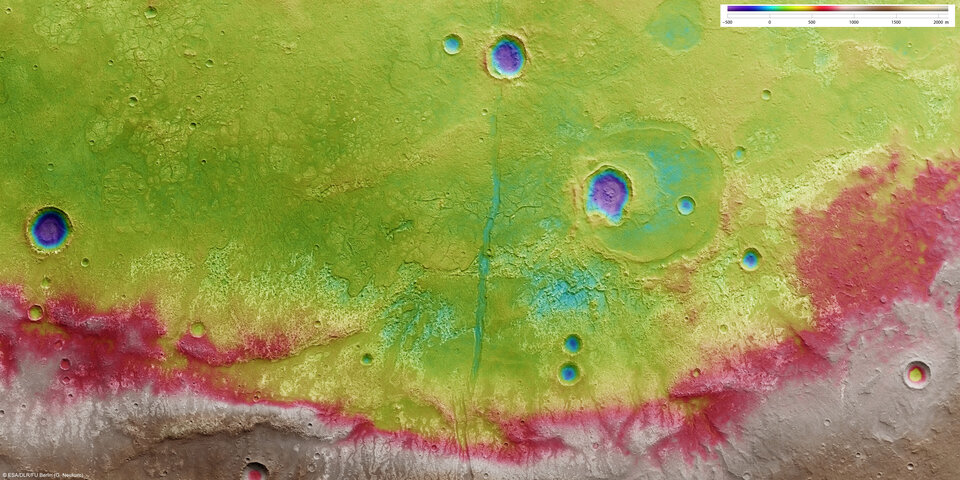
    After Valles Marineris, Ma’adim Vallis is one of the largest canyons on Mars. The region, lying south-east of Ma’adim Vallis, was imaged on 24 December 2008. The pictures are centred at about 29°S and 182°E and have a ground resolution of 15 m/pixel.

    Ma'adim Vallis context map
    Ma'adim Vallis context map

    Ma’adim Vallis is located between the volcanic region of Tharsis, which harbours four volcanoes, including the largest in the Solar System, and the Hellas Planitia impact basin. The canyon, 20 km wide and 2 km deep, originates in the southern highlands close to the ‘dichotomy boundary’ and ends in Gusev crater. The dichotomy boundary is a narrow region separating the cratered highlands, located mostly in the southern hemisphere of Mars, from the northern hemisphere's lowland plains.

    Close to Ma'adim Vallis, ortho-image
    Close to Ma'adim Vallis, ortho-image

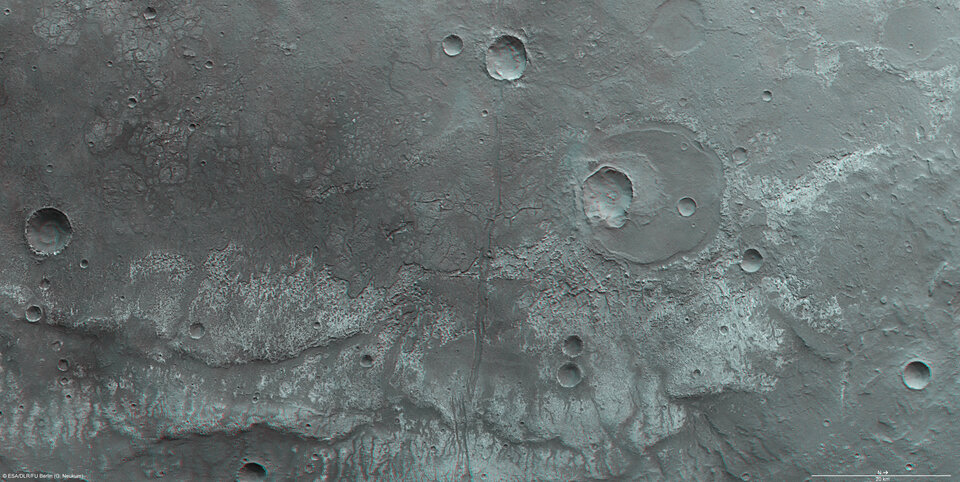
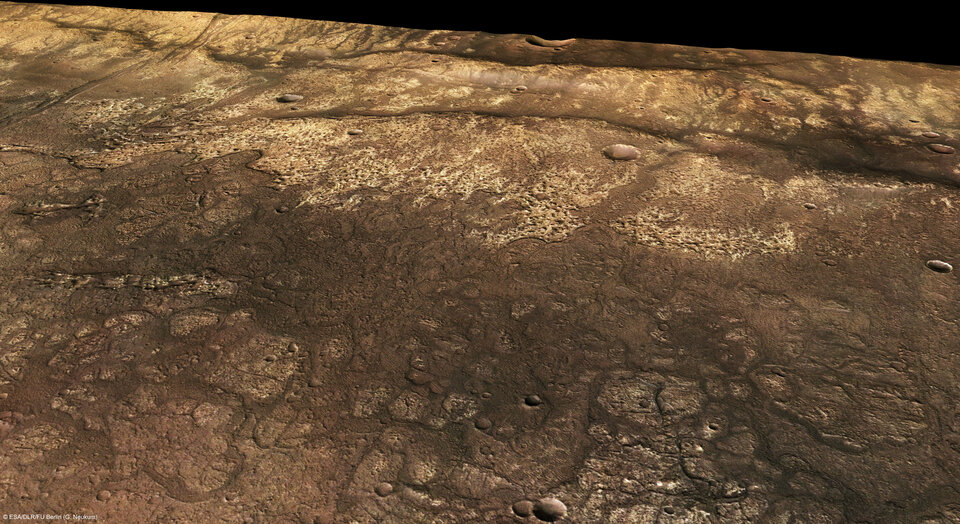
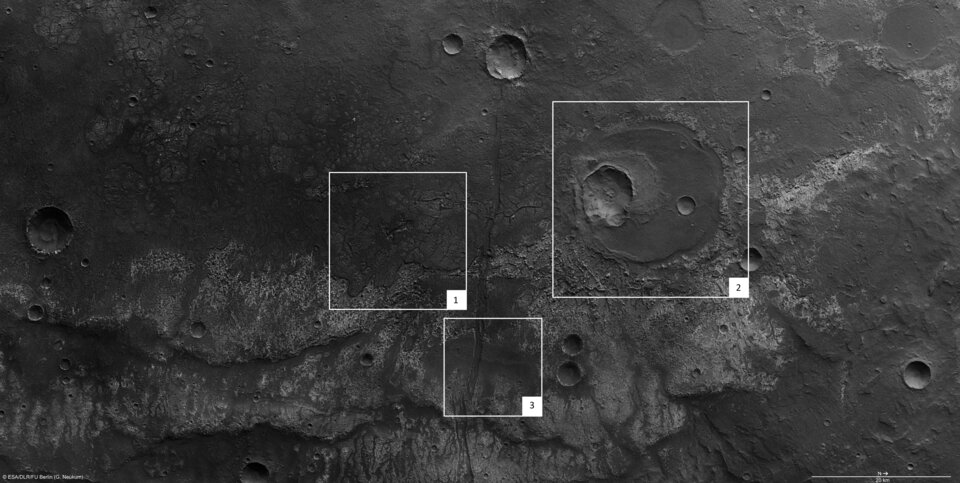
    The images cover 138 x 70 km, roughly the size of Cyprus. A sharp boundary is visible in the centre, dividing dark material to the west and light material to the east. Scientists suspect that this feature is most likely the edge of a basaltic lava flow.
    Close to Ma'adim Vallis, perspective view
    Close to Ma'adim Vallis, perspective view

    Wrinkle ridges are clearly visible on the surface of the lava flow. They were most likely formed by compressive forces.

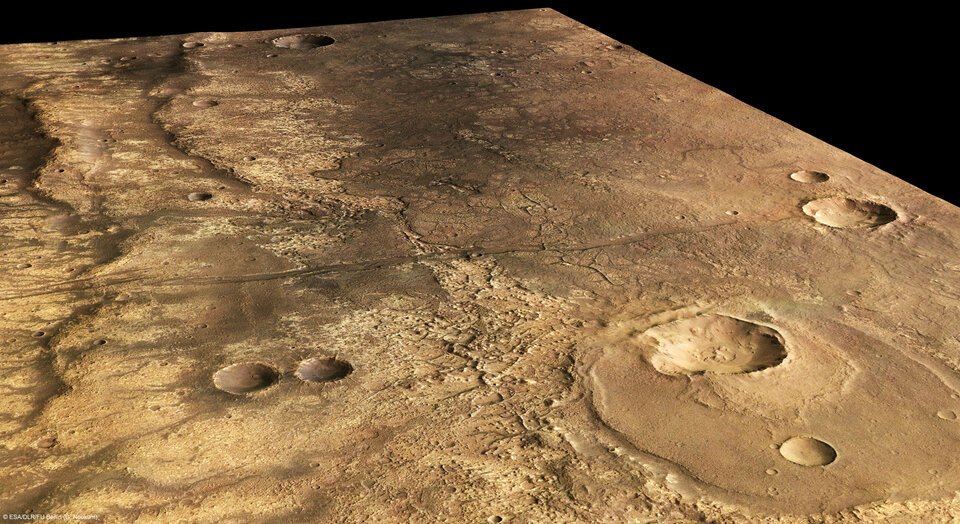
    To the north is a crater, almost 20 km in size. It is partially filled with lava, which shows that it must have formed before the lava set in. The smaller, 7 km crater at the southern edge of the larger crater must have formed later because it has an ejecta blanket that may have formed from material rich in water-ice ejected during impact.

    Close to Ma'adim Vallis, perspective view
    Close to Ma'adim Vallis, perspective view

    A linear feature, more than 200 km long, divides the image almost in the centre. It is most likely a trough associated with the uprising of the Tharsis volcanic region in the north-east. The uprising may have created a lot of stress in the crust which was released when the fracture zones formed, creating the trough.
    Close to Ma'adim Vallis, perspective view
    Close to Ma'adim Vallis, perspective view

    The colour scenes have been derived from the three HRSC-colour channels and the nadir channel. The perspective views have been calculated from the digital terrain model derived from the stereo channels. The anaglyph image was calculated from the nadir and one stereo channel. The black and white high-resolution images were derived from the nadir channel, which provides the highest detail of all channels.
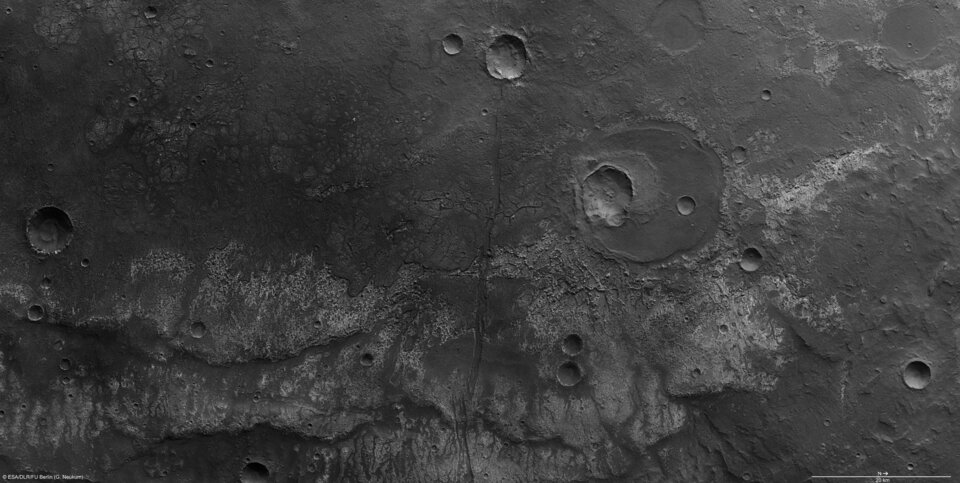
    Close to Ma'adim Vallis, annotated nadir view
    Close to Ma'adim Vallis, nadir view
    Close to Ma'adim Vallis, in 3D

    For more information on Mars Express HRSC images, please read our updated FAQ (frequently asked questions).
    Rate this

    Views

    Share

    • Currently 0 out of 5 Stars.
    • 1
    • 2
    • 3
    • 4
    • 5
    Rating: 0/5 (0 votes cast)

    Thank you for rating!

    You have already rated this page, you can only rate it once!

    Your rating has been changed, thanks for rating!

    245
    Tweet
    • Mars Express image browser
    • Related articles
      • Craters and channels in Hephaestus Fossae
        • Chaotic terrain in Ariadnes Colles
          • Ice-covered martian North Pole
            • The Euminedes Dorsum mountains on Mars
              • Lava deposits in Mangala Fossae
                • Echus Chasma
                  • Echus Chasma, page two
                    • Crater in martian valley Mamers Valles
                      • Hebes Chasma, a trough in the Grand Canyon of Mars
                      • Related links
                      • High Resolution Stereo Camera
                        • Behind the lens...
                          • Frequently asked questions
                          • For specialists
                          • ESA Planetary Science archive (PSA)
                          • NASA Planetary Data System
                          • HRSC data viewer

    Connect with us

    • RSS
    • Youtube
    • Twitter
    • Flickr
    • G+
    • Facebook
    • Livestream
    • Subscribe
    • App Store
    • LATEST ARTICLES
    • · Earth Explorers take centre stage …
    • · The fast winds of Venus are gettin…
    • · ExoMars 2016 set to complete const…
    • · Herschel ends operations as orbiti…
    • · Europe’s largest spaceship reache…
    • FAQ

    • Jobs at ESA

    • Site Map

    • Contacts

    • Terms and conditions