• → European Space Agency

      • Space for Europe
      • Space News
      • Space in Images
      • Space in Videos
    • About Us

      • Welcome to ESA
      • DG's News and Views
      • For Member State Delegations
      • Business with ESA
      • ESA Exhibitions
      • ESA Publications
      • Careers at ESA
    • Our Activities

      • Space News
      • Observing the Earth
      • Human Spaceflight
      • Launchers
      • Navigation
      • Space Science
      • Space Engineering
      • Operations
      • Technology
      • Telecommunications & Integrated Applications
    • For Public

    • For Media

    • For Educators

    • For Kids

    • ESA

    • SMART-1

    • ESA Science

    • About SMART-1
    • SMART-1 factsheet
    • Towards final impact
    • Approaching the mission end
    • Frequently Asked Questions
    • Ask about the SMART-1 impact
    • Join the SMART-1 impact observation campaign
    • About the journey

      • The magic of ion engines
      • The SMART way to travel
      • A spiral pathway to the Moon
    • About the mission

      • Masterpieces of miniaturisation
      • What do all the instruments do?
    • About the Moon

      • Welcome to the double planet
      • Lunar science - still plenty left to do!
      • Where did the Moon come from?
    • Multimedia
    • SMART-1 images
    • SMART-1 videos
    • SMART-1 animations
    • 3D Flash 'model'
    • SMART-1 wallpaper
    • Launch replay
    • Services
    • Comments

    ESA > Our Activities > Space Science > SMART-1

    Landscapes from the ancient and eroded lunar far side

    Ancient and eroded lunar far side
    14 July 2006

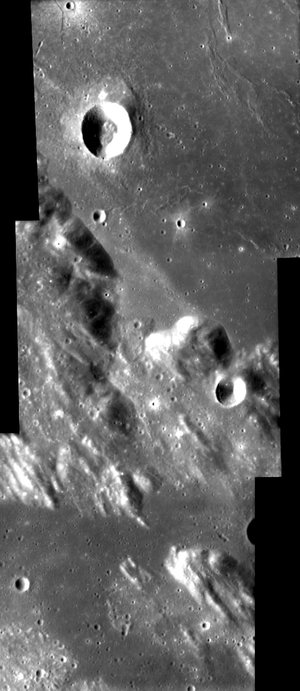
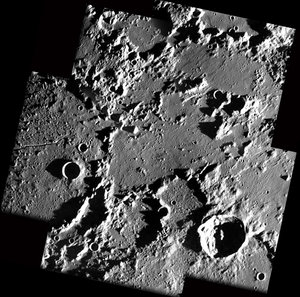
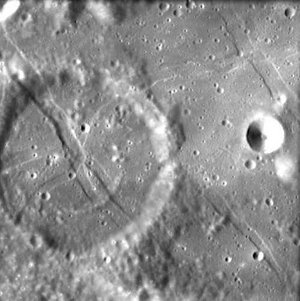
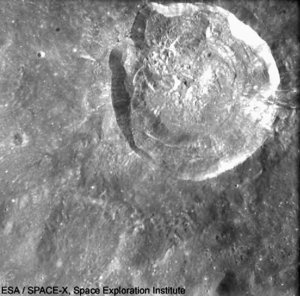
    This image, taken by the advanced Moon Imaging Experiment (AMIE) on board ESA's SMART-1 spacecraft, shows a highly eroded highland area on the lunar far side, close to the equator.

    AMIE obtained this image on 1 January 2006, from a distance of 1483 kilometres from the surface, with a ground resolution of 134 metres per pixel. The imaged area is centred at a latitude of 4.2º South and longitude 98.4º East.

    The Moon's rotation is locked to the Earth, that is the Moon always presents roughly the same side to the Earth. We call the side facing the Earth the ‘near side’, while the side facing away is the ‘far side’.

    After the first lunar missions orbited the Moon, it was discovered that unlike the near side, the far side is lacking large lava plains, the so-called ‘maria’. The far side is mainly composed of heavily cratered highlands, while only very small areas contain smooth lava plains.

    The reason for this difference between near side and far side is not exactly understood. Could the tidal pull of the Earth on the Moon - just like the Moon introduces tides on the water bodies of the Earth - have resulted in such a difference?

    The modelling of previous topography and gravity measurements indicate that the solid crust is thinner on the near side. As a consequence, large impacts could excavate the crust more easily on the near side, and so lava had an easier way to flow out and create maria formations.

    This image shows some highly eroded highland area on the lunar far side. Many craters are almost not longer visible, as they were destroyed by subsequent impacts.

    For more information

    Bernard H. Foing, ESA SMART-1 Project Scientist
    Email: bernard.foing @ esa.int

    Jean-Luc Josset, AMIE Principal Investigator
    SPACE-X Space Exploration Institute
    Email: jean-luc.josset @ space-x.ch
    Rate this

    Views

    Share

    • Currently 0 out of 5 Stars.
    • 1
    • 2
    • 3
    • 4
    • 5
    Rating: 0/5 (0 votes cast)

    Thank you for rating!

    You have already rated this page, you can only rate it once!

    Your rating has been changed, thanks for rating!

    80
    Tweet
    • SMART-1
    • More about...
      • SMART-1 view of crater Sulpicius Gallus
        • The SMART-1 way - giving the Moon some great new looks
          • Mare Humorum: where craters tell the story of basalt
            • Gassendi crater - clue on the thermal history of Mare Humorum
              • Kepler Crater as seen by SMART-1
                • Lunar West Side Story - the SMART-1 Movie
                  • SMART-1 close-up on Zucchius crater's central peaks
                    • Highlands and Mare landscapes on the Moon
                      • SMART-1’s view of Crater Hopmann: on the shoulder of a giant
                        • SMART-1’s view of Crater Hopmann: on the shoulder of a giant
                          • SMART-1’s view of craters Mayer and Bond
                            • Tectonic ‘wrinkles’ in Crater De Gasparis
                              • SMART-1’s view of craters Mayer and Bond
                                • Dark lava floor of crater Billy seen by SMART-1
                                  • Crater Lichtenberg and young lunar basalts tracked by SMART-1
                                    • SMART-1 uses new imaging technique in lunar orbit
                                      • SMART-1's dancing shadows at lunar north pole
                                        • ‘Alpine’ landscape on the Moon
                                          • SMART-1 views Glushko crater on the Moon
                                          • Related links
                                          • Space-X
                                          • Advanced Moon micro-Imager Experiment (AMIE)

    Connect with us

    • RSS
    • Youtube
    • Twitter
    • Flickr
    • G+
    • Facebook
    • Livestream
    • Subscribe
    • App Store
    • LATEST ARTICLES
    • · ESA astronaut Timothy Peake set fo…
    • · Space drives e-mobility
    • · Proba-V opens its eyes
    • · First new Galileo satellite arrive…
    • · Next destination: space
    • FAQ

    • Jobs at ESA

    • Site Map

    • Contacts

    • Terms and conditions