• → European Space Agency

      • Space for Europe
      • Space News
      • Space in Images
      • Space in Videos
    • About Us

      • Welcome to ESA
      • DG's News and Views
      • For Member State Delegations
      • Business with ESA
      • ESA Exhibitions
      • ESA Publications
      • Careers at ESA
    • Our Activities

      • Space News
      • Observing the Earth
      • Human Spaceflight
      • Launchers
      • Navigation
      • Space Science
      • Space Engineering
      • Operations
      • Technology
      • Telecommunications & Integrated Applications
    • For Public

    • For Media

      • Media
      • ESA TV
      • Videos for professionals
      • Photos
    • For Educators

    • For Kids

    • ESA

    • SMART-1

    • ESA Science

    • About SMART-1
    • SMART-1 factsheet
    • Towards final impact
    • Approaching the mission end
    • Frequently Asked Questions
    • Ask about the SMART-1 impact
    • Join the SMART-1 impact observation campaign
    • About the journey

      • The magic of ion engines
      • The SMART way to travel
      • A spiral pathway to the Moon
    • About the mission

      • Masterpieces of miniaturisation
      • What do all the instruments do?
    • About the Moon

      • Welcome to the double planet
      • Lunar science - still plenty left to do!
      • Where did the Moon come from?
    • Multimedia
    • SMART-1 images
    • SMART-1 videos
    • SMART-1 animations
    • 3D Flash 'model'
    • SMART-1 wallpaper
    • Launch replay
    • Services
    • Comments

    ESA > Our Activities > Space Science > SMART-1

    SMART-1 birthday postcard of Apollo 11 landing site

    SMART-1 postcard of Apollo 11 landing site
    20 July 2006

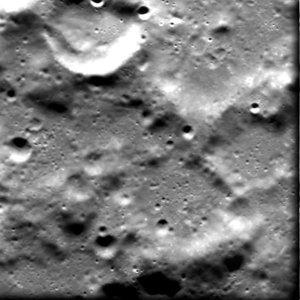
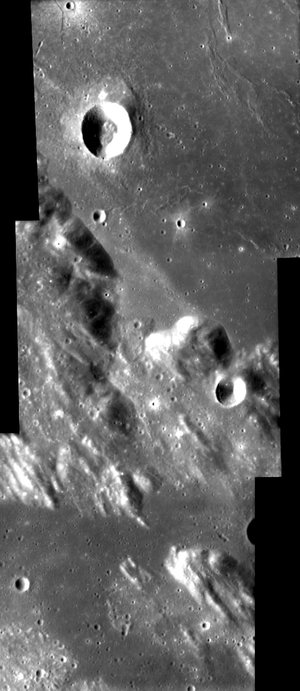
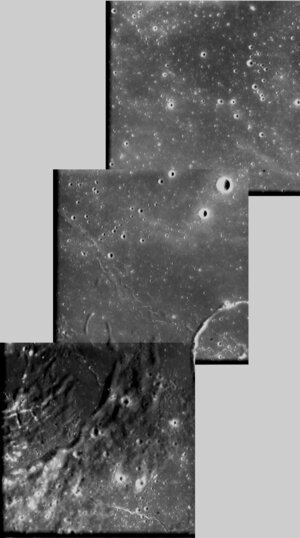
    This image, taken by the advanced Moon Imaging Experiment (AMIE) on board ESA’s SMART-1 spacecraft, shows the Apollo 11 landing site in the Mare Tranquillitatis on the Moon.

    AMIE obtained the image on 5 February 2006 from a distance of 1764 kilometres from the surface, with a ground resolution of 159 metres per pixel. The imaged area is centred at a longitude of 23.9º East close to the Moon equator, at 1.7º latitude.

    The area is close to crater Moltke (outside the field of view of this image) in the Mare Tranquilitatis. The arrow shows the landing site of Apollo 11, where the first men from Earth set foot on another object in our solar system on 20 July 1969. The two prominent craters nearby are named after two of the Apollo 11 astronauts. The first man on the Moon, Armstrong, has a crater named after him outside the field of this image.

    As can be seen from the image, the area which was selected for the first landing has a fairly featureless, on a large scale smooth surface. This was done on purpose to make the landing easier.

    The landing sites of the Apollo missions are important calibration targets for lunar remote sensing missions, as these are the places from where material was brought back to Earth and analysed in detail. The age of the rocks returned with Apollo can be determined with radioisotopic dating methods to very high accuracy and give 'reference points' to remote sensing instruments.

    "From SMART-1 observations of previous landing sites we can compare remote observations to the ground truth, and expand from local to global views of the Moon," says Bernard Foing, ESA’s SMART-1 Project scientist. "And we can better define potential sites for future landers," he concluded. This image is a mosaic of several filter images of AMIE, the boundaries of which can be seen by thin horizontal lines (north is up).


    Note to editors

    The SMART-1 team is also contributing its experience and data set for the upcoming fleet of lunar orbiters and landers. This is being discussed with international partners at the COSPAR Committee for Space Research assembly taking place this week at Beijing, China, 37 years after the historical landing in Mare Tranquillitatis, and on 23-27 July, during an ILEWG (International Lunar Explorer Working Group) international conference on exploration and utilisation of the Moon, also taking place at Beijing.

    For more information

    Jean-Luc Josset
    AMIE Principal Investigator
    SPACE-X Space Exploration Institute
    Email: jean-luc.josset @ space-x.ch

    Bernard H. Foing, ESA SMART-1 Project Scientist
    Email: bernard.foing @ esa.int
    Rate this

    Views

    Share

    • Currently 0 out of 5 Stars.
    • 1
    • 2
    • 3
    • 4
    • 5
    Rating: 0/5 (0 votes cast)

    Thank you for rating!

    You have already rated this page, you can only rate it once!

    Your rating has been changed, thanks for rating!

    169
    Tweet
    • SMART-1
    • More about...
      • Gruithuisen: non-mare volcanism in Procellarum
        • Landscapes from the ancient and eroded lunar far side
          • SMART-1 view of crater Sulpicius Gallus
            • The SMART-1 way - giving the Moon some great new looks
              • Mare Humorum: where craters tell the story of basalt
                • Gassendi crater - clue on the thermal history of Mare Humorum
                  • Kepler Crater as seen by SMART-1
                    • Lunar West Side Story - the SMART-1 Movie
                      • SMART-1 close-up on Zucchius crater's central peaks
                        • Highlands and Mare landscapes on the Moon
                          • SMART-1’s view of Crater Hopmann: on the shoulder of a giant
                            • SMART-1’s view of craters Mayer and Bond
                              • Tectonic ‘wrinkles’ in Crater De Gasparis
                                • Dark lava floor of crater Billy seen by SMART-1
                                  • Crater Lichtenberg and young lunar basalts tracked by SMART-1
                                    • SMART-1 uses new imaging technique in lunar orbit
                                      • SMART-1's dancing shadows at lunar north pole
                                      • Related links
                                      • COSPAR Assembly 2006
                                      • ILEWG 8th Conference on Exploration and Utilisation of the Moon
                                      • Space-X
                                      • Advanced Moon micro-Imager Experiment (AMIE)

    Connect with us

    • RSS
    • Youtube
    • Twitter
    • Flickr
    • G+
    • Facebook
    • Livestream
    • Subscribe
    • App Store
    • LATEST ARTICLES
    • · Rare merger reveals secrets of gal…
    • · Watching for hazards: ESA opens as…
    • · ESA astronaut Timothy Peake set fo…
    • · Space drives e-mobility
    • · Proba-V opens its eyes
    • FAQ

    • Jobs at ESA

    • Site Map

    • Contacts

    • Terms and conditions