Titan's pebbles 'seen' by Huygens radio
An unexpected radio reflection from the surface of Titan has allowed ESA scientists to deduce the average size of stones and pebbles close to the Huygens’ landing site. The technique could be used on other lander missions to analyse planetary surfaces for free.
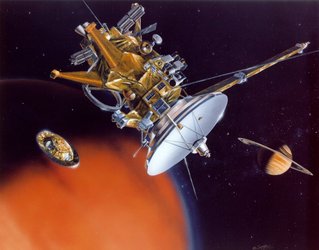
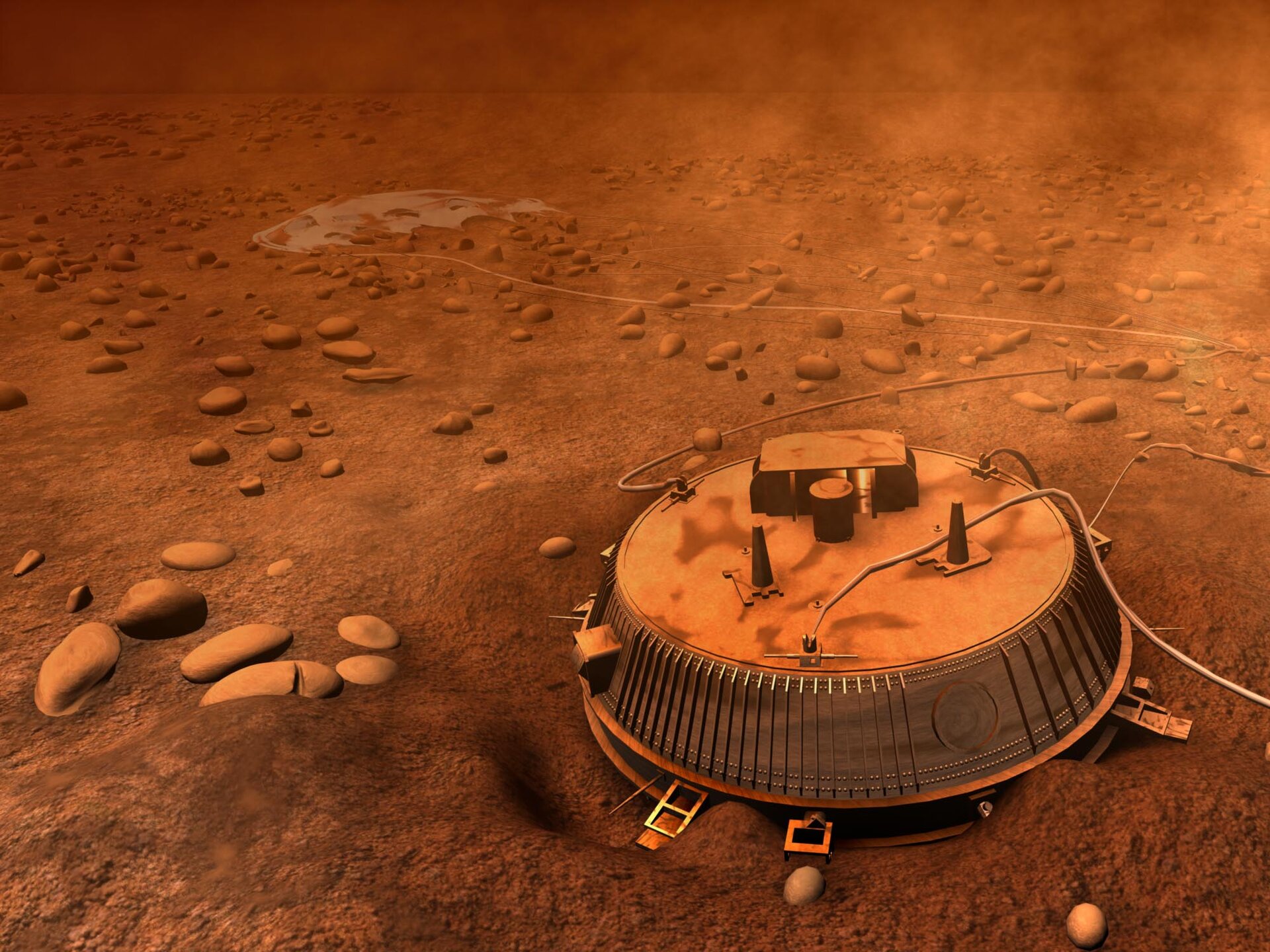
When Huygens came to rest on the surface of Titan on 14 January 2005, it survived the impact and continued to transmit to the Cassini mothership, orbiting above. Part of that radio signal 'leaked' downwards and hit the surface of Titan before being reflected back up to Cassini. On its way up, it interfered with the direct beam.
As Miguel Pérez-Ayúcar, a member of the Huygens Team at ESA’s European Space Research and Technology Centre (ESTEC) in The Netherlands, and his colleagues watched the signal coming back, they were initially puzzled to see the power of the signal rising and falling in a repetitive manner.
“Huygens had not been designed to necessarily survive impact so we had never thought about what the signal would look like from the surface,” says Pérez. After making a joke that aliens must be dragging the craft along the surface, Pérez and the team began work at once to understand the signal.
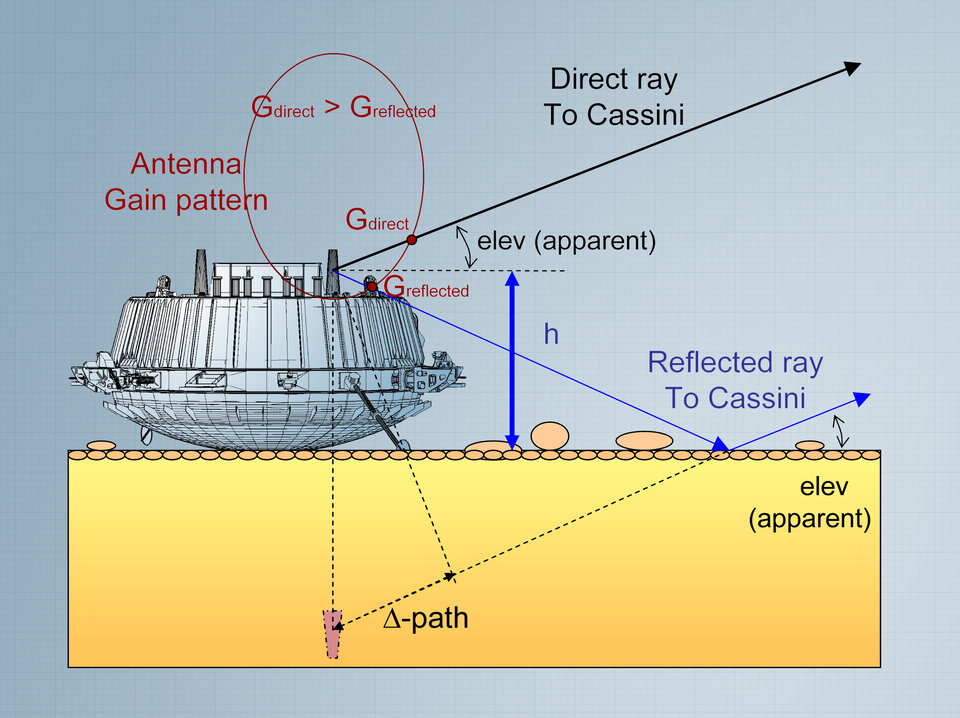
The clue was the repetitive oscillation of the power. It made Pérez think about the interaction of the direct signal with that reflecting from the surface of Titan. As Cassini travelled away from the Huygens landing site, the angle between it and Huygens changed. This altered the way in which the interference between the reflected and direct beams was detected, perhaps causing the variation in power.
He began running computer models and saw that not only could he reproduce the received signal but also it was sensitive to the size of pebbles on the surface of Titan.
Cassini collected data for 71 minutes after Huygens landed. After that time, the spacecraft’s motion took it below the horizon as seen from Huygens' landing site. Until then, it soaked up radio signals that encoded information about a swathe of Titan’s surface from 1 metre to 2 kilometres to the west of the landed probe.
To accurately mirror the true signal, Pérez and his team discovered that the surface swathe must be relatively flat and covered mostly in stones of around 5-10 centimetres in diameter.
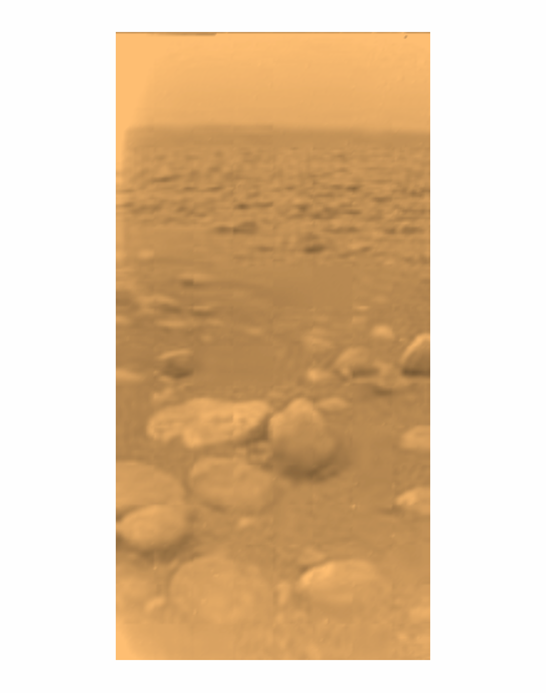
This unique result complements the data taken by the Descent Imager and Spectral Radiometer (DISR) instrument. When Huygens came to rest on the surface of Titan, DISR was pointing due south. Its images show stones and terrain in good agreement with the newly deduced western facing radio data. "This is a real bonus to the mission. It requires no special equipment, just the usual communications subsystem," says Pérez.
Now that the scientists have understood the process using the unexpected Huygens data, the technique could be implemented on future lander missions. "This experience can be inherited by any future lander," says Pérez, "All that will be needed is a few refinements and it will become a powerful technique."
By subtly altering the properties of the radio beam for instance, the radio transmitter and receiver can be optimised to help deduce the chemical composition of the planetary surface.
Note to editors:
The results appear in the 25 July 2006 issue of the Journal of Geophysical Research (Vol. 111. Doi: 10.1029/2005JE002613, 2006). The paper, titled 'Bistatic Observations of Titan’s Surface with the Huygens probe radio signal', is by M Pérez-Ayúcar, J.P.Lebreton, N.Floury and R.Prieto-Cerdeira (ESA-ESTEC, Noordwijk, The Netherlands), and R.D.Lorenz (Univ.of Arizona, Tucson, Arizona, USA).
For more information:
Miguel Pérez-Ayúcar, ESA-ESTEC, The Netherlands
Email: mperez @ rssd.esa.int
Jean-Pierre Lebreton, ESA Huygens Project Scientist
Email: jean-pierre.lebreton @ esa.int