Andromeda’s coat of many colours
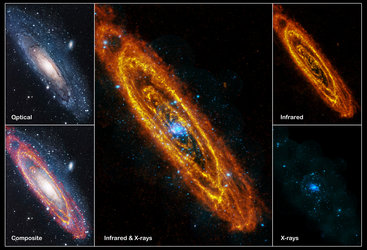
ESA’s fleet of space telescopes has captured the nearby Andromeda Galaxy, also known as M31, in different wavelengths. Most of these wavelengths are invisible to the eye and each shows a different aspect of the galaxy’s nature.
Visible light, as seen by optical ground-based telescopes and our eyes, reveals the various stars that shine in the Andromeda Galaxy, yet it is just one small part of the full spectrum of electromagnetic radiation. There are many different wavelengths that are invisible to us but which are revealed by ESA’s orbiting telescopes.
Starting at the long wavelength end, the Planck spacecraft collects microwaves. These show up particles of incredibly cold dust, at just a few tens of degrees above absolute zero. Slightly higher temperature dust is revealed by the shorter, infrared wavelengths observed by the Herschel space telescope. This dust traces locations in the spiral arms of the Andromeda Galaxy where new stars are being born today.
The XMM-Newton telescope detects wavelengths shorter than visible light, collecting ultraviolet and X-rays. These show older stars, many nearing the end of their lives and others that have already exploded, sending shockwaves rolling through space. By monitoring the core of Andromeda since 2002, XMM-Newton has revealed many variable stars, some of which have undergone large stellar detonations known as novae.
Ultraviolet wavelengths also display the light from extremely massive stars. These are young stars that will not live long. They exhaust their nuclear fuel and explode as supernovae typically within a few tens of millions of years after they are born. The ultraviolet light is usually absorbed by dust and re-emitted as infrared, so the areas where ultraviolet light is seen directly correspond to relatively clear, dust-free parts of Andromeda.
By putting all of these observations together, and seeing Andromeda in its many different colours, astronomers are able to follow the life cycle of the stars.