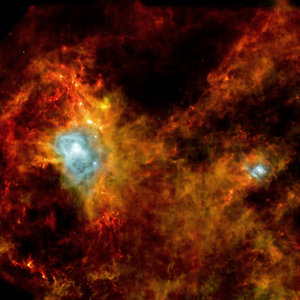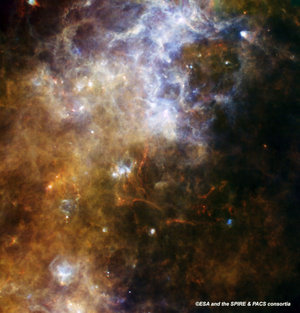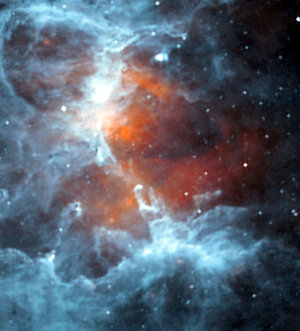
Stars are born in dense clouds of dust and gas that can now be studied in unprecedented detail with Herschel. Although jets and winds of gas have been seen coming from young stars in the past, it has always been a mystery exactly how a star uses these to blow away its surroundings and emerge from its birth cloud. Now, for the first time, Herschel may be seeing an unexpected step in this process.
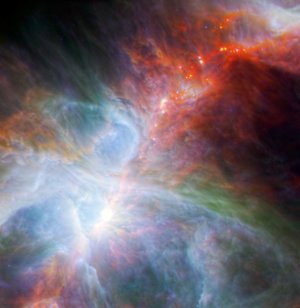
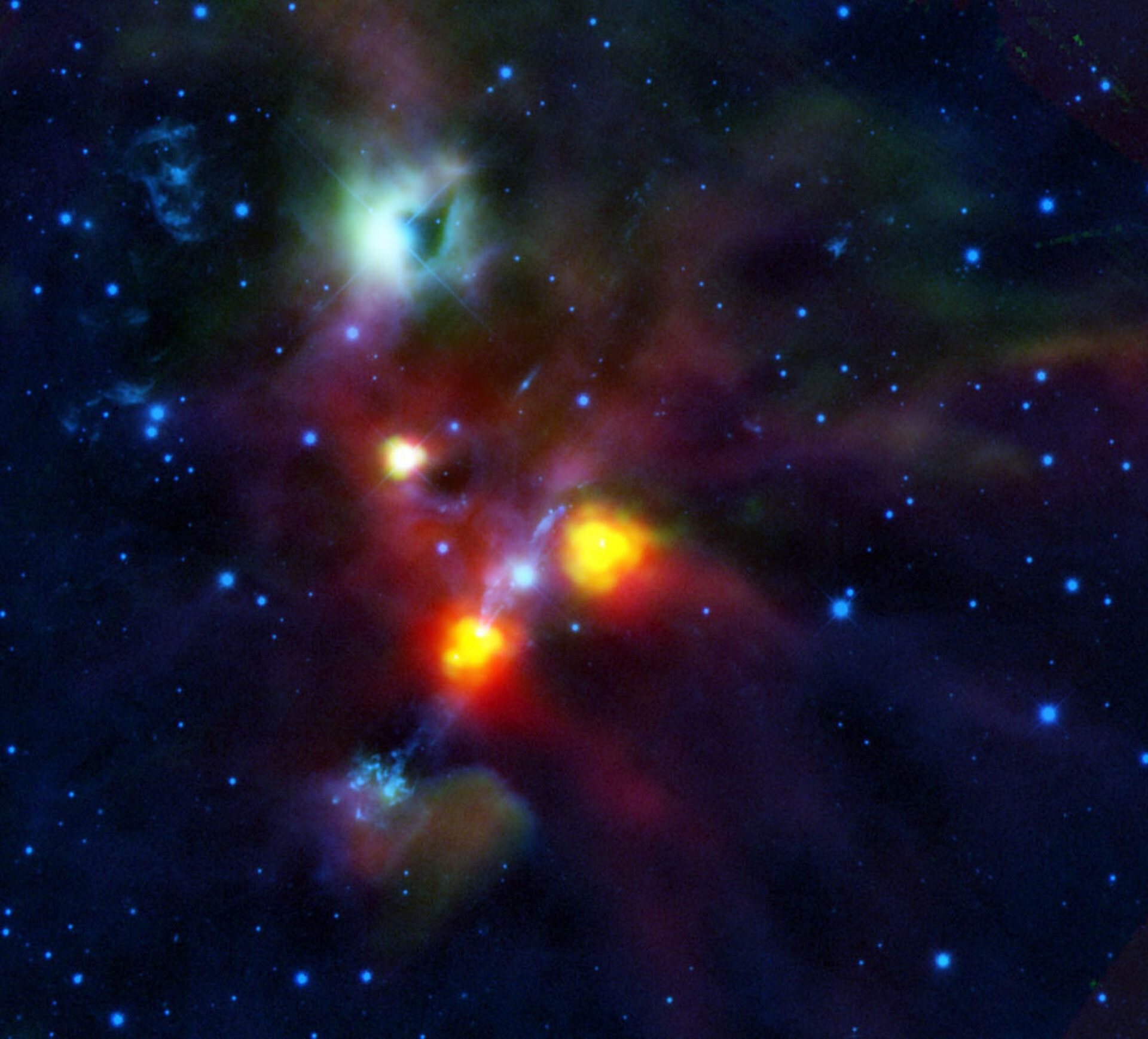
A cloud of bright reflective gas known to astronomers as NGC 1999 sits next to a black patch of sky. For most of the 20th century, such black patches have been known to be dense clouds of dust and gas that block light from passing through.
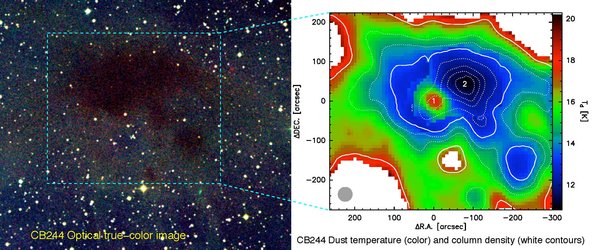
When Herschel looked in its direction to study nearby young stars, the cloud continued to look black. But wait! That should not be the case. Herschel’s infrared eyes are designed to see into such clouds. Either the cloud was immensely dense or something was wrong.
Investigating further using ground-based telescopes, astronomers found the same story however they looked: this patch looks black not because it is a dense pocket of gas but because it is truly empty. Something has blown a hole right through the cloud.
“No-one has ever seen a hole like this,” says Tom Megeath, of the University of Toledo, USA. “It’s as surprising as knowing you have worms tunnelling under your lawn, but finding one morning that they have created a huge, yawning pit.”
The astronomers think that the hole must have been opened when the narrow jets of gas from some of the young stars in the region punctured the sheet of dust and gas that forms NGC 1999. The powerful radiation from a nearby mature star may also have helped to clear the hole. Whatever the precise chain of events, it could be an important glimpse into the way newborn stars disperse their birth clouds.
 |  |
| | Herschel: ESA's giant infrared observatory (http://www.esa.int/SPECIALS/Herschel/index.html) |
 |
 More on Herschel First Results

|
| | Herschel overview (http://www.esa.int/SPECIALS/Herschel/index.html) |
 |
| | Notes to editors (http://www.esa.int/esaSC/SEMTP7KPO8G_index_0.html) |
 |
| | - (http://www.esa.int/esaSC/SEMM4AKPO8G_index_0_ov.html) |
 |
| | Online Showcase of Herschel Images OSHI (http://oshi.esa.int/) |
 |
 Herschel on YouTube

|
| | Inside Herschel (http://www.youtube.com/watch?v=j9_VBKn8Jq4 &feature=PlayList &p=CD471914889C152B &index=1) |
 |
| | Herschel mission objectives (http://www.youtube.com/watch?v=YyEpV1_CH4w &feature=PlayList &p=CD471914889C152B &index=5) |
 |
 Related articles

|
| | Herschel spots comet massacre around nearby star (http://www.esa.int/esaCP/SEM1XBHWP0H_index_0.html) |
 |
| | Fledgling stars flicker in the heart of Orion (http://www.esa.int/esaCP/SEMXRL4Y1ZG_index_0.html) |
 |
| | A New View of an Icon (http://www.esa.int/esaCP/SEMG4NMXDXG_index_0.html) |
 |
| | Herschel and Planck win the French Grand Prix (http://www.esa.int/esaCP/SEMARKPK2AG_index_0.html) |
 |
| | Herschel reveals the hidden side of star birth (http://www.esa.int/esaCP/SEM7N7KPO8G_index_0.html) |
 |
| | Herschel takes the temperature of an interstellar cloud (http://www.esa.int/esaSC/SEMMZ9KPO8G_index_0.html) |
 |
| | Tracing the Milky Way’s hidden reservoirs of gas (http://www.esa.int/esaSC/SEMJ0AKPO8G_index_0.html) |
 |
| | Herschel resolves the cosmic infrared fog (http://www.esa.int/esaSC/SEMO1AKPO8G_index_0.html) |
 |
| | Baby stars in the Rosette cloud (http://www.esa.int/esaCP/SEMWQ59MT7G_index_0.html) |
 |
| | Inside the dark heart of the Eagle (http://www.esa.int/esaCP/SEMT0T9K73G_index_0.html) |
 |
| | Herschel views deep-space pearls on a cosmic string (http://www.esa.int/esaCP/SEMUABGNA0G_index_0.html) |
 |
| | Herschel and Planck pass in-orbit 'exam' (http://www.esa.int/SPECIALS/Herschel/SEM778E3GXF_0.html) |
 |
| | Herschel images promise bright future (http://www.esa.int/esaCP/SEMAYT6CTWF_index_0.html) |
 |
| | Herschel’s daring test: a glimpse of things to come (http://www.esa.int/esaCP/SEM76A0P0WF_index_0.html) |
 |
| | Herschel cryocover is open (http://www.esa.int/esaCP/SEMR943XTVF_index_0.html) |
 |
 Read more

|
| | Observations: Seeing in infrared wavelengths (http://www.esa.int/esaSC/SEMS72T1VED_index_0.html) |
 |
| | Why infrared astronomy is a hot topic (http://www.esa.int/esaCP/SEMX9PZO4HD_FeatureWeek_0.html) |
 |
| | L2, the second Lagrangian Point (http://www.esa.int/esaSC/SEMO4QS1VED_index_0.html) |
 |
 In depth

|
| | This article in depth (http://sci.esa.int/jump.cfm?oid=50252) |
 |
| | Herschel in depth (http://sci.esa.int/science-e/www/area/index.cfm?fareaid=16) |
 |
| | Herschel first science results in depth (http://sci.esa.int/science-e/www/object/index.cfm?fobjectid=46985) |
 |
| | Herschel Science Centre (http://herschel.esac.esa.int/) |
 |