First X-ray detection of a colliding-wind binary beyond the Milky Way
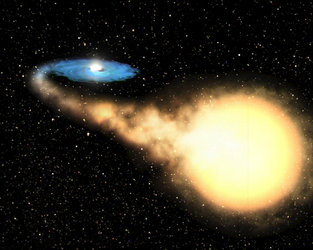
Imagine two stars with winds so powerful that they eject an Earth's worth of material roughly once every month. Next, imagine those two winds colliding head-on. Such titanic collisions produce multimillion-degree gas, which radiates brilliantly in X-rays. Astronomers have conclusively identified the X-rays from about two-dozen of these systems in our Milky Way. But they have never seen one outside our galaxy — until now.
Thanks to the European Space Agency's XMM-Newton X-ray observatory, with help from NASA's Chandra X-ray Observatory, an international team led by Dr Yaël Nazé of the Université de Liège in Belgium has found such a system in a nearby galaxy. This galaxy, the Small Magellanic Cloud, orbits the Milky Way and is located about 170 000 light-years from Earth.

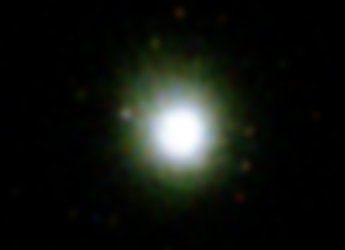
The binary system, known as HD 5980, contains two extremely massive stars, 'weighing' about 50 and 30 times the mass of the Sun. Each star radiates more than a million times as much light as the Sun, meaning they put out more light in one minute than our host star generates in an entire year.
The sheer photon pressure of this incredible outpouring of light blows off gas from each star in a supersonic 'wind'. These winds are so powerful that they carry away roughly an Earth mass each month, a rate 10 thousand million times greater than the solar wind, and at a speed 5 times faster than the solar wind itself.

HD 5980's two stars are separated by only about 90 million kilometres, roughly half Earth's average distance from the Sun. "These stars are so close to each other that if they were in our solar system they could fit inside the orbit of Venus," says Nazé. As a result, the winds smash into each other with tremendous force, heating the gas and generating enormous numbers of X-rays.
"The system emits about 10 times more energy in X-rays alone than the Sun radiates over the entire spectrum," says team member Dr Michael F. Corcoran, a scientist with the Universities Space Research Association at NASA's Goddard Space Flight Center in Greenbelt, Maryland.

Using data from Chandra, the same team first reported HD 5980's highly energetic X-ray emission in 2002. But its origin was uncertain. Data taken from 2000 to 2005 with XMM-Newton shows that it is indeed produced by a wind collision.
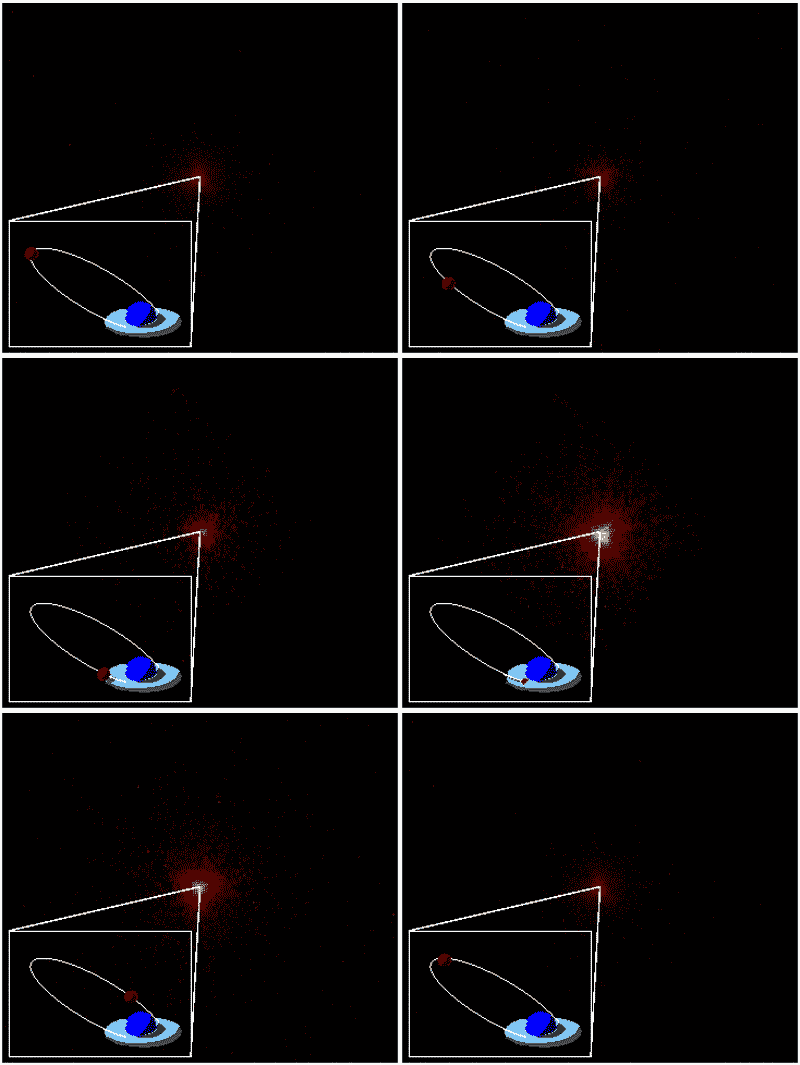
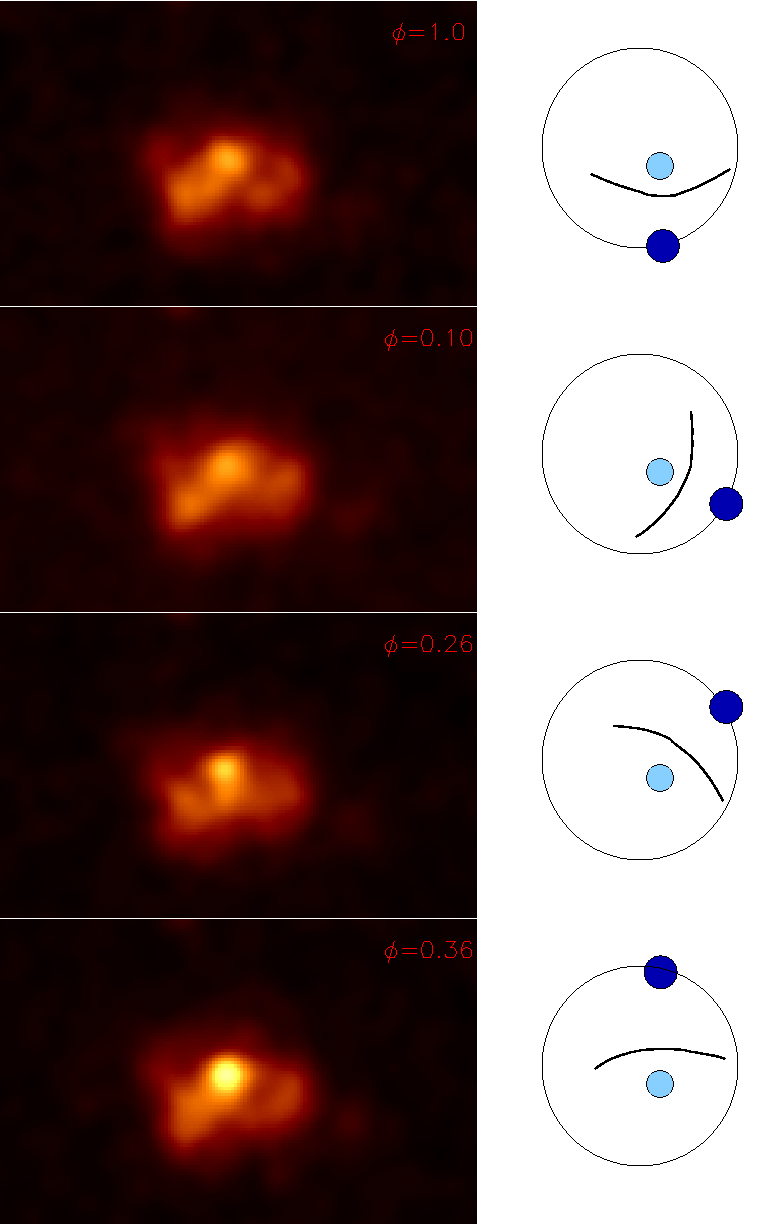
The stars orbit each other every 20 days in a plane that is edge-on to Earth's line of sight, so the stars periodically eclipse each other. The wind collision is thus seen from different angles and through different amounts of material. XMM-Newton saw the X-ray emission rise and fall in a repeatable, predictable pattern.
"Similar X-ray variability from massive binaries inside the Milky Way have been detected, but this is the first indisputable evidence for the phenomenon outside our galaxy," says Nazé. "This discovery highlights the great capabilities of modern X-ray observatories."
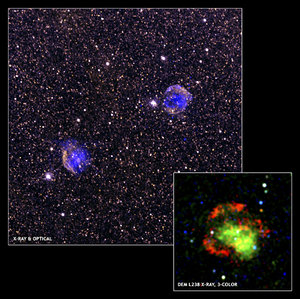
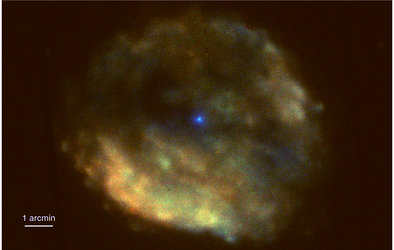
XMM-Newton has the largest mirrors of any X-ray observatory ever flown, and the sheer size of these mirrors allowed astronomers to monitor this distant system. HD 5980 itself is surrounded by hot interstellar material that creates a diffuse X-ray glow that makes the object difficult to study. "The Chandra data allowed us to pinpoint HD 5980 and resolve the system from the diffuse emission," says Corcoran.
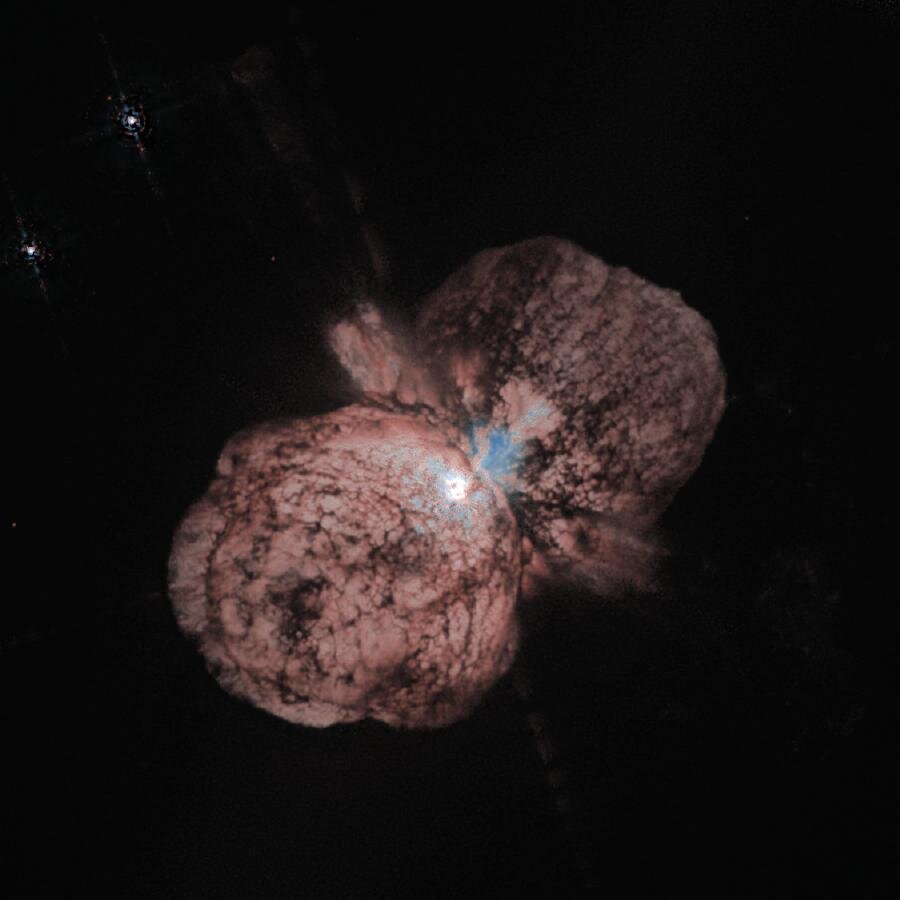
HD 5980 is one of the Small Magellanic Cloud's brightest stars. Situated on the periphery of the star cluster NGC 346, the two stars are nearing the end of their lives and will eventually explode as supernovae. The more massive star, HD 5980A, is passing through a Luminous Blue Variable (LBV) phase — a short-lived, erratic stage that only the most massive stars go through. The most well-known LBV in our galaxy, Eta Carinae, produced a giant outburst that was recorded by astronomers in the 1840s. HD 5980A experienced a smaller-scale outburst that was seen in 1993-94. Its companion, HD 5980B, is an evolved Wolf-Rayet star that has already ejected much of its original envelope.
"It's interesting to be able to study an extragalactic colliding-wind binary like HD 5980 as if it were in our own galaxy", says Corcoran. "Colliding winds provide an important handle on how massive stars shed material. Being able to study them in external galaxies means we can study the effects of different compositions and environments on how these massive stars evolve. From the XMM-Newton data, we can study the delicate balance between the two winds, and determine the changing strength of the winds."
Note for editors
The results will appear on-line today in The Astrophysical Journal Letters, in the article titled: "First detection of phase-dependent colliding wind X-ray emission outside the Milky Way" (http://arxiv.org/abs/astro-ph/0702403).
Coauthors also include Dr Gloria Koenigsberger of the Universidad Nacional Autonoma de México and Dr Anthony J. Moffat of the Université de Montréal in Canada.
For more information
Yaël Nazé, Université de Liège, Belgium
Tel: +32 4 366 9720
Email: naze @ astro.ulg.ac.be
Michael F. Corcoran, Universities Space Research Association at NASA/GSFC, Greenbelt, Maryland, USA
Email: corcoran @ milkyway.gsfc.nasa.gov
Gloria Koenigsberger, Universidad Nacional Autonoma de México
Email: gloria @ astroscu.unam.mx
Anthony J. Moffat, Université de Montréal, Canada
Email: moffat @ astro.umontreal.ca
Norbert Schartel, ESA XMM-Newton Project Scientist
Email: norbert.schartel @ sciops.esa.int