Greek fires seen from space
ESA’s Envisat satellite captures thick clouds of smoke billowing from wildfires that have been raging through Greece and are threatening the capital, Athens.
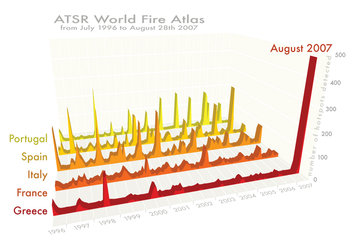
More than 2000 firefighters and soldiers are working to contain the blazes, the worst to hit Greece since 2007 when deadly wildfires raged across the country killing more than 70 people.
The wildfires, which began late Friday some 40 km northeast of Athens in the village of Grammatikos, have burned at least 15 000 hectares of land and forced thousands to flee their homes. On Saturday, Greek authorities declared a state of emergency after the fires spread to neighbouring villages.
One of the biggest problems during and after fires is obtaining an overall view of the damage and its evolution. Earth Observation (EO) satellites are used to detect fire spots from space and to quickly estimate the extent of burned areas.

On Sunday, the Greek General Secretariat for Civil Protection asked the International Charter on Space and Major Disasters for support. The initiative, referred to as ‘the Charter’, was established in 2000 to provide satellite data free of charge to those responding to disasters anywhere in the world.
In addition to data being made available through the Charter activation, ESA provides EO data from contributing satellite missions to SAFER, the GMES Emergency Response Service. GMES is an EU-led initiative to combine ground- and space-based observations to develop an integrated environmental monitoring capability. ESA’s role within GMES is to implement its space component.
These images were acquired by Envisat’s Medium Resolution Imaging Spectrometer (MERIS) optical instrument on 22 and 24 August 2009, working in Full Resolution mode to provide a spatial resolution of 300 metres and is available on ESA’s MIRAVI website, which gives free access to Envisat’s most recently acquired images.