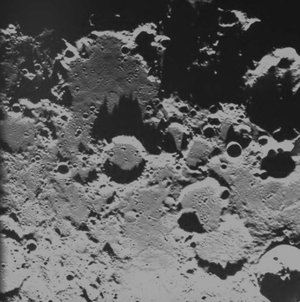
SMART-1 birthday postcard of Apollo 11 landing site
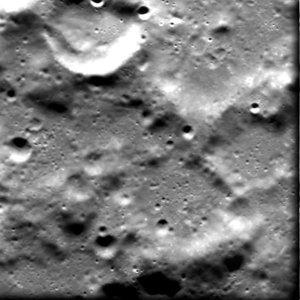
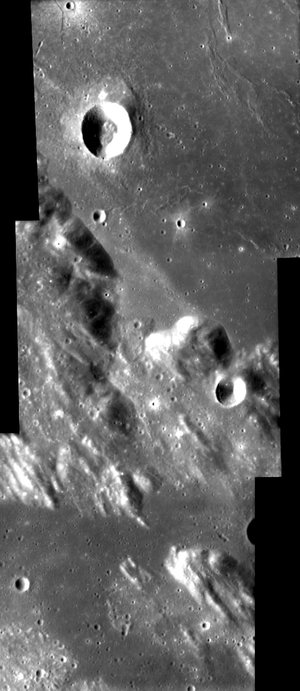
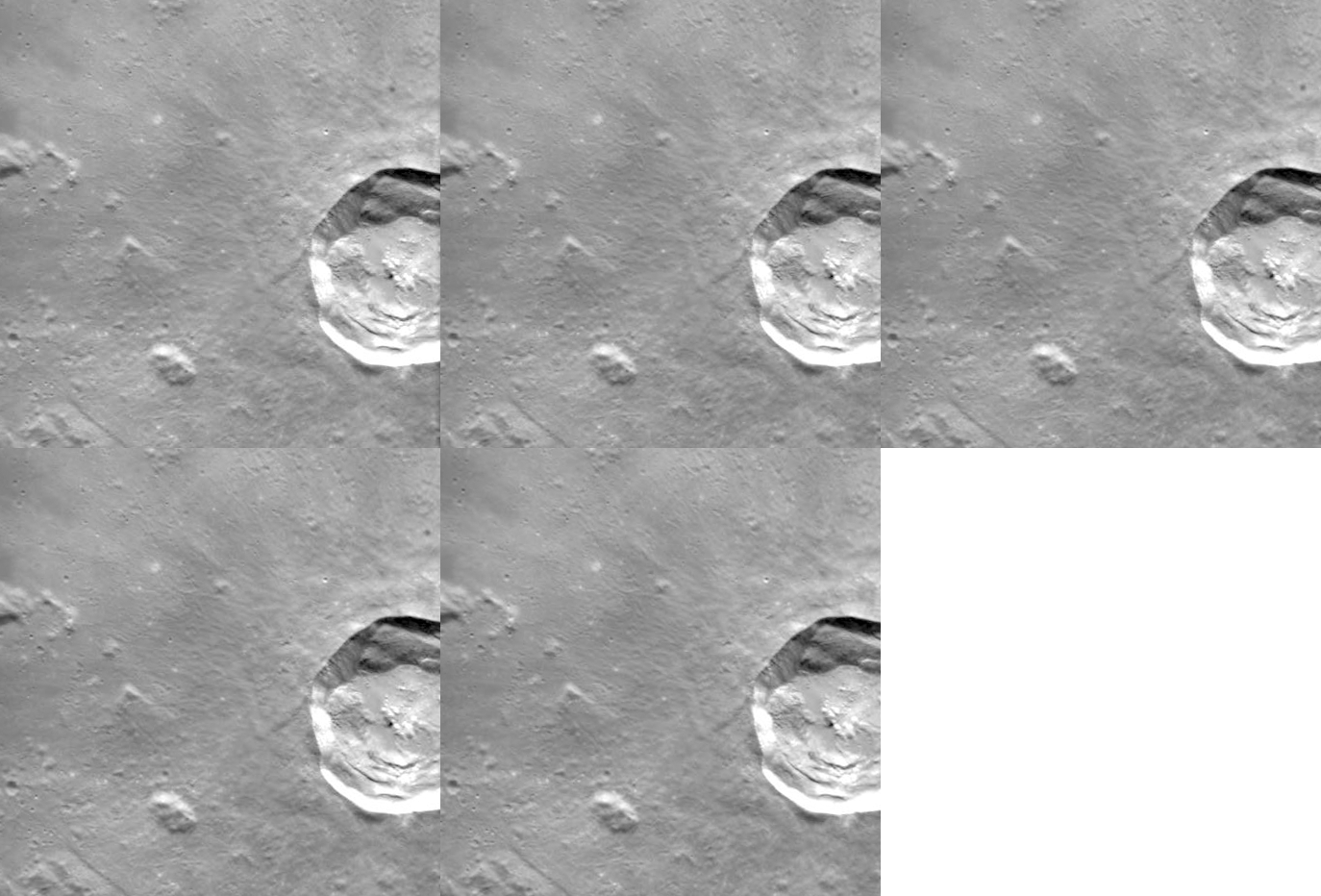
This image, taken by the advanced Moon Imaging Experiment (AMIE) on board ESA’s SMART-1 spacecraft, shows the Apollo 11 landing site in the Mare Tranquillitatis on the Moon.
AMIE obtained the image on 5 February 2006 from a distance of 1764 kilometres from the surface, with a ground resolution of 159 metres per pixel. The imaged area is centred at a longitude of 23.9º East close to the Moon equator, at 1.7º latitude.
The area is close to crater Moltke (outside the field of view of this image) in the Mare Tranquilitatis. The arrow shows the landing site of Apollo 11, where the first men from Earth set foot on another object in our solar system on 20 July 1969. The two prominent craters nearby are named after two of the Apollo 11 astronauts. The first man on the Moon, Armstrong, has a crater named after him outside the field of this image.
As can be seen from the image, the area which was selected for the first landing has a fairly featureless, on a large scale smooth surface. This was done on purpose to make the landing easier.
The landing sites of the Apollo missions are important calibration targets for lunar remote sensing missions, as these are the places from where material was brought back to Earth and analysed in detail. The age of the rocks returned with Apollo can be determined with radioisotopic dating methods to very high accuracy and give 'reference points' to remote sensing instruments.
"From SMART-1 observations of previous landing sites we can compare remote observations to the ground truth, and expand from local to global views of the Moon," says Bernard Foing, ESA’s SMART-1 Project scientist. "And we can better define potential sites for future landers," he concluded. This image is a mosaic of several filter images of AMIE, the boundaries of which can be seen by thin horizontal lines (north is up).
Note to editors
The SMART-1 team is also contributing its experience and data set for the upcoming fleet of lunar orbiters and landers. This is being discussed with international partners at the COSPAR Committee for Space Research assembly taking place this week at Beijing, China, 37 years after the historical landing in Mare Tranquillitatis, and on 23-27 July, during an ILEWG (International Lunar Explorer Working Group) international conference on exploration and utilisation of the Moon, also taking place at Beijing.
For more information
Jean-Luc Josset
AMIE Principal Investigator
SPACE-X Space Exploration Institute
Email: jean-luc.josset @ space-x.ch
Bernard H. Foing, ESA SMART-1 Project Scientist
Email: bernard.foing @ esa.int