XMM-Newton discovers the star that everyone missed
XMM-Newton has discovered an exploding star in the Milky Way. Usually that would be important in itself, but this time there is a special twist. Calculations show that the explosion must have been clearly visible to the unaided eye but was missed by the legions of star watchers around the planet.
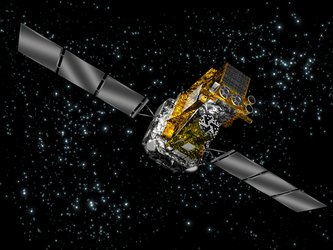
On 9 October 2007, ESA’s orbiting X-ray observatory XMM-Newton was turning from one target to another. As it did so, it passed across a bright source of X-rays that no one was expecting. The source was not listed in any previous X-ray catalogue, yet XMM-Newton was receiving some 50 X-rays every second from this mysterious object.

The only celestial object the XMM-Newton team could find at this location was a faint star, known only by its catalogue number USNO-A2.0 0450-03360039. Acting quickly, Andy Read of the University of Leicester and Richard Saxton of ESA’s European Space Astronomy Centre (ESAC), Spain, arranged for an astronomical telegram to be circulated across the Internet, informing other astronomers of the newly-discovered X-ray source.
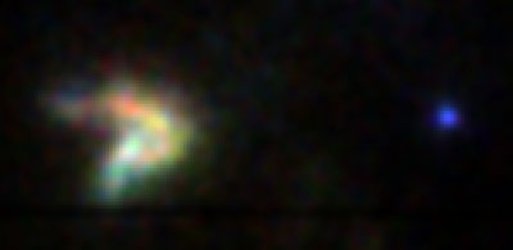
Astronomers using the 6.5-m Magellan-Clay telescope at Las Campanas Observatory in Chile, found that USNO-A2.0 0450-03360039 had dramatically brightened by more than 600 times. Analysing the light from the source meant that they could classify the object as a nova.
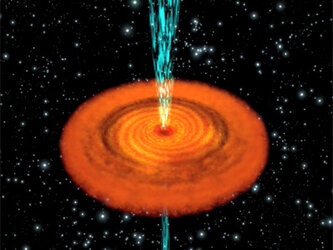
Novae occur when a compact star, called a white dwarf, feeds off the gas of a nearby companion star. When sufficient gas builds up on the white dwarf, a nuclear reaction begins releasing large quantities of energy, prompting the white dwarf to shoot up in brightness.

But there was a puzzle. The incandescent explosion does not immediately release X-rays; the expanding cloud of debris created in the detonation temporarily masks them. As this clears, the X-rays shine through. So, for XMM-Newton to see this nova, the explosion must have taken place many days before. Yet, no one had reported seeing it.
Usually, dedicated amateur and professional astronomers find novae by regularly sweeping the night sky for stars that suddenly brighten. This one, it seemed, had slipped the net. Saxton contacted the robotic survey project ASAS and asked them to check their data. They found the nova. It had taken place on 5 June 2007 and had been clearly visible, even to the unaided eye.
“Anyone who went outside that night and looked towards the constellation of Puppis would have seen it,” says Saxton.

The nova is now officially designated V598 Puppis and is one of the brightest for almost a decade, doubling the irony that it was not spotted during its brilliant peak. As news of it spread, the global effort to track its fading light became intense. “Suddenly there was all this data being collected about the star. For variable star work like this, the contribution of the amateur community can be at least as important as that from the professionals,” says Read.
Thanks to XMM-Newton, this story has a happy ending, but it does make astronomers wonder whether there are other discoveries going unnoticed too.
Notes for editors:
This nova was discovered in the XMM-Newton slew survey; a systematic processing of data taken while the satellite moves between objects. To date, the survey has covered 30% of the sky and produced a catalogue of 7700 X-ray sources that has been released to the public.
XMM-Newton slew survey discovery of the nova XMMSL1 J070542.7-381442 by Read et al. is published in Astronomy and Astrophysics.
The first XMM-Newton slew survey catalogue: XMMSL1 by Saxton et al. is published in Astronomy and Astrophysics.
The XMM-Newton science teams are based in several European and US institutes, grouped into three instrument teams and the XMM-Newton Survey Science Centre (SSC). Science operations are managed at ESA’s European Space Astronomy Centre (ESAC), at Villanueva de la Cañada near Madrid, Spain. Spacecraft operations are managed at ESA’s European Space Operations Centre (ESOC) in Darmstadt, Germany.