Tracing the Milky Way’s hidden reservoirs of gas
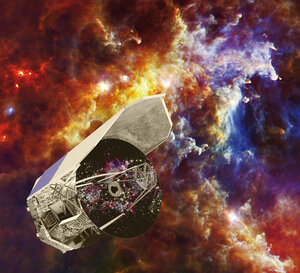
ESA’s Herschel infrared space observatory has found that hydrogen fluoride molecules are everywhere in interstellar gas clouds. They betray hidden reservoirs of gas, and may ultimately become a key tracer of star-forming gas clouds in distant galaxies.
Hydrogen is the most abundant element in the Universe, making up three-quarters of the normal matter. But at the low temperatures found in a star-forming cloud, hydrogen pairs up into molecules that do not readily emit radiation. That means these molecules are hidden from astronomers’ telescopes.
Traditionally, astronomers have looked for the hydrogen by detecting carbon monoxide, which does emit at such low temperatures. But carbon monoxide does not form directly from hydrogen; intermediate steps include the creation of other molecules first.
Now, help is at hand. Herschel finds that hydrogen fluoride is ubiquitous throughout the Milky Way. It marks the clouds of hydrogen molecules. This is because fluorine is highly reactive: it attacks the surrounding hydrogen, making hydrogen fluoride in a single step.
Hot hydrogen fluoride was first detected in space by ESA’s Infrared Space Observatory in 1997. This new finding from Herschel is the first detection of cold hydrogen fluoride and shows that almost all fluorine in clouds of hydrogen molecules has been transformed into the molecule. It confirms a prediction made by the observing team five years ago and presents astronomers with a new way to trace hydrogen.
“Hydrogen fluoride may be a more robust tracer of hidden molecular hydrogen than any other molecule used at present,” says Edwin Bergin of the University of Michigan, USA.
Looking for hydrogen fluoride may even become a standard way for astronomers to trace hydrogen molecules throughout the Universe. This is because it shows up in interstellar gas clouds of all sizes, and not just the largest ones.
Contacts
David Neufeld
Johns Hopkins University, Baltimore, Maryland, USA
Tel: +1 410 516 8582
Email: neufeld @ pha.jhu.edu
Edwin Bergin
University of Michigan, Ann Arbor, USA
Tel: +1 734 615 8720
Email: ebergin @ umich.edu
Maryvonne Gerin
LERMA, Observatoire de Paris, France
Tel: +33 (0)1 44 32 33 48
Email: maryvonne.gerin @ lra.ens.fr