XMM-Newton factsheet
On 10 December 1999 at 14:32 GMT the European Space Agency's XMM-Newton observatory was launched and started exploring the wonders of the X-ray Universe. Since its launch, XMM-Newton has simultaneously collected X-rays, visible and ultraviolet light and consistently demonstrated its role as one of the most important astronomical observatories of all time.
Name: XMM-Newton. The name stands for “X-ray Multi-Mirror Mission” and also honours Sir Isaac Newton, the English physicist and mathematician (1642-1727) who advanced theories of gravitation and optics, built the first working reflecting telescope and discovered how to split light into its components to study its spectrum.
Mission: Exploring the hot and extreme Universe.
XMM-Newton is studying X-ray sources across the Universe: looking deep into the centre of galaxies, studying stars at all stages of their live, investigating what happens in and around black holes, and following up on explosive events like gamma-ray bursts. XMM-Newton helps us explore how the Universe was formed and how matter behaves under the most extreme circumstances.
Launch: 10 December 1999, on the first Ariane-5 commercial mission, from ESA’s Kourou Spaceport in French Guiana.
Mission lifetime: Originally designed to work for 10 years, on 10 December 2019 XMM-Newton celebrated its 20th anniversary in space. Based on the present health and performance of all its systems and scientific instrumentation, the estimated remaining lifetime goes well into the 2030s. Currently, operations are approved up to December 2026, with the possibility of extensions.
Operational orbit: After launch, XMM-Newton was placed in a 48-hour elliptical orbit around the Earth, inclined at 40 degrees. The orbit takes it from 7 000 to 114 000 km altitude. For 40 hours every orbit, the satellite is therefore outside Earth’s obscuring radiation belts.
Cost: 689 million Euros. This included the spacecraft design and development, the launch and the ground operations during the first two years.
Partnerships: XMM-Newton is an ESA science mission with instruments and contributions directly funded by ESA Member States and NASA.
Mission objectives
XMM-Newton continues supplying key new data to every aspect of astronomy:
- Life in the Universe, studying our Solar System and how the activity of more distant stars impacts the habitability of their orbiting planets;
- Extreme Universe, exploring places beyond our imagination shaped by the extraordinary gravity around black holes and by shocks from the most powerful cosmic explosions;
- Cosmology, dissecting the cosmic structure formed and evolved after the Big Bang.
XMM-Newton is paving the way for a joint adventure with NewAthena and LISA, exploring together the hot and energetic Universe and the powerful radiative counterparts of gravitational waves, bringing sound to the cosmic movies.
Scientific highlights
XMM-Newton is a highly successful observatory with over 6900 refereed publications by the end of 2021. In two decades, the mission has supplied a constant stream of outstanding science.
These examples illustrate the scientific impact of the mission:
- Observing the brightest gamma-ray burst ever seen
- Detection of three young neutron stars that are unusually cold for their age
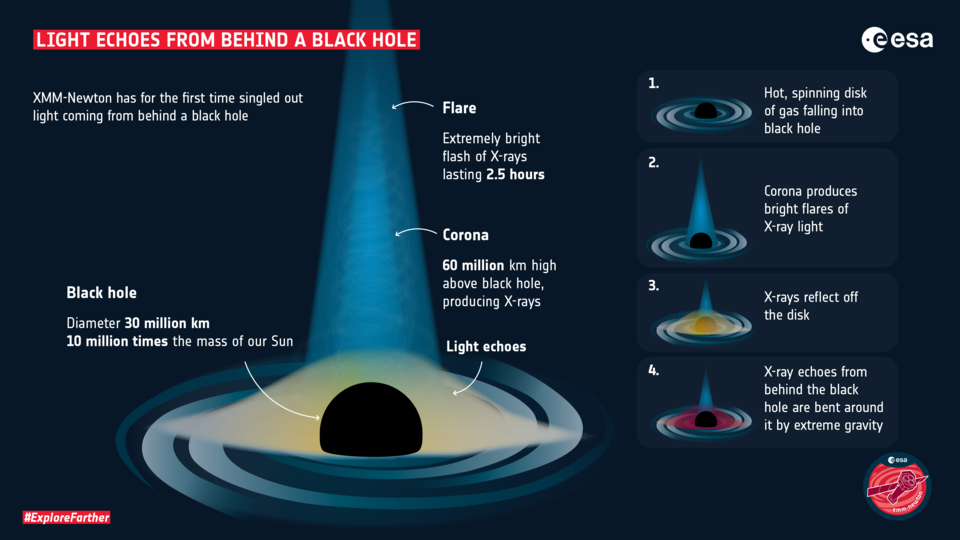
- XMM-Newton has singled out light coming from behind a black hole.
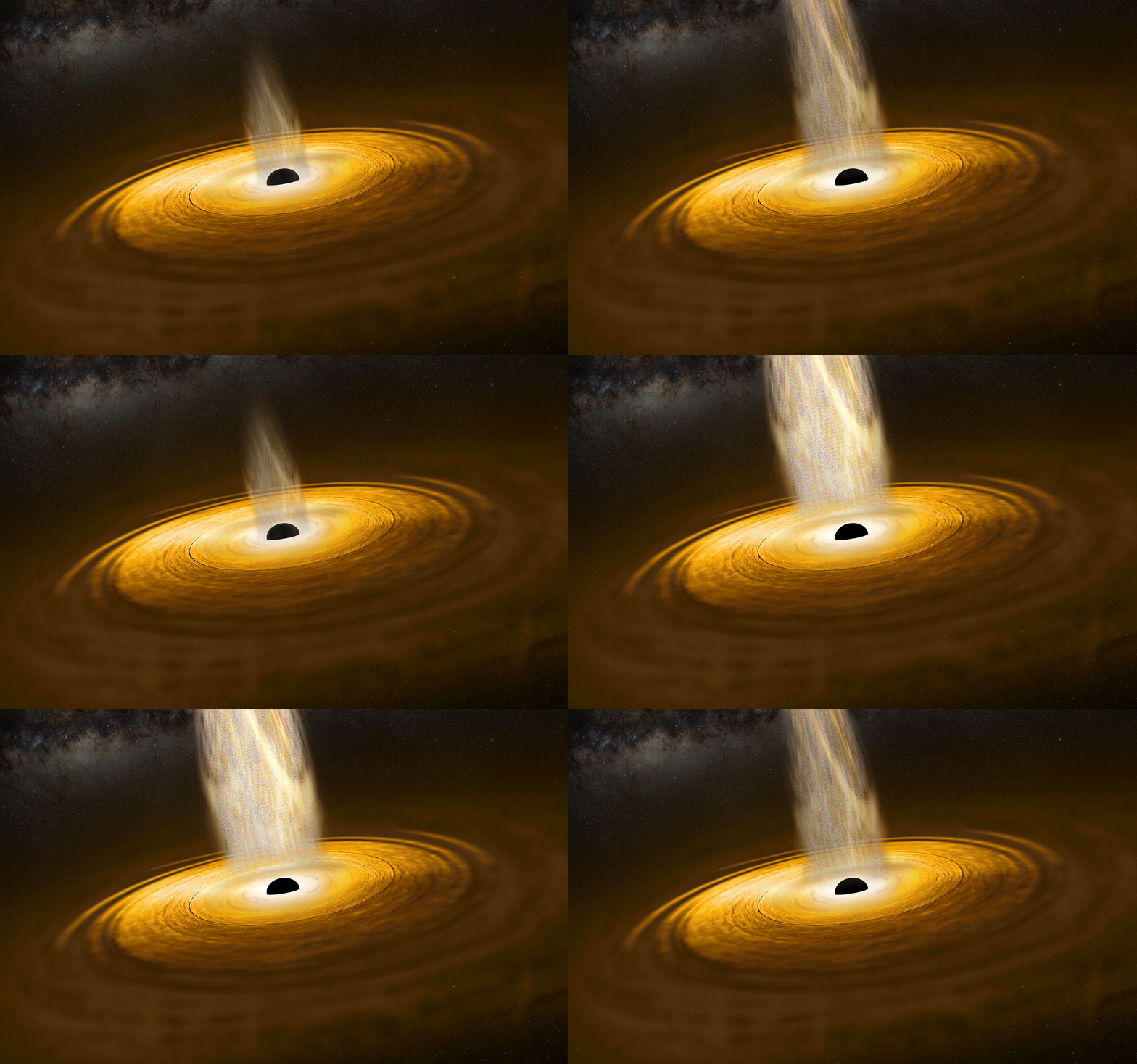
- It uniquely used the echoes of X-rays to map the dynamic behaviour and surroundings of a black hole.
- It can determine the mass and spin (rotational speed) of a black hole.
- It showed that the black hole at the centre of galaxy NGC 1365 is rotating quickly, opening a new window into how galaxies grow.
- XMM-Newton discovered mysterious flashes from a black hole at the centre of a galaxy called GSN 069.
- It captured dust rings from gamma-ray burst 221009A, the brightest gamma-ray burst ever seen.
- It made an important step in the quest to find a planet outside of the Milky Way.
- It captured an enormous ‘super flare’ of X-rays on a star of about eight percent the Sun’s mass – a dramatic high-energy eruption that poses a fundamental problem for astronomers, who did not think it possible on stars that small.
- Observation of the youngest pulsar ever discovered – the remnants of a once-massive star that is also a 'magnetar', sporting a magnetic field some 70 quadrillion times stronger than that of the Earth.
- Never-before-seen insight into the process responsible for Jupiter’s X-ray auroral flares.
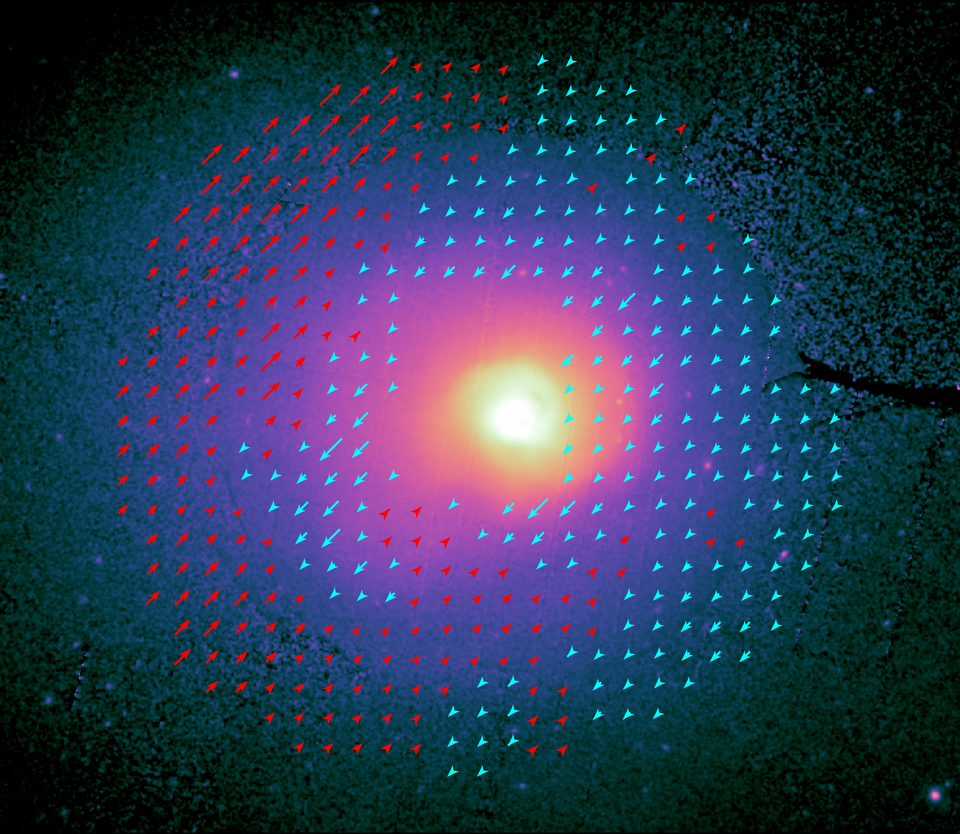
- The first sighting of hot gas sloshing within a galaxy cluster. While this kind of motion has been predicted theoretically, it had never been seen before in the cosmos. The finding was made possible by a new calibration technique applied to XMM-Newton's European Photon Imaging Camera (EPIC).
- XMM-Newton found evidence of hot, diffuse gas permeating the cosmos, closing a puzzling gap in the overall budget of ‘normal’ matter in the Universe.
- It discovered that gas lurking within the Milky Way’s halo reaches far hotter temperatures than previously thought and has a different chemical make-up than predicted, challenging our understanding of our galactic home.
- XMM-Newton provided an X-ray view of the Red Planet.
Spacecraft
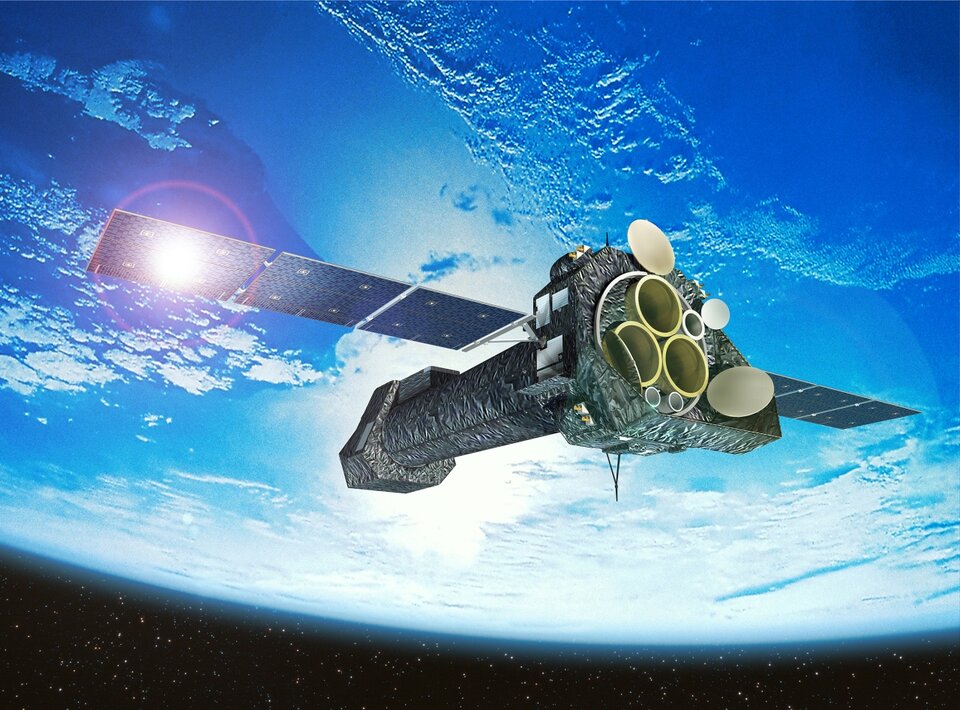
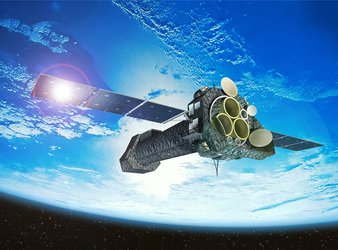
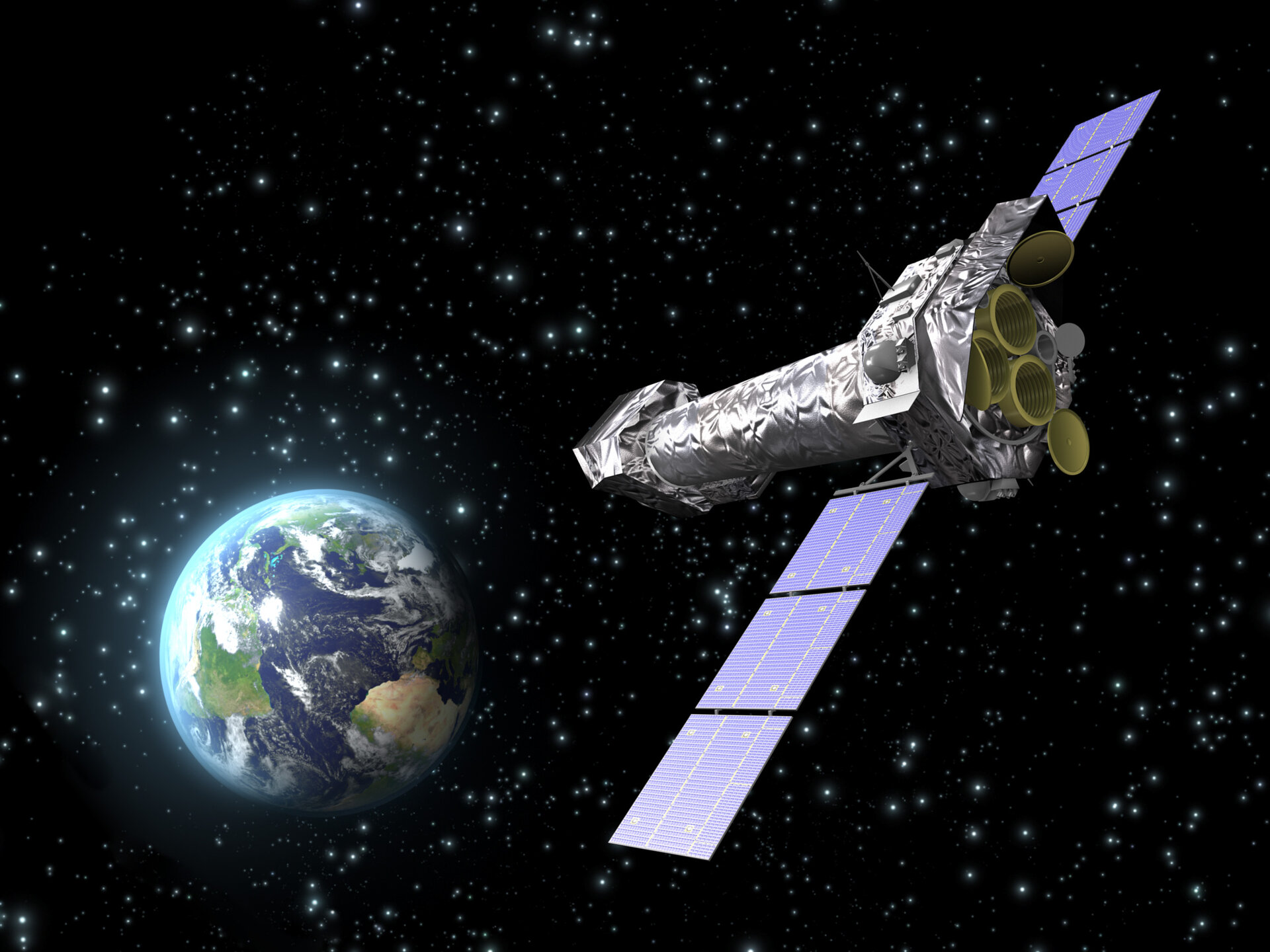
Design: XMM-Newton is a three-axis stabilised spacecraft with a high pointing accuracy. The satellite consists of a service module bearing the X-ray mirror modules, propulsion, and electrical systems, a long telescope tube, and the focal plane assembly carrying the science instruments.
Mirror: Because of their high energy and their interaction with matter, X-rays are difficult to focus. When using mirrors, like XMM-Newton, the mirror surface has to be made of a material that does not readily absorb the X-rays, and the design has to ensure that the incoming rays hit the mirror surface at a shallow angle (grazing). Only in this way can the X-rays be efficiently reflected and directed to a focus point.
XMM-Newton uses barrel-shaped mirrors angled along their length to focus the X-rays on the detectors. The three 'mirror modules' each have 58 wafer-thin nickel mirrors, which are gold-plated and nested in each other just a few millimetres apart. The total mirror surface area of the three mirror modules together exceeds 120 m², rivalling the size of a tennis court. Constructing the mirror modules to such a level of perfection is one of the programme's greatest achievements.
Dimensions: XMM-Newton is the biggest science satellite ever built in Europe. Total length is 10 metres and, with its solar arrays, the satellite has a 16-metre span.
Mass: 3.8 tonnes (each X-ray mirror module has a mass of 500 kilograms).
Industrial involvement: The prime contractor was Dornier Satellitensysteme, part of Daimler Chrysler Aerospace (Friedrichshafen, Germany). They led an industrial consortium involving 46 companies from 14 European countries and one in the United States. Media Lario, Como, Italy, developed the X-ray Mirror Modules. About 1000 engineers and 150 scientists were involved in the creation of XMM-Newton.
What’s on board?
There are six scientific instruments aboard XMM-Newton:
European Photon Imaging Camera (EPIC)
At the prime focus of each of the spacecraft's three telescopes, behind a six-position filter wheel, are a European Photon Imaging Cameras (EPICs). Two telescopes are equipped with EPIC-MOS cameras, which provide the highest spatial resolution on-board XMM-Newton, while the third telescope focuses it’s X-rays on the EPIC-pn camera, which provides the highest sensitivity of all instruments.
Reflection Grating Spectrometer (RGS)
For a complementary analysis of the spectrum, the two EPIC-MOS telescopes have a grating structure on their mirror module that reflects about 40% of the incoming rays to a secondary focus, with its own CCD camera. This Reflection Grating Spectrometer (RGS) 'fans out' the various wavelengths, thus indicating, in more detail than EPIC, the exact condition of individual elements, such as oxygen and iron.
Optical Monitor (OM)
The sixth instrument aboard XMM-Newton is a conventional but very sensitive optical/UV telescope, the Optical Monitor (OM). It can observe simultaneously the same regions as the X-ray telescopes, but at ultraviolet and visible wavelengths. This gives astronomers complementary data about the X-ray sources. The 2-metre long telescope is mounted on the mirror support platform of XMM-Newton alongside the X-ray mirror modules. In orbit, this 30 cm diameter telescope is as sensitive as a four-metre diameter instrument on the Earth's surface.
Operations

Ground control: European Space Operations Centre (ESOC) in Darmstadt, Germany, using ground stations at Perth (Australia), Kourou (French Guiana) and Santiago de Chile (Chile).
Science Operations: The ESA Science Operations Centre at ESAC in Villanueva de la Cañada, near Madrid, Spain, manages observation requests and the receipt, processing and distribution of XMM-Newton data. The XMM-Newton Survey Science Centre (SSC), a consortium of institutes in the ESA community, generates catalogues of X-ray sources and correlates all XMM-Newton observations with existing data acquiredelsewhere in the world and in space observatories.