Herschel takes the temperature of an interstellar cloud
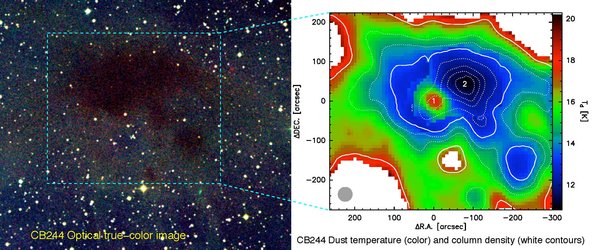
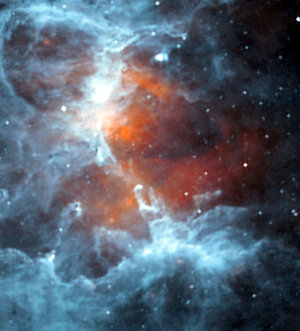
The unrivalled ability of ESA’s Herschel infrared space observatory to discern detail in celestial objects has been used to take the temperature across a star-forming cloud. For the first time, an entire cloud has had its temperature mapped from the centre to the edge.
Herschel has revealed two regions inside the cloud where individual stars will form. In the first, which has a temperature of –255°C, Herschel pinpointed the nascent star. The second region is so young that there is not even a star yet, just a collapsing core of gas and dust. Eventually, this too will become a hot star but at present its temperature is just –262°C.
The temperature map has allowed astronomers to calculate the amount of matter inside the cloud. The young star contains 1.6 times the mass of the Sun, the collapsing region contains between 3 and 7 times the Sun’s mass. Overall, the cloud is between 10 and 20 times the Sun’s mass, meaning that almost half of its mass is involved in forming these two stars.
The observation also reveals that the temperature of the cloud rises towards the outer edges. This shows where the light from the surrounding stars is heating the outer faces.
“We cannot measure these temperatures from the ground,” says Amelia Stutz, of the Max-Planck-Institut für Astronomie, Heidelberg. “That’s because the atmosphere blocks these wavelengths but Herschel is poised perfectly in space and designed to investigate these coldest regions of the Universe.”
Contacts
Amelia Stutz
Max-Planck-Institut für Astronomie, Heidelberg, Germany
Tel: +49 6221 528 370
Email: stutz @ mpia-hd.mpg.de