Venusian rendezvous results: chapter one
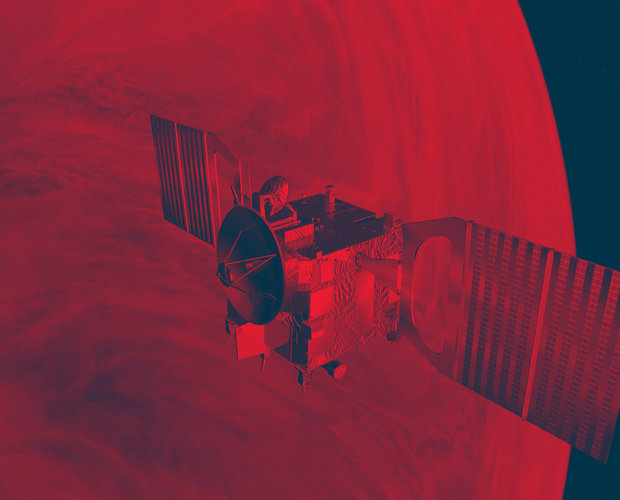
ESA’s Venus Express and NASA’s MESSENGER booked an appointment at Venus late in the evening of 5 June, to look at the oddities of this mysterious planet in tandem for a few hours. Just a few weeks on, scientists from both teams are ready to present a first set of images.
This unique opportunity to make multi-point observations of the Venusian atmosphere was possible thanks to the MESSENGER (MErcury Surface, Space ENvironment, Geochemistry, and Ranging) swingby of Venus – a key step during its long journey to Mercury - while Venus Express was already orbiting the planet in the course of its mission.
The two spacecraft carry sets of instruments employing different observation techniques which complement each other. The data collected at Venus are now being analysed by teams on both sides of the Atlantic and, as can be appreciated in the first images presented here, already hints at the potential of the results to come.
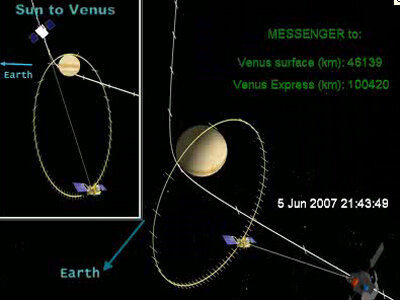
The particular orbital geometry of Venus Express when MESSENGER skimmed past Venus on 5 June meant that the two spacecraft were not at the same location (with respect to the surface of the planet) at the exact same time.

MESSENGER made its closest approach at a distance of about 338 km from the planet over the planetary coordinates 12.25° South and 165° East, on the night side of the planet. Meanwhile, Venus Express was behind the horizon, almost right above the South Pole, at about 35 000 km from Venus.
So how could they make true joint observations of the same regions and phenomena? Scientists came up with a highly creative solution.
Two hunters for the same cloud
The scientists used a computer simulation based on real atmospheric data about Venus obtained from previous ground and space observations. Knowing the speed of the local winds, which depend both on the altitude and the latitude, they were able to predict where a particular set of clouds would be at a given point in time.
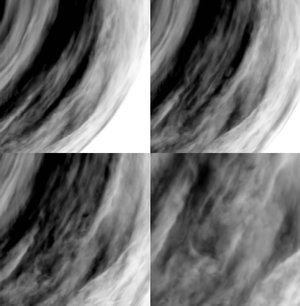
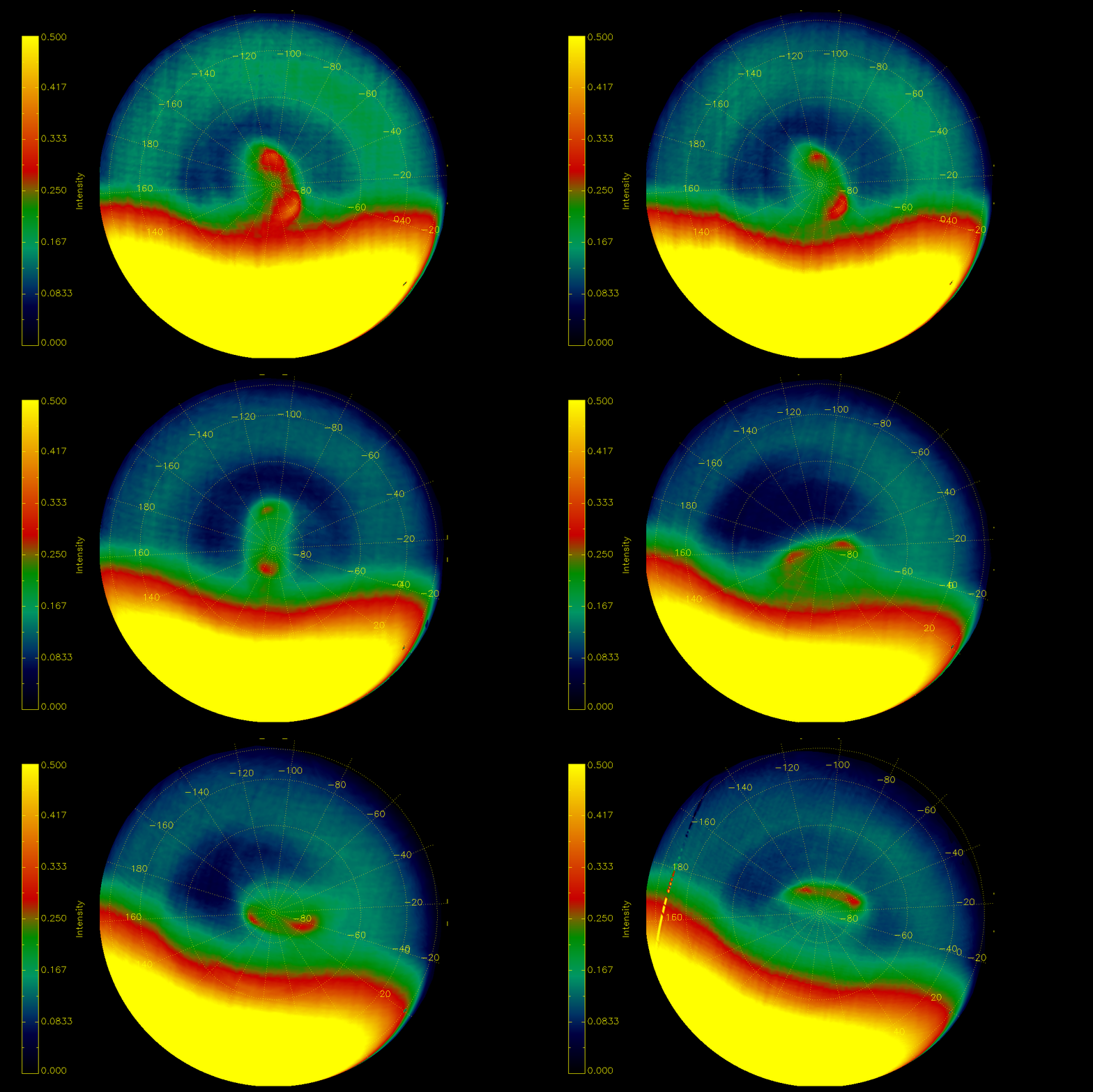
For their observation, the Venus Express scientists selected a cloud that – moving west by about 90° longitude every day - was visible to Venus Express and would be in view of MESSENGER 12 hours later, at the time of its closest approach. The same cloud became visible again for Venus Express 12 hours after MESSENGER’s closest approach, this time on the night-side.

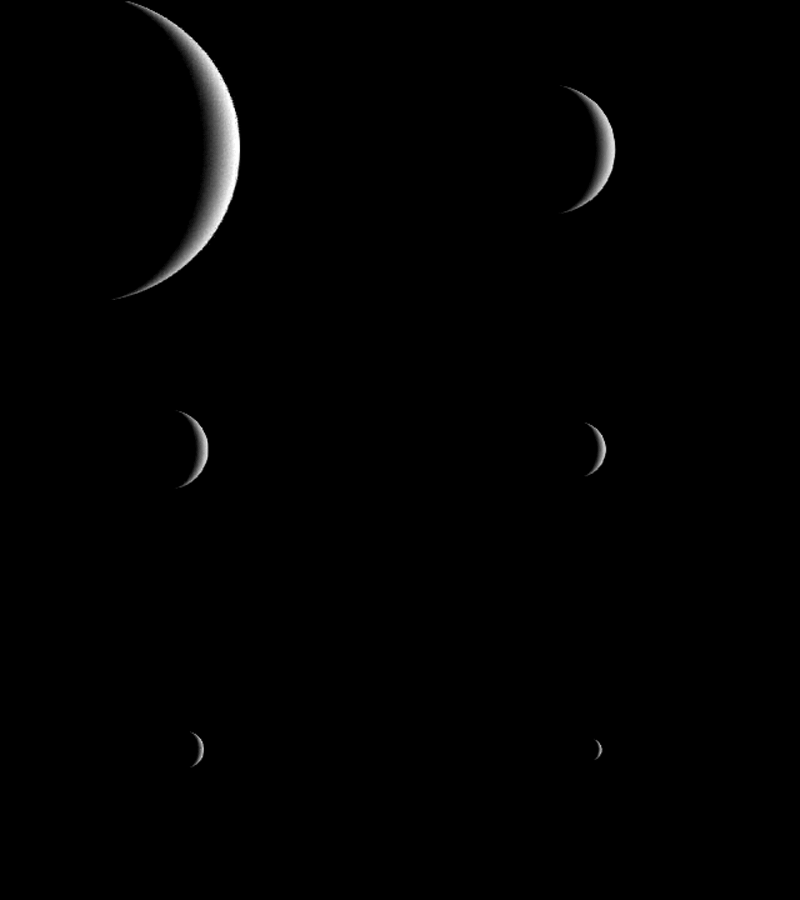
The VIRTIS imaging spectrometer on board Venus Express probed this cloud (top row of this image composite) at several wavelengths. These observations provided a view of the cloud at about 45-50 km altitude (bottom row) from the planet. The clouds below the point of closest approach can be seen in the top row.
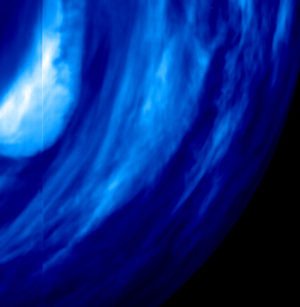
The Mercury Laser Altimeter (MLA) instrument on board MESSENGER probed the same cloud structure at 50-75 km from the surface, like VIRTIS.
Such an observation – a typical example of atmospheric structure at Venus – with cross-sections obtained at different altitudes and with different instruments, is a unique opportunity for researchers hoping to solve the puzzle of the Venusian atmosphere’s dynamics and composition.
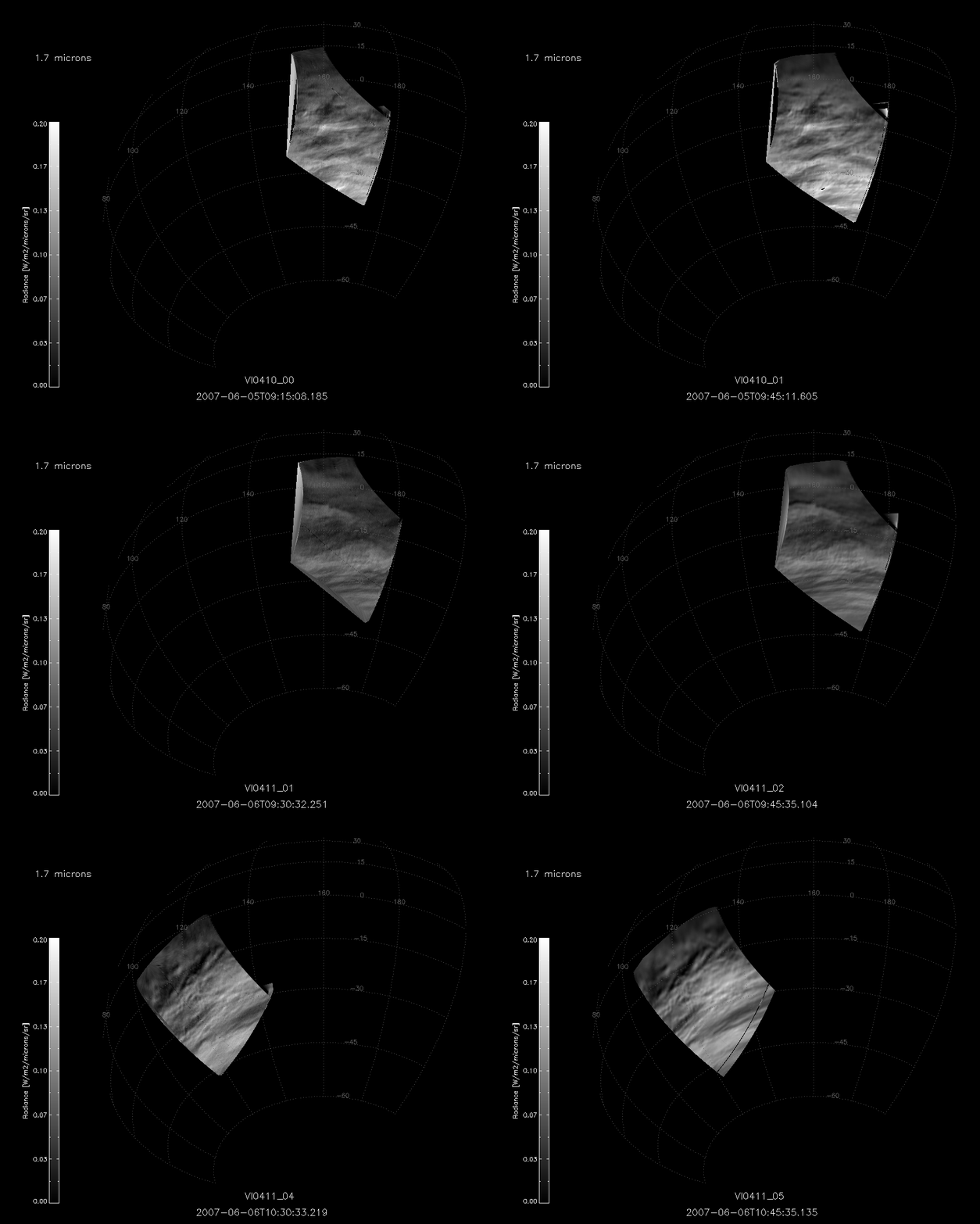
Over about 24 hours, not only did the two spacecraft observe the same clouds, but MESSENGER also flew closely over the atmospheric region. Again, these dual-spacecraft, multi-instrument observations may provide additional atmospheric details.
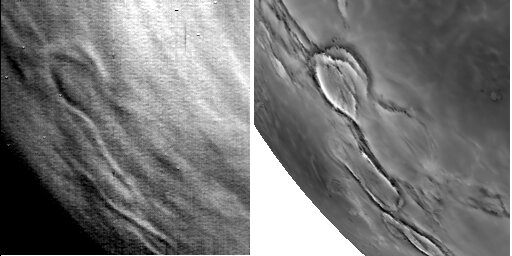
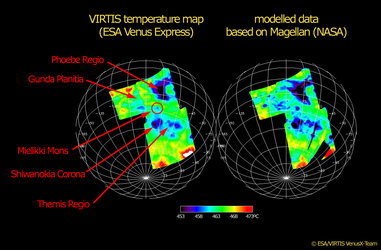
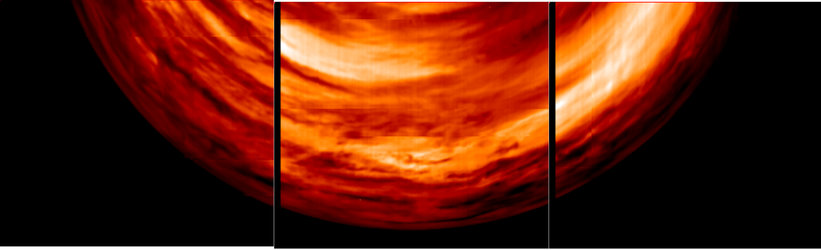
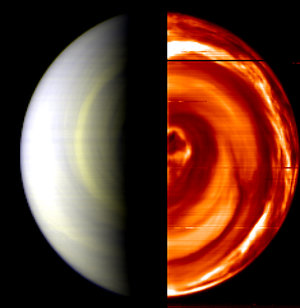
A spectacular view obtained by VIRTIS (left), in the region of MESSENGER's closest approach to Venus provides, even if still unprocessed, a ‘thermal view’ of the Venusian surface. The image is compared here with an image of the same feature synthesized by data from NASA’s Magellan spacecraft in the 1990s (right).
Magellan provided radar imaging and altimetry maps, providing information on the topography (elevation) and the radar reflectivity of the surface. Venus Express’ VIRTIS is providing ‘thermal maps’ of the surface containing information on the emissivity in the infrared. Correlations between topographic and thermal data similar to the ones shown here, will allow scientists to understand if the measured temperature of the surface depends on the altitude – where ‘higher’ simply corresponds to ‘colder’ – or if it depends on the presence of previously undetected sources of heat, such as active volcanoes or other geological activities.
The Venus Express and MESSENGER scientists are now continuing the analysis of this rich and complex set of data collected at Venus. The data also involve several other instruments studying not only Venus’ cloud deck and surface, but also the plasma environment, magnetic fields, and the atmospheric oxygen airglow.
More mature results from this joint observation campaign are expected by the end of the year.
Notes for editors:
Venus Express, ESA’s first mission to Venus was launched on 9 November 2005 and reached the planet on 11 April 2006.
NASA’s MESSENGER was launched on 3 August 2004, and swung by Venus for the second time on 5 June 2007 on its way to Mercury. It is expected to be inserted into Mercury orbit in March 2011.
For more information:
Håkan Svedhem, ESA Venus Express Project Scientist
Email: Hakan.Svedhem @ esa.int
Sean Solomon, Principal Investigator for the NASA MESSENGER mission, Carnegie Institution of Washington
Email: scs @ dtm.ciw.edu
Giuseppe Piccioni, VIRTIS co-Principal Investigator, IASF-INAF, Rome, Italy
Email: Giuseppe.Piccioni @ iasf-roma.inaf.it
Pierre Drossart, VIRTIS co-Principal Investigator, Observatoire de Paris, France
Email: Pierre.Drossart @ obspm.fr