AKARI’s observations of galaxy M101
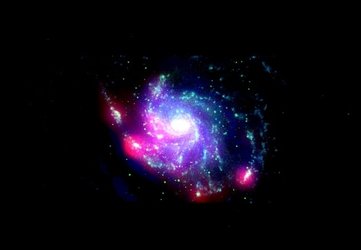
M101 is a spiral galaxy,
Toyoaki Suzuki at the University of Tokyo conducted observations of M101 with AKARI at four infrared wavelengths (65, 90, 140, and 160 micrometres) using the Far-Infrared Surveyor (FIS) instrument. Many young high-temperature stars populate the spiral arms, revealing the areas of star formation and warming the interstellar dust. This causes the galaxy to shine at shorter infrared wavelengths. In contrast, the longer wavelengths show where the ‘cold’ dust is located. Normal stars, typically like our own Sun, warm this dust.
FIS data was compared to an image of M101 in the visible and far-ultraviolet. It shows that warm dust is distributed along the spiral arms, with many hot spots located along the outer edge of the galaxy. These spots correspond to giant star-forming regions. This is unusual because star formation is generally more active in the central parts of spiral galaxies.
The evidence points to M101 having experienced a close encounter with a companion galaxy in the past, dragging out gas from the hapless companion. The gas is now falling onto the outer edge of M101 at approximately 150 km/s, triggering the active star formation.
Read the full story on the ESA Science pages