


Concurrent Engineering Workshop open for applications
ESA’s Education Office is looking for motivated university students with an engineering or physics background to participate in the upcoming edition of the ESA Academy’s Concurrent Engineering Workshop, taking place from 26 to 29 May 2026 at ESA’s European Space Security and Education Centre (ESEC)-Galaxia in Transinne, Belgium.
This intensive workshop introduces students to the concurrent engineering approach, a method used at ESA to efficiently design space missions. Unlike traditional design methods where subsystems are developed sequentially, in concurrent engineering all subsystems are designed simultaneously in a collaborative, multidisciplinary environment.
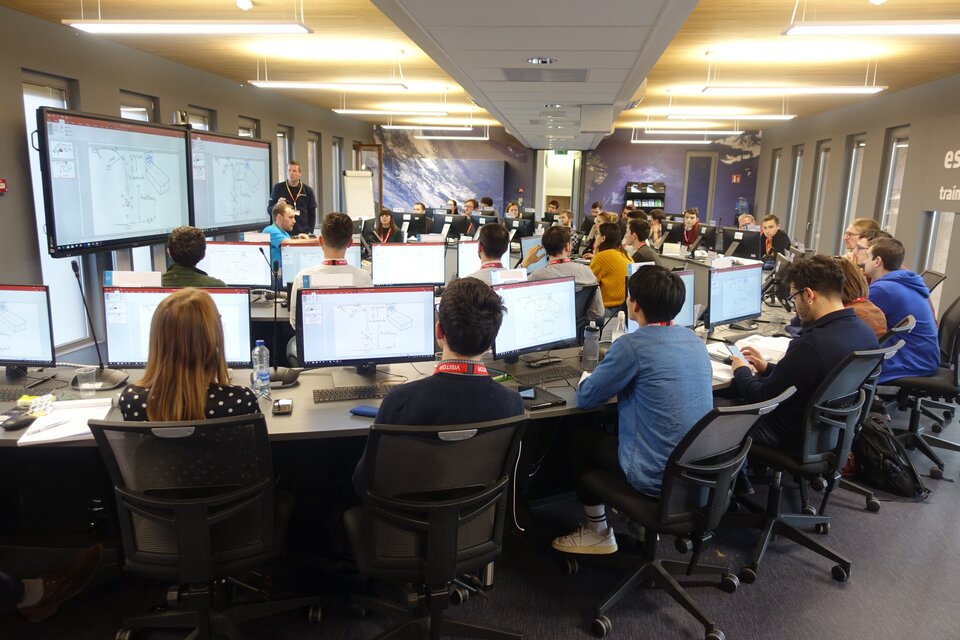
This is a far more efficient way of working but comes with its own unique challenge: solutions in one area that could impact the design of another subsystem must be instantly identified and communicated between teams. Although concurrent engineering is a more complex process to begin with, in effect it allows engineering discrepancies to be identified and rectified earlier, thereby reducing the overall design time.
ESA’s main Concurrent Design Facility (CDF) is located at ESA’s European Space Research and Technology Centre (ESTEC) in the Netherlands. However, within the framework of the ESA Academy programme, ESA has developed a similar facility exclusively for educational purposes, located at ESEC-Galaxia. Access to this facility during the workshop complements what students learn at university by familiarising them with the concurrent engineering approach to designing a mission.
Workshop content
During the workshop, students will:
- attend expert-led lectures on concurrent engineering principles,
- work together in subsystem teams to design a realistic space mission using the concurrent engineering approach.

Guided by ESA systems engineers, students will learn about concurrent engineering and its benefits, gaining first-hand experience with the Concurrent Model-based Engineering Tool (COMET) design drivers. To make the most of this experience, the selected students will follow a COMET tutorial to allow them to become familiar with the tool the week before the workshop.
In addition to COMET, the workshop will also incorporate the use of STK by Ansys. The integration of STK will allow participants to simulate and analyse various aspects of space missions, enhancing their understanding of mission design and development. Selected students will find it useful to explore the STK Level 1 Beginner Training prior to the workshop.

Participants will be given mission requirements and constraints and will then use concurrent engineering to create a mission design while working in teams. Cost engineering principles will also be integrated into the workshop’s agenda. Students will be invited to apply them practically, aiding in the costing of their projects.
In the application form, students can indicate up to three mission subsystems they would like to focus on during the hands‑on activity:
- Structures and Mechanisms
- Configuration
- Power
- Thermal
- Attitude and Orbit Control System (AOCS)
- Propulsion
- Mission Analysis
- Communications, Data Handling& Ground Segment
- Cost Engineering
Based on these preferences, participants will be grouped into subsystem teams. Within their assigned subsystem, students will develop a concept that fulfils the mission objectives and produce a budget for their design. Teams will iterate their designs several times, refining technical details and improving subsystem compatibility. Students will present their progress throughout the workshop, and their work will be reviewed by experts.
Who can apply?
To participate, students must fulfil the following eligibility criteria:
- Aged minimum 18 years old. ESA Academy and relevant partners will only appraise applications from students who have no or limited professional experience in relevant scientific, engineering, or other space-related topics;
- Citizen of an ESA Member State, Canada* or Associate Member;
- Enrolled as a university student for the year 2025-2026 as a 3rd or 4th year Bachelor, Master or a doctoral (i.e., Ph.D. or equivalent) degree programme with a background in engineering or physics;
Selected students will be required to attend the entire 4 days' workshop at ESEC. They will be sponsored by ESA to cover accommodation and meals, as well as up to 350 Euros for travelling to Belgium.
ESA is committed to achieving diversity and creating an inclusive professional environment. To this end, we welcome proposals and applications from all eligible candidates irrespective of gender, sexual orientation, ethnicity, beliefs, age, disability, or other characteristics. ESA Academy strongly encourages inclusiveness within its programmes and within participating teams, which contributes to the enrichment of our programme.
Whenever possible, we seek to accommodate individuals with disabilities by providing the necessary support, either digitally or at the location of the training. In case of any questions or specific needs, please reach out to academy.training@esa.int to get assistance or advice during the application process.
* Canadian students enrolled in a Canadian post-secondary institution may apply for additional support from the Canadian Space Agency through this Announcement of Opportunity (grant applications must be submitted at least 7 weeks before the course delivery and account creation 3 weeks before the deadline). This additional support is to cover costs that are not already covered by ESA for selected Canadian post-secondary students.
How to apply
- Apply through ESA Learn the ESA Education and Community Platform;
- Select preferred disciplines;
- Upload a motivation letter (PDF, maximum 1 page, no images);
- Upload a CV (Europass format, PDF, maximum 2 pages, no images);
- Upload a formal recommendation letter (PDF, maximum 1 page, including signature, no images) from a university professor or academic supervisor of current university (if it is not possible to receive the recommendation letter from your referee, please ask them to send a recommendation email to academy.training@esa.int before the application deadline);
- Upload a copy of your Transcript of Grades from the two previous semesters, or, if not available, the previous graded academic year (PDF).
All answers and documents should be in English (Transcript of Grades can be submitted in the language of the hosting university, if unavailable in English).
The deadline for applications is 30 March 2026, 23:55 CEST.
The selection results will be announced two weeks after the application deadline.
For more information, please contact academy.training@esa.int.