

Ground Segment Reference Facility
Without a 'ground segment' − the complex combination of hardware and software on Earth used to fly a satellite in space − it would be impossible to operate any mission. A ground segment is a complex 'system of systems', comprising many elements that must function together perfectly. For spacecraft flown from ESA's ESOC mission control centre, the ground segments are based on a generic infrastructure that is reused, in so far as possible, across missions, and adapted to meet mission or 'family of mission'-specific requirements and configuration needs.
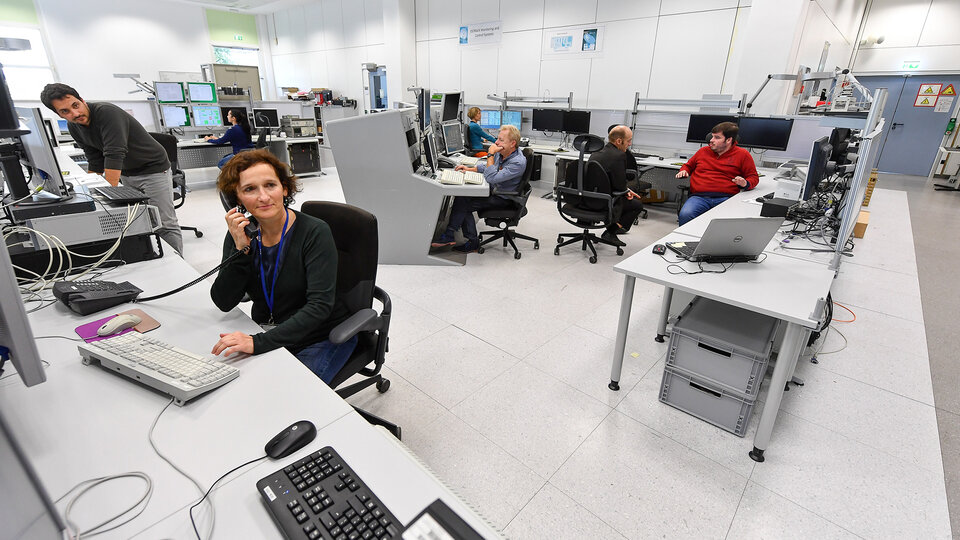
Unique reference environment
Supported by European industry, ESA's ground systems engineers design and develop individual software and hardware elements used in ground segments that can perform satellite control, mission planning, simulations, training and ground station control and management.
At ESOC, the Ground Segment Reference Facility (GSRF) provides a unique reference environment where all these software and hardware systems can be integrated and tested throughout their life cycle, in isolation as well as in various test chains up to a complete end-to-end ground segment.
The 'representativeness' of such an environment, including the representativeness of the test scenarios with respect to use cases, is critical.
Mission-representative test chains for subsystem and system testing
The GSRF comprises a full spectrum of systems constituting a ground segment and the simulated space segment.
Representative test chains range from simpler chains (mission control systems, network interface systems, ground stations and spacecraft models) to a chain containing the full ground segment (mission control system, network interface system, network delay simulator, signal processing and conversion, antenna and spacecraft simulator).
The GSRF enables system testing with all involved subsystems, for early verification of novel technologies, operations concepts and architecture prior to deployment in operations.
Testing the communication link

One of the most fundamental tests performed prior to launch is to validate the radio frequency (RF) communication link between the spacecraft and the ground stations.
To carry out the radiofrequency compatibility tests (RFCT), the spacecraft transponder and on-board computer are integrated into a dedicated rack known as the RF suitcase. The setup is placed inside a shielded Faraday cage located in the GSRF, which blocks out all external electromagnetic interference. This controlled environment allows to isolate the spacecraft’s signals, verify the integrity of its communication and catch potential glitches.
The RF suitcase remains at ESOC throughout the mission, alongside similar hardware from other ESA missions. This allows ESA teams to quickly troubleshoot and solve any unexpected communication issues encountered while the spacecraft is in space.
Network Data Interface Units
Network Data Interface Units (NDIU) are used to interface with the satellite's electrical ground support equipment (EGSE) during system validation tests at prime’s facilities or at ESOC. Such systems are integrated, tested and operationally validated in the GSRF. They are a unique interface with the satellite, allowing exercising on-board procedures and monitoring the spacecraft status up to the Launch.
Innovative environment
The GSRF-provided environment promotes cross-fertilisation among engineering domains, and between engineering and operations, where experts can share their knowledge, experience, efforts and expectations among a multi-disciplinary team. Furthermore new technologies, like those related to optical communications, are deployed in the facilities.
R&D studies
The GSRF supports research and development (R&D) studies needed to explore and validate new concepts, to demonstrate the suitability and the maturity of new technologies in particular in the domain of space communications and tracking.
State-of-the art communications solutions are deployed enabling the verification of system performance of newly developed on-board and ground communications and tracking systems.

