Hera's CubeSats
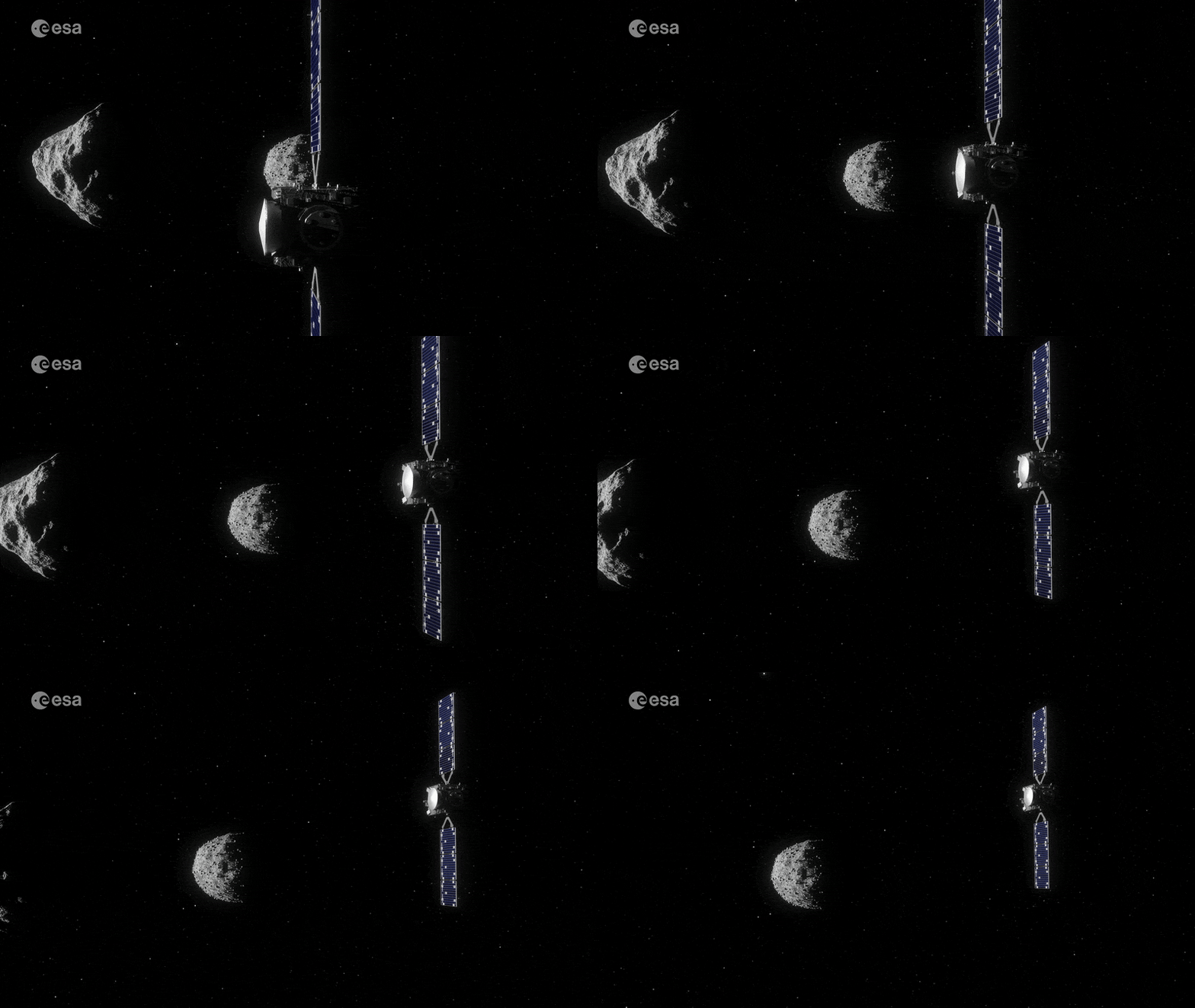
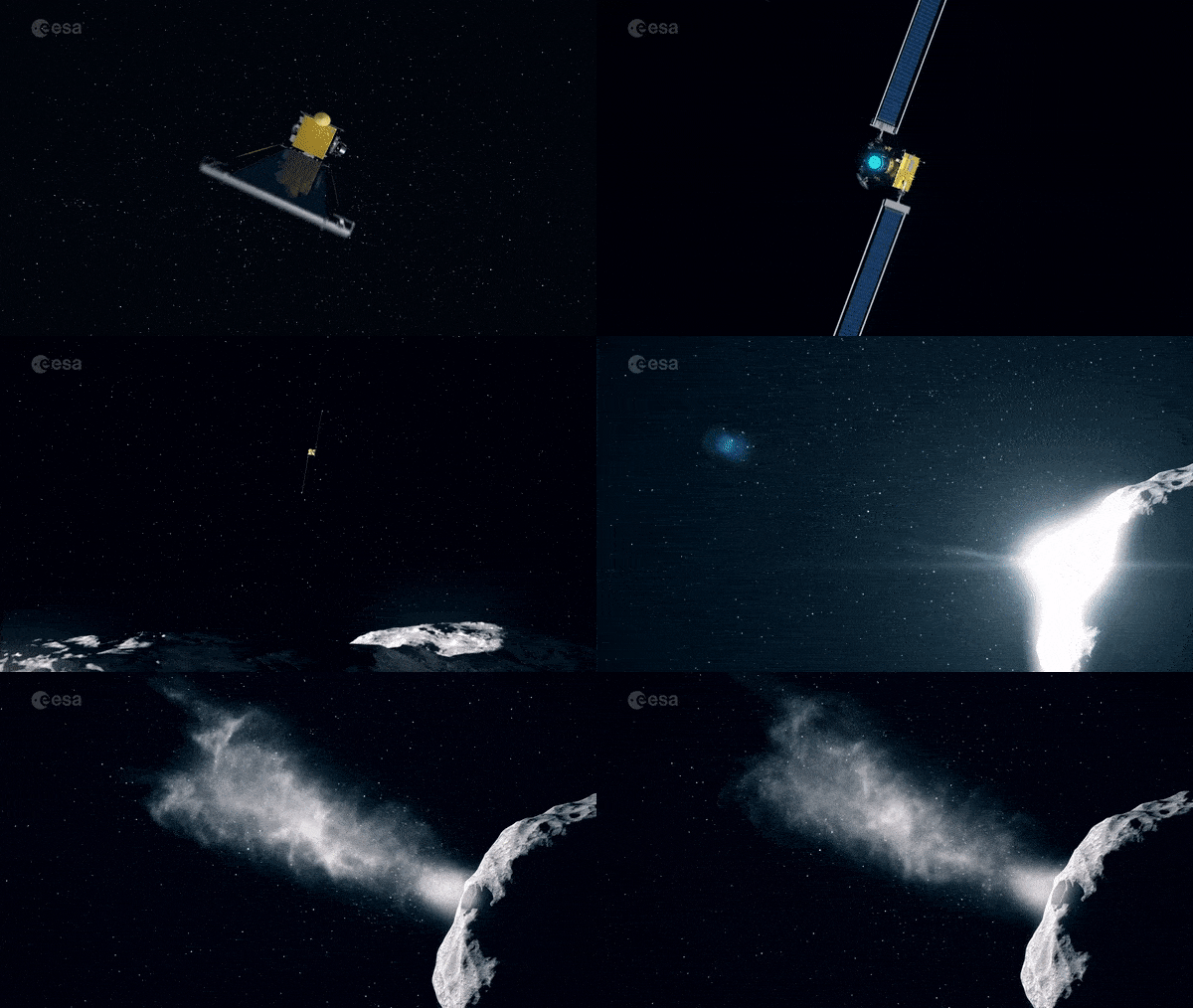
While in the vicinity of the Didymos system, Hera will deploy ESA’s first deep-space CubeSats, in order to gather additional data on the Dimorphos asteroid, its parent and their surrounding environment while testing new intersatellite link technology for future mission architectures, based on distributed systems.
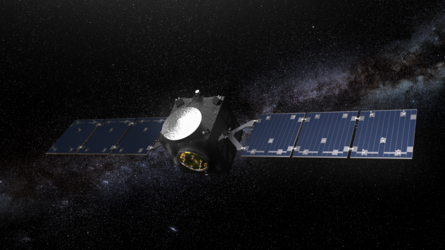
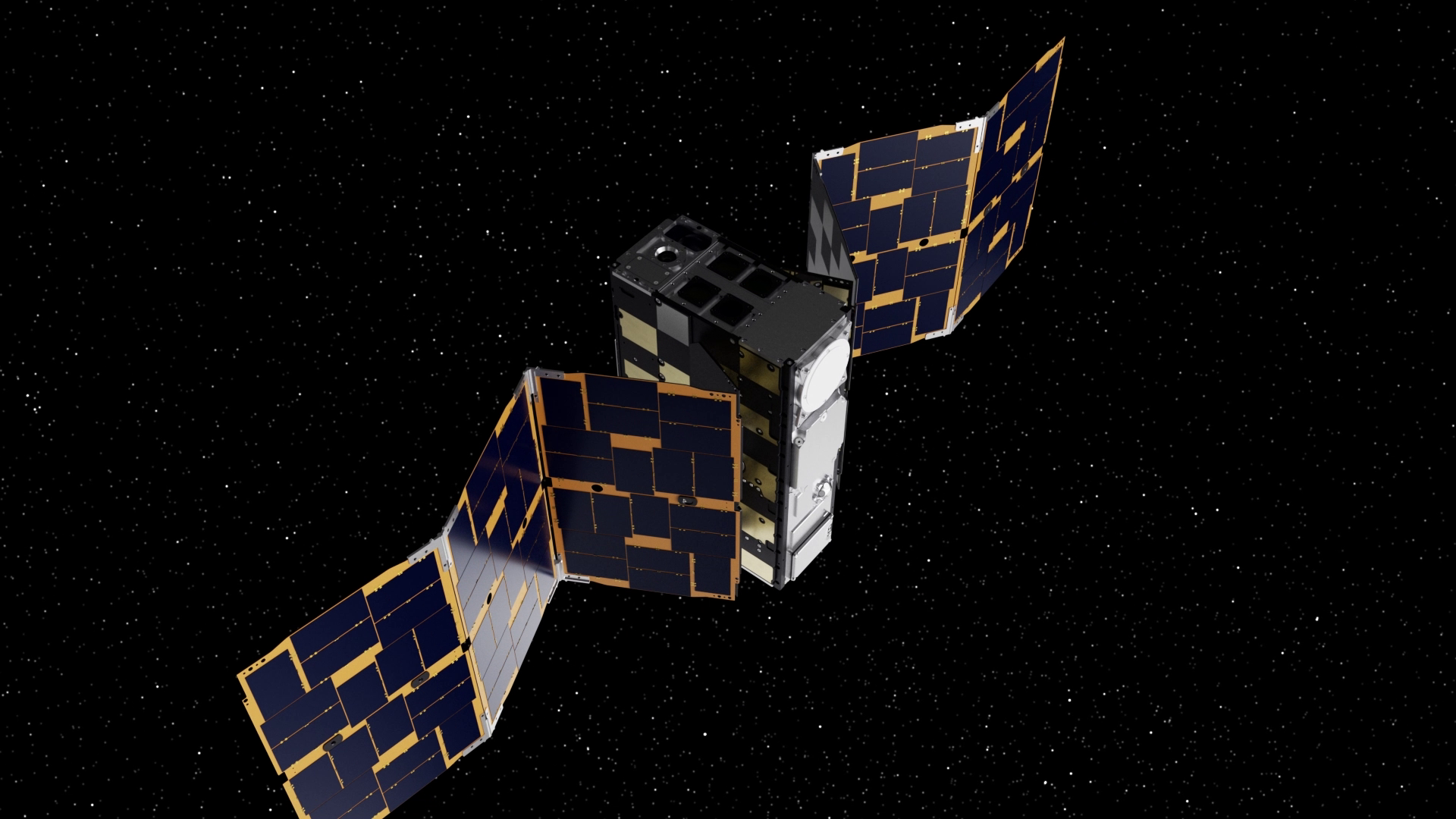
CubeSats are nanosatellites based on standardised 10 cm-sized units. Each companion spacecraft will be small enough to fit inside a briefcase, as compared to the car-sized Hera. CubeSats were originally developed for educational purposes but are increasingly finding operational roles in Earth orbit. Further out, in 2018 NASA deployed twin CubeSats in the vicinity of Mars and in 2022 DART’s impact of Dimorphos was recorded by Italy’s LICIACube.
Hera will deliver two ‘six-unit’ CubeSat missions to the Didymos asteroid system. Think of Hera like an aircraft and the CubeSats as drones, flying closer to the target asteroids and taking more risks. Hosting added instruments, they will give different perspectives and complementary investigations of this exotic binary asteroid system. They will also provide Europe with valuable experience of close proximity operations relayed by the Hera mothercraft in extreme low-gravity conditions. This should also be very valuable to many future missions.
The CubeSats will be overseen from a purpose-built facility at ESA’s European Space Security and Education Centre, at Redu in Belgium. Hera will serve as a relay for signals to and from the CubeSat pair.
Milani

The Milani CubeSat, developed by Tyvak in Italy, will perform detailed spectral measurements of Dimorphos’s surface – breaking down the sunlight it reflects into individual colours to discern what materials it is made from, and highlighting its interaction with the space environment and potentially spotting any differences with its Didymos parent body.
Milani will also perform a census of the dust surrounding Dimorphos, measuring its size and identifying its makeup.
Milani instruments
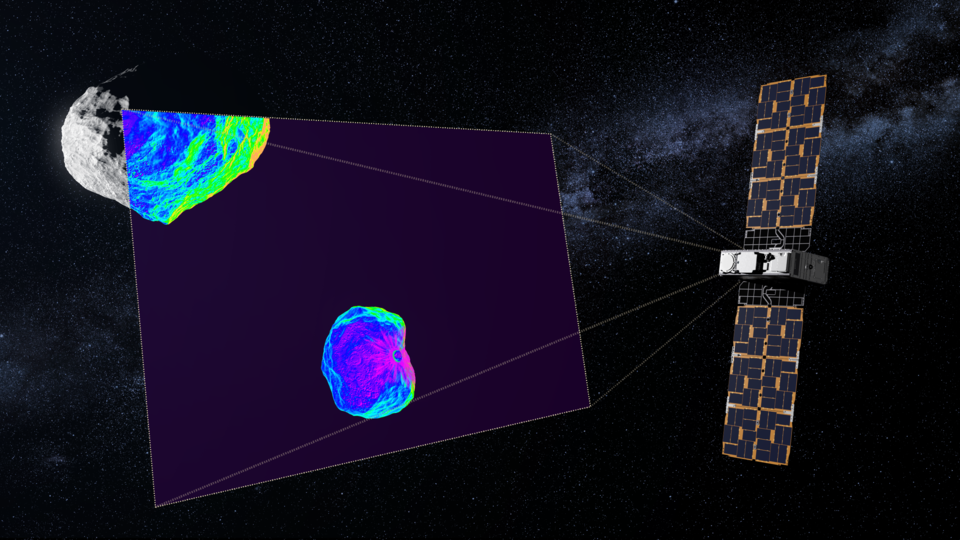
Asteroid Spectral Imager – A descendant of compact hyperspectral imagers originally designed to fly aboard terrestrial drones, ASPECT will image Dimorphos in visible, near and shortwave infrared bands to perform close-up prospecting of the mineralogy of the asteroid surface and individual boulders. It was developed by the VTT Technical Research Centre of Finland.
Volatile In-Situ Thermogravimetre Analyser – based on piezoelectric quartz microbalances, the 5-cubic-cm sized VISTA detects dust particles smaller than 5-10 micrometres (thousandths of a millimetre) and volatiles such as water in their makeup. Developed by Italy’s National Research Council National Institute for Astrophysics and National Institute of Space Astrophysics and Planetology and Politecnico di Milano.
Milani Narrow Angle Camera – to be used for navigation of the CubeSat as well as scientific study.

Access the video

Juventas

The Juventas CubeSat, developed by GomSpace in Luxembourg, will perform the first internal radar sounding of an asteroid, revealing the inner structure of Dimorphos.
Juventas will peer up to 100 m deep within the 151-m-diameter Dimorphos body.
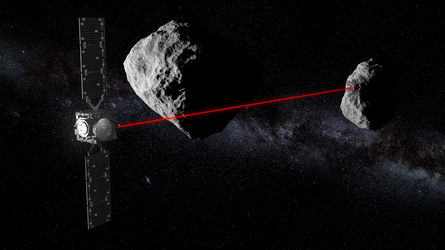
In close orbit around Dimorphos, Juventas will line up with Hera to perform satellite-to-satellite radio-science experiments and carry out a low-frequency radar survey of the asteroid interior, similar to performing a detailed ‘X-ray scan’ of Dimorphos to unveil its interior.
The adventure will end with a landing, using the dynamics of any likely bouncing to capture details of the asteroid’s surface material – followed by several days of surface operations. Once it lands it will also measure the asteroid’s gravity field, and how it shifts during each orbit of Didymos.
Juventas instruments

Juventas Radar – the smallest radar instrument ever flown in space, which will perform the first radar sounding inside an asteroid.
JURA will unfurl a quartet of 1.5-m long antennas larger than the CubeSat itself to peer up to 100 m within Dimorphos to a resolution of 15 m. Its synthetic aperture radar design takes advantage of the low velocity and distance to the target asteroid to send the same signal multiple times to boost its signal to noise ratio, compensating for the CubeSat’s lack of power.
The signal is coded in such a way that the reflections can be disentangled back on Earth to compute a three-dimensional picture. JURA has been developed by France’s Institut de Planétologie et d'Astrophysique de Grenoble at the Université Grenoble Alpes and Technical University Dresden, with electronics coming from EmTroniX in Luxembourg and antennas from Astronika in Poland.
Gravimeter for the Investigation of Small Solar System Bodies – the first instrument to directly measure gravity on the surface of an asteroid, GRASS will come into play once Juventas touches down on the surface of Dimorphos, which will constitute the first landing of a CubeSat on such a small body. It should show how gravity levels on Dimorphos change over the course of its orbit due to the influence of its parent asteroid Didymos.
Juventas Narrow Angle Camera – to be used for navigation of the CubeSat as well as scientific study.