Hera's New Technology
ESA's Hera mission was conceived with a triple set of objectives: asteroid deflection, technology and science. The mission includes a very strong technology demonstration component.
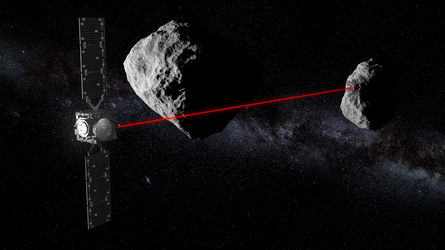
Hera will prepare the way for future interplanetary missions by testing deep-space navigation and guidance, inter-satellite communication between the main Hera spacecraft and its CubeSats as well as proximity operations in the asteroid's extremely low-gravity environment.
Probably the single most significant technology Hera will demonstrate during its mission to the Didymos binary system is intangible in nature, a software algorithm rather than physical hardware, taking a data fusion approach to combine inputs from multiple sensors on a real-time basis, building up a detailed picture of its surroundings in space, while also being able to identify and isolate faults as they arise.

These are technologies relevant to many future missions, such as Mars Sample Return or novel exploration missions with distributed systems, as well as multi-functional space servicing vehicles. In addition, the Hera platform itself will be capable of repurposing for other small deep space missions.
Hera’s extremely tight focus in terms of mission design will lead to a new type of deep space mission, one that is low in cost and high in innovation. It will apply lessons learned from previous interplanetary missions, such as Rosetta, as well as many studies developed within ESA's Concurrent Design Facility.

Fault detection, isolation and recovery
Failure will not be an option during close Dimorphos flybys or other key manoeuvres, performed through autopilot to take place extremely near to the asteroid’s surface, less than a kilometre away at times. But what if one or more of the sensor inputs is in error or an actuator delivers the wrong correction to the spacecraft trajectory or attitude?
That is where Hera’s ‘Fault Detection, Isolation and Recovery’ (FDIR) technique comes in. FDIR is an approach widely applied in space engineering, ranging from the protection of individual electronic components to the safeguarding of the entire spacecraft.
For example, modern space computer chips seeking to recover from memory ‘bit flips’ due to space radiation can perform calculations on a multiple, parallel basis, sometimes voting to decide which of an inconsistent set of results is the most likely to be reliable.

In a similar fashion, Hera’s data-fusion-based guidance and navigation FDIR is designed to identify errors in real time through ongoing sensor cross-checks, to isolate them as needed then making up for them by triggering sensor or actuator reconfigurations – or even, in case of extreme emergency, triggering an autonomous collision avoidance manoeuvre.
Such seamless real-time data fusion is an algorithm-based technique, which is seen as essential to the coming class of autonomous ‘space servicing vehicles’, tasked with refuelling or repairing satellites or removing large items of space debris.