Europe must be able to predict and prevent asteroid impacts
With its Council Ministerial 2025 proposal, ESA’s Space Safety Programme is expanding its efforts in Planetary Defence. The proposal strengthens Europe’s ability to predict and prevent asteroid impacts, reinforces ESA’s commitment to protecting life on Earth, and encourages European industry to develop new technologies.
Recent years have brought planetary defence into the global spotlight. High-profile discoveries and missions such as asteroid 2024 YR4, interstellar comet 3I/ATLAS, the NASA DART and ESA Hera missions, and renewed interest in the asteroid Apophis, have all captured public attention. ESA is ready to demonstrate that planetary defence is a vital public service, and to inspire and reassure citizens across Europe and beyond.
ESA’s CM25 Planetary Defence proposal will:
Ensure the NEOCC remains a world leader in planetary defence
ESA’s Near-Earth Object Coordination Centre (NEOCC) is the operational heart of the Agency’s Planetary Defence activities. The NEOCC is responsible for:
• Asteroid observations: The Centre conducts observations of asteroids and comets with ESA assets, such as the Test Bed Telescopes, and coordinates observations from partners. It will also commission and manage ESA’s Flyeye asteroid survey telescopes.
• Risk assessment: The Centre calculates the trajectories of all near-Earth objects observed by or for ESA, and independently determines the impact risk of all objects submitted to the Minor Planet Center in the USA, the international hub for asteroid observations.
ESA’s quick-warning system ‘Meerkat’ and long-term impact warning system ‘Aegis’ play an important role in global planetary defence efforts and are being upgraded to accommodate the rapid rise in data quantity and quality generated by new telescopes.
• Information provision: The NEOCC issues information about asteroids passing close to Earth and potential impacts via its web portal. Detailed impact effect analyses are distributed upon request to National and Multinational stakeholders and will be expanded to include new types of information to support decision-makers.
Develop new planetary defence capabilities for Europe
A major focus in the coming years will be the research and development of additional capabilities and technologies for Europe, including but not limited to:
• European near-Earth object radar observation capabilities. US radar observations were famously responsible for confirming that the asteroid Apophis will not impact Earth.
• A lightweight, space-based camera system to detect meteor fireballs in Earth’s atmosphere.
• Collaboration with space surveillance activities in other domains.
• The development and onboarding of AI-based asteroid detection and risk assessment tools.
Establish a robust European Near-Earth Object survey system

Flyeye telescopes: ESA’s Flyeye asteroid survey telescope are custom-designed to autonomously scan the night sky each night on the hunt for new asteroids, particularly those with a chance of impacting Earth within the next 100 years. The first Flyeye will soon be deployed on the island of Sicily, Italy.
Flyeye will be most effective as a globally distributed network of telescopes. Funding in the coming period will support the operations of Flyeye-1 and the completion and deployment of Flyeye-2, in South America.
Telescope Array: ESA is also working to complement Europe’s existing asteroid discovery and follow-up capabilities by establishing an array of telescopes around the globe that will be developed, deployed and operated by industry. The coming years will see the deployment of the first unit of the array.
Cover Earth’s largest asteroid blind spot (NEOMIR)
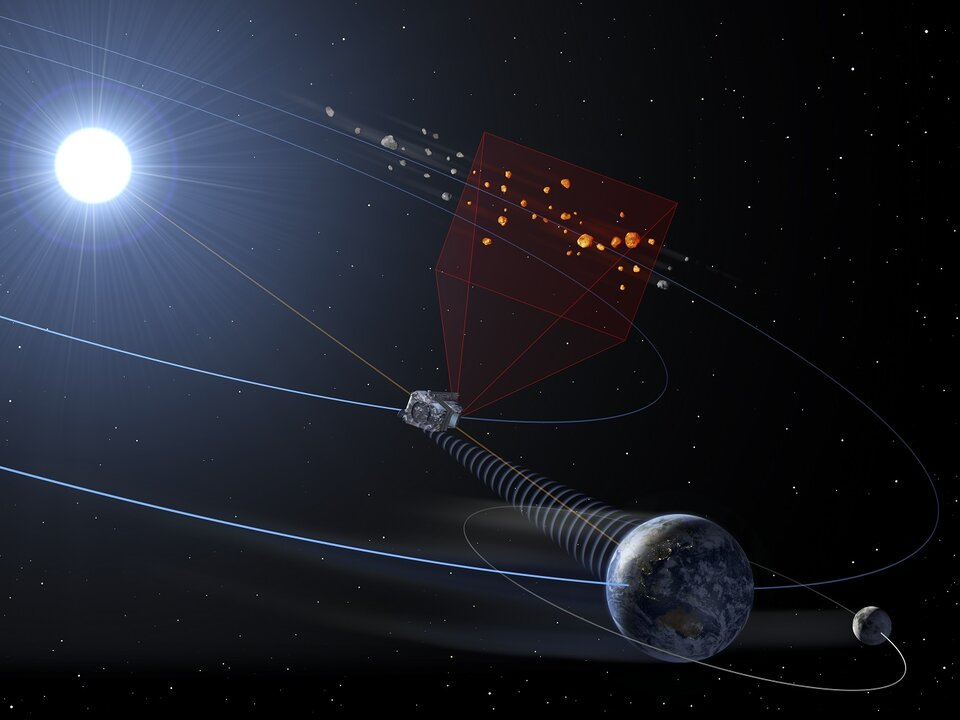
The Near-Earth Object Mission in the Infra-Red (NEOMIR) will close a large blind spot on the dayside hemisphere of Earth. Here, bright sunlight prevents the detection of asteroids with optical, ground-based telescopes. Hunting asteroids in the infrared, NEOMIR will enable us to detect impact hazards similar to the Chelyabinsk event in advance for the first time.
Funding secured at CM25 will be used to de-risk and mature the technology of critical spacecraft components, such as the infrared sensors and the cooling system. A launch is targeted in the mid-2030s.
Demonstrate a fast, cheap method for asteroid reconnaissance (Satis)
The two CubeSat’s carried by ESA’s first asteroid mission, Hera, are demonstrating the potential of small spacecraft for the exploration of deep-space objects. ESA’s Satis mission will go a step further by using a 12U-XL CubeSat to independently reach and explore a near-Earth object.
CubeSat’s can be developed and launched at a fraction of the cost of traditional deep-space missions, making Satis a game-changer for Europe’s Fast Asteroid Reconnaissance capability. Funding is requested to develop and mature the remaining technology necessary to complete the demonstrator mission.
Explore ion-beam asteroid deflection (PAN)
The NASA DART and ESA Hera missions are demonstrating the use of a kinetic impactor to deflect an asteroid. However, DART’s impact on the asteroid Dimorphos produced some unexpected results, likely due to our uncertainty about the interior structure of the asteroid.
Asteroids are diverse, and we will need multiple proven deflection methods in order to reliably protect our planet. ESA is working with partners to evaluate alternative, contactless methods for asteroid deflection that may be better suited to mitigate certain dangerous objects.
The Precision Asteroid Nudging (PAN) spacecraft would direct an ion-beam electric propulsion system towards an asteroid over a prolonged period of time in order to impart a small but continuous force and change the asteroid’s trajectory.
This type of mission is recommended by the UN-endorsed Space Missions Advisory Planning Group (SMPAG) and would see European industry develop new technological capabilities. If funding is secured, ESA will initiate the mission’s study phase.