• → European Space Agency

      • Space for Europe
      • Space News
      • Space in Images
      • Space in Videos
    • About Us

      • Welcome to ESA
      • DG's News and Views
      • For Member State Delegations
      • Business with ESA
      • ESA Exhibitions
      • ESA Publications
      • Careers at ESA
    • Our Activities

      • Space News
      • Observing the Earth
      • Human Spaceflight
      • Launchers
      • Navigation
      • Space Science
      • Space Engineering
      • Operations
      • Technology
      • Telecommunications & Integrated Applications
    • For Public

    • For Media

      • Media
      • ESA TV
      • Videos for professionals
      • Photos
    • For Educators

    • For Kids

    • ESA

    • ESA Science

    • Mars Express

    • Europe goes to Mars

      • Europe reclaims a stake in Mars exploration
      • Space age transforms our knowledge about Mars
    • About Mars Express

      • Mars Express mission facts
      • Mars Express instruments
      • The mission
      • The spacecraft
      • The launcher
    • About Mars

      • Geography of Mars
      • Water on early Mars?
      • Signatures of life
      • Facts about Mars
    • Meet the team

      • International collaboration
      • Project Manager
      • Project Scientist
      • Mars Lead Scientist
      • Principal Investigators
      • Operations
      • Industry
    • Multimedia
    • VideoTalk
    • Mars Express images
    • Mars Express videos
    • HRSC videos
    • Animation in 11 languages
    • Download wallpapers
    • Download screensavers
    • 3D Flash 'model'
    • Make a model
    • Services
    • Comments

    ESA > Our Activities > Space Science > Mars Express

    Phobos in colour, close-up

    Martian moon Phobos in detail

    11 November 2004

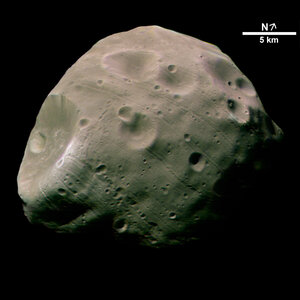
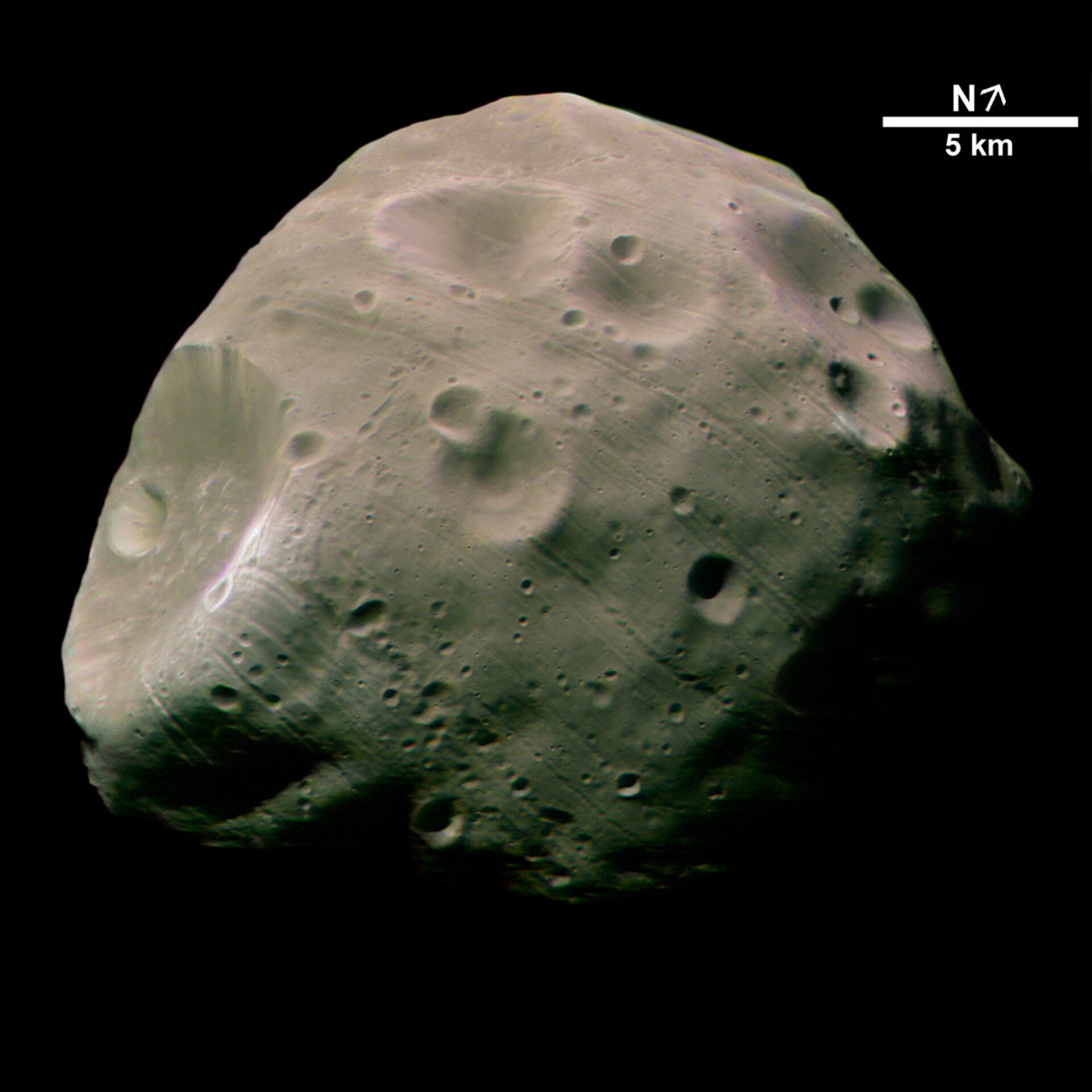
    These images, taken by the High Resolution Stereo Camera (HRSC) on board ESA’s Mars Express spacecraft, are Europe’s highest-resolution pictures so far of the Martian moon Phobos.

    These HRSC images show new detail that will keep planetary scientists busy for years, working to unravel the mysteries of this moon. The images show the Mars-facing side of the moon, taken from a distance of less than 200 kilometres with a resolution of about seven metres per pixel during orbit 756.

    Images of Phobos as shown here had already been taken at lower resolution in previous orbits (413, 649, 682, 715 and 748). In the coming months, these first pictures will be followed by a series of images taken in subsequent fly-bys.
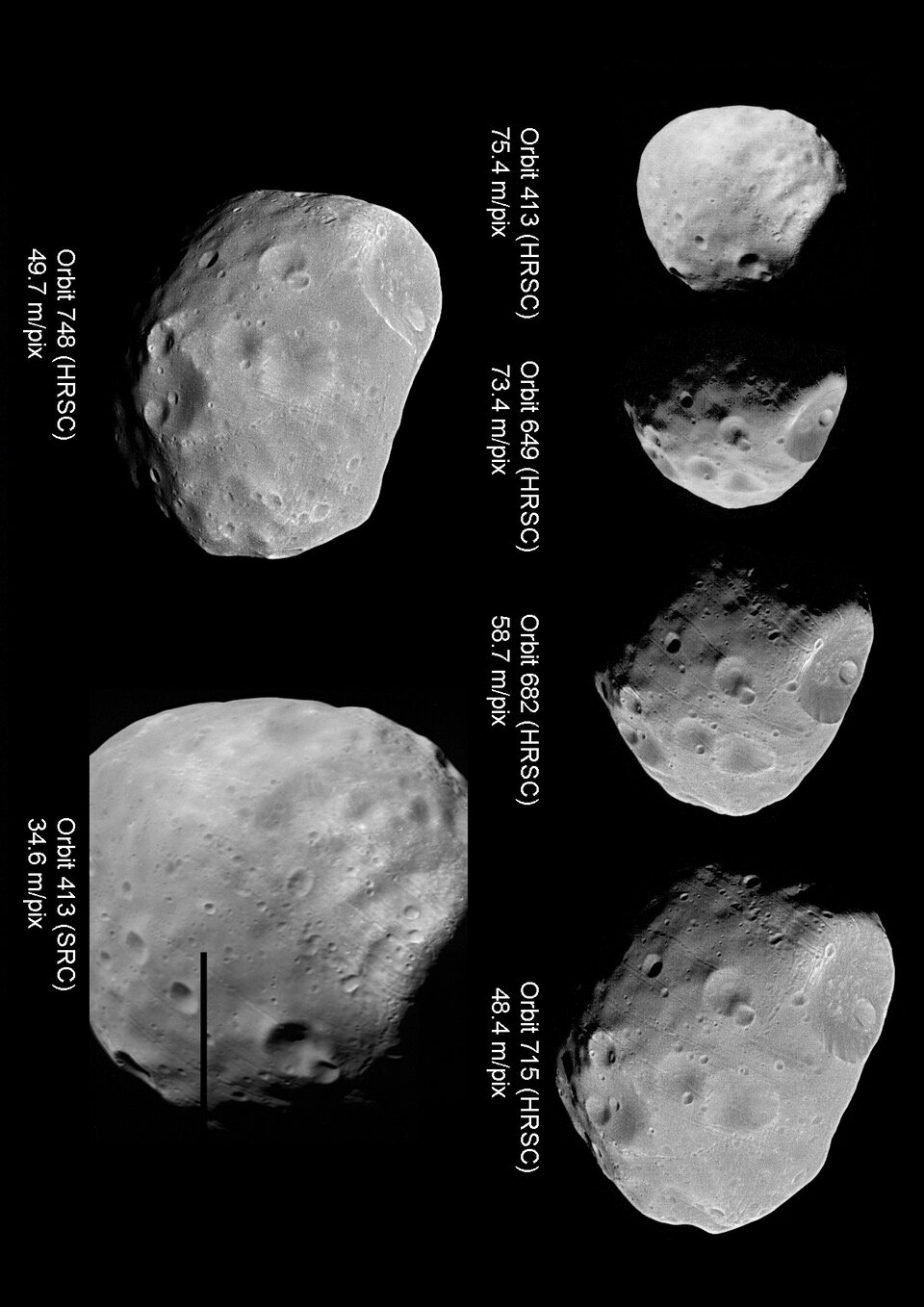
    Collection of Phobos images from different orbit passes

    The Mars Express spacecraft periodically passes near Phobos about one hour before it flies at an altitude of only 270 kilometres above the Martian surface, just above the atmosphere. Within minutes, the orbiting spacecraft turns from its attitude where it points at Mars to train its camera on this little world.

    The HRSC provided an unprecedented near-simultaneous group of 10 different images of the surface, enabling the moon's shape, topography, colour, ‘regolith’ light-scattering properties, and rotational and orbital states to be determined. The regolith is the small-grained material covering most non-icy planetary bodies, resulting from multiple impacts on the body’s surface.


    Phobos in 3D

    These images have surpassed all previous images from other missions in continuous coverage of the illuminated surface, not blurred and at the highest resolution. The US Viking Orbiter obtained a few small areas sampled at an even higher resolution of a few metres per pixel, but these were not so sharp due to the close and fast fly-by.

    The global ‘groove’ network is seen in sufficient detail to cover the Mars-facing surface continuously from near the equator up to the north pole with regular spacing between the grooves. It now may be possible to determine whether the grooves existed before the large cratering events, and exist deep within Phobos, or came after the cratering events and were superimposed on them.

    Much more detail is seen inside the various-sized craters, showing some with marked albedo variations. Some craters have dark materials near the crater floors, some have regolith that slid down the crater walls, and some have very dark ejecta, possibly some of the darkest material in our Solar System.

    Phobos in black and white, close-up

    This tiny moon is thought to be in a ‘death spiral’, slowly orbiting toward the surface of Mars. Here, Phobos was found to be about five kilometres ahead of its predicted orbital position. This could be an indication of an increased orbital speed associated with its secular acceleration, causing the moon to spiral in toward Mars.

    Eventually Phobos could be torn apart by Martian gravity and become a short-lived ring around Mars, or even impact on the surface. This orbit will be studied in more detail over the lifetime of the Mars Express.

    The 3D anaglyph image was generated from a combination of the nadir and the blue channel. The colour image was calculated from the three colour channels and the nadir channel. Due to geometric reasons the scale bar is only valid for the centre of the image.

    For more information on Mars Express HRSC images, you might like to read our updated 'Frequently Asked Questions'.
    Rate this

    Views

    Share

    • Currently 0 out of 5 Stars.
    • 1
    • 2
    • 3
    • 4
    • 5
    Rating: 0/5 (0 votes cast)

    Thank you for rating!

    You have already rated this page, you can only rate it once!

    Your rating has been changed, thanks for rating!

    426
    Tweet
    • Looking at Mars
    • Mars Express image browser
    • Recent images
      • Crater Hale in Argyre basin
        • Coprates Catena’s ‘collapsed’ structures
          • Martian moon Phobos in detail
            • Tithonium Chasma, Valles Marineris, on Mars
              • Rim of Crater Huygens on Mars
                • Promethei Terra, southern highlands of Mars
                  • Ophir Chasma, part of Valles Marineris
                    • Solis Planum, Thaumasia region
                      • Eos Chasma, part of Valles Marineris
                        • Crater dunes in Argyre Planitia
                          • The eroded valleys of Dao and Niger Valles
                            • Olympus Mons caldera in perspective
                              • Escarpment and landslides of Olympus Mons
                                • View of deposits in Melas Chasma on Mars
                                • High Resolution Stereo Camera
                                  • Behind the lens...

    Connect with us

    • RSS
    • Youtube
    • Twitter
    • Flickr
    • G+
    • Facebook
    • Livestream
    • Subscribe
    • App Store
    • LATEST ARTICLES
    • · Rare merger reveals secrets of gal…
    • · Watching for hazards: ESA opens as…
    • · ESA astronaut Timothy Peake set fo…
    • · Space drives e-mobility
    • · Proba-V opens its eyes
    • FAQ

    • Jobs at ESA

    • Site Map

    • Contacts

    • Terms and conditions