• → European Space Agency

      • Space for Europe
      • Space News
      • Space in Images
      • Space in Videos
    • About Us

      • Welcome to ESA
      • DG's News and Views
      • For Member State Delegations
      • Business with ESA
      • ESA Exhibitions
      • ESA Publications
      • Careers at ESA
    • Our Activities

      • Space News
      • Observing the Earth
      • Human Spaceflight
      • Launchers
      • Navigation
      • Space Science
      • Space Engineering
      • Operations
      • Technology
      • Telecommunications & Integrated Applications
    • For Public

    • For Media

    • For Educators

    • For Kids

    • ESA

    • Space Science

    • Our Universe
    • About Space Science
    • ESA's 'Cosmic Vision'
    • Science missions
    • Mission navigator
    • Target groups
    • For Media
    • For Scientists
    • For Kids
    • Multimedia
    • Science images
    • Science videos
    • Animations
    • Downloads
    • Sounds from space
    • Resources
    • Reference section
    • Services
    • FAQs
    • Glossary
    • Help
    • Portal terms of use
    • Comments
    • Follow us
    • RSS feeds
    • ESA Sci on Twitter
    • ESA Space Science Images on Flickr
    • ESA 3D on Flickr

    ESA > Our Activities > Space Science

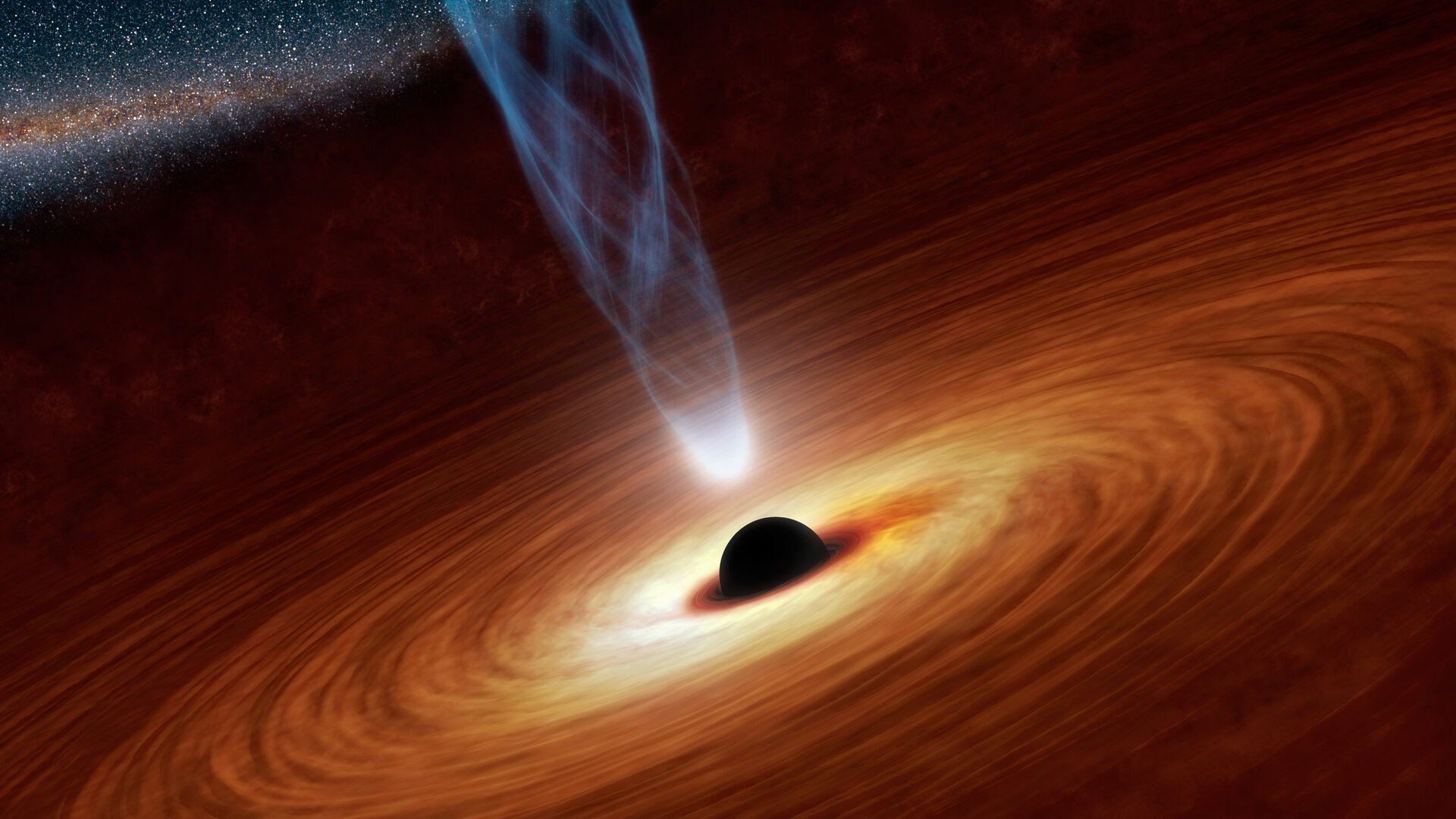
    Rapidly rotating black hole accreting matter

    Speedy black hole holds galaxy’s history

    27 February 2013

    A rapidly rotating supermassive black hole has been found in the heart of a spiral galaxy by ESA’s XMM-Newton and NASA’s NuSTAR space observatories, opening a new window into how galaxies grow.

    Supermassive black holes are thought to lurk in the centre of almost all large galaxies, and scientists believe that the evolution of a galaxy is inextricably linked with the evolution of its black hole. 

    How fast a black hole spins is thought to reflect the history of its formation. In this picture, a black hole that grows steadily, fed by a uniform flow of matter spiralling in, should end up spinning rapidly. Rapid rotation could also be the result of two smaller black holes merging. 

    On the other hand, a black hole buffeted by small clumps of material hitting from all directions will end up rotating relatively slowly.

    These scenarios mirror the formation of the galaxy itself, since a fraction of all the matter drawn into the galaxy finds its way into the black hole. Because of this, astronomers are keen to measure the spin rates of black holes in the hearts of galaxies.

    One way of doing so is to observe X-rays emitted just outside the ‘event horizon’, the boundary surrounding a black hole beyond which nothing, including light, can escape.

    In particular, hot iron atoms produce a strong signature of X-rays at a specific energy, which is smeared out by the rotation of the black hole. The nature of this smearing can then be used to infer the spin rate.

    Using this technique, previous observations have suggested there are extremely rapidly spinning black holes in some galaxies. However, confirming the spin rate has been very difficult, because the X-ray spectrum can also be smeared out by absorbing clouds of gas lying close to the disc. Until now, telling the two scenarios apart has been impossible.

    For roughly 36 hours in July 2012, ESA’s XMM-Newton and NASA’s NuSTAR – the Nuclear Spectroscopic Telescope Array – simultaneously observed the spiral galaxy NGC 1365. XMM-Newton captured the lower energy X-rays, NuSTAR the higher energy data.

    The combined data proved to be key to unlocking the puzzle. A spinning black hole model makes a clear prediction for the ratio of high-energy to low-energy X-rays. The same is true for an absorbing cloud of gas.

    But importantly, the predictions are different and the new data agree only with a rapidly spinning black hole. This suggests that the galaxy has grown steadily with time, with material streaming uniformly into the central black hole.

    However, astronomers cannot yet rule out a single large event where two galaxies and their black holes subsequently merged, producing a sudden acceleration of the resulting supermassive black hole.

    “But we can completely rule out the absorption model,” says Guido Risaliti, INAF – Osservatorio Astrofisico di Arcetri, Italy, who led the investigation.

    “Now that we know how to measure black hole spin rates for certain, we can more confidently use them to infer the evolution of their host galaxies.”


    Measuring black hole spins also provides a new way to test general relativity. Published in 1915, general relativity is Albert Einstein’s description of gravity. It predicts effects that are most easily seen in extremely strong gravitational fields, such as those found near black holes, and NGC 1365’s black hole is spinning almost as fast as Einstein's theory of gravity will allow.

    “Both physics and astrophysics benefit from this result,’ says Dr Risaliti, who is already applying the X-ray measurement technique to different galaxies.

    “The result is a great example of the synergy that can be achieved when complementary space missions are used together. It would have been impossible to achieve this work without the two spacecraft working in tandem,” says Norbert Schartel, ESA XMM-Newton project scientist.


    Notes for Editors

    “A rapidly spinning supermassive black hole at the centre of NGC 1365” by G. Risaliti et al. is published in Nature 28 February 2013; doi:10.1038/nature11938

    The European Space Agency's X-ray Multi-Mirror Mission, XMM-Newton, was launched in December 1999. It is the biggest scientific satellite to have been built in Europe and uses over 170 wafer-thin cylindrical mirrors spread over three high throughput X-ray telescopes. Its mirrors are among the most powerful ever developed. XMM-Newton's orbit takes it almost a third of the way to the Moon, allowing for long, uninterrupted views of celestial objects. The scientific community can apply for observing time on XMM-Newton on a competitive basis.

    NuSTAR is a Small Explorer mission led by the California Institute of Technology in Pasadena and managed by NASA's Jet Propulsion Laboratory, also in Pasadena, for NASA's Science Mission Directorate in Washington.

    For further information, please contact:

    Markus Bauer
    ESA Science and Robotic Exploration Communication Officer
    Tel: +31 71 565 6799
    Mob: +31 61 594 3 954
    Email: markus.bauer@esa.int

    Guido Risaliti
    INAF–Osservatorio Astrofisico di Arcetri
    Tel: +39 055 2752286
    Email: risaliti@arcetri.astro.it

    Norbert Schartel
    ESA XMM-Newton Project Scientist
    Tel: +34 91 8131 184
    Email: norbert.schartel@esa.int
    Rate this

    Views

    Share

    • Currently 5 out of 5 Stars.
    • 1
    • 2
    • 3
    • 4
    • 5
    Rating: 4.82/5 (62 votes cast)

    Thank you for rating!

    You have already rated this page, you can only rate it once!

    Your rating has been changed, thanks for rating!

    12938
    Tweet

    Related articles

    Artist's view of intermediate-mass black hole in its host galaxy

    XMM-Newton discovers a new class of black holes01 July 2009

    Artist's view of intermediate-mass black hole in its host galaxy

    XMM-Newton discovers a new class of black holes01 July 2009 Astronomers using ESA’s XMM-Newton X-ray observatory have discovered a black hole weighing more than 500 solar masses, a missing link between lighter stellar-mass and heavier supermassive black holes, in a distant galaxy. This discovery is the best de...

    Supermassive black hole

    XMM-Newton takes astronomers to a black hole’s edge27 May 2009

    Supermassive black hole

    XMM-Newton takes astronomers to a black hole’s edge27 May 2009 Using new data from ESA’s XMM-Newton spaceborne observatory, astronomers have probed closer than ever to a supermassive black hole lying deep at the core of a distant active galaxy.

    SGR 1627-41

    XMM-Newton measures speedy spin of rare celestial object13 January 2009

    SGR 1627-41

    XMM-Newton measures speedy spin of rare celestial object13 January 2009 XMM-Newton has caught the fading glow of a tiny celestial object, revealing its rotation rate for the first time. The new information confirms this particular object as one of an extremely rare class of stellar zombie – each one the dead heart of a st...

    Artist’s impression of a super-massive black hole

    XMM-Newton uncovers well-tuned super-massive black hole17 September 2008

    Artist’s impression of a super-massive black hole

    XMM-Newton uncovers well-tuned super-massive black hole17 September 2008 XMM-Newton has uncovered a well-tuned periodic signal from a super-massive black hole lodged at the centre of a galaxy, ending a long quest for such an object. The discovery provides scientists with a clearer picture on black hole accretion processes...

    Our galaxy's centre

    Milky Way's giant black hole awoke from slumber 300 years ago15 April 2008

    Our galaxy's centre

    Milky Way's giant black hole awoke from slumber 300 years ago15 April 2008 A team of Japanese astronomers using ESA’s XMM-Newton, along with NASA and Japanese X-ray satellites, has discovered that our galaxy’s central black hole let loose a powerful flare three centuries ago.

    Broad Absorption Line quasar

    Cosmic engines surprise XMM-Newton07 April 2008

    Broad Absorption Line quasar

    Cosmic engines surprise XMM-Newton07 April 2008 XMM-Newton has been surprised by a rare type of galaxy, from which it has detected a higher number of X-rays than thought possible. The observation gives new insight into the powerful processes shaping galaxies during their formation and evolution.

    • More about...
      • XMM-Newton overview
      • XMM-Newton image gallery
      • In depth
      • XMM-Newton in-depth
      • Related links
      • More XMM & NuSTAR graphics
      • NuSTAR NASA site
      • NuSTAR Caltech site

    Connect with us

    • RSS
    • Youtube
    • Twitter
    • Flickr
    • G+
    • Facebook
    • Livestream
    • Subscribe
    • App Store
    • ESA Science Twitter

    Follow ESA science

    • LATEST ARTICLES
    • · ESA astronaut Timothy Peake set fo…
    • · Space drives e-mobility
    • · Proba-V opens its eyes
    • · First new Galileo satellite arrive…
    • · Next destination: space
    • FAQ

    • Jobs at ESA

    • Site Map

    • Contacts

    • Terms and conditions