• → European Space Agency

      • Space for Europe
      • Space News
      • Space in Images
      • Space in Videos
    • About Us

      • Welcome to ESA
      • DG's News and Views
      • For Member State Delegations
      • Business with ESA
      • ESA Exhibitions
      • ESA Publications
      • Careers at ESA
    • Our Activities

      • Space News
      • Observing the Earth
      • Human Spaceflight
      • Launchers
      • Navigation
      • Space Science
      • Space Engineering
      • Operations
      • Technology
      • Telecommunications & Integrated Applications
    • For Public

    • For Media

    • For Educators

    • For Kids

    • ESA

    • Venus Express

    • ESA Science

    • Europe goes to Venus

      • Tribute to the cryptic planet
      • Penetrating an impenetrable world
      • Past missions to Venus
    • About Venus Express

      • Venus Express mission facts
      • Venus Express objectives
      • The spacecraft
      • Orbiter instruments
      • The launcher
      • Operating Venus Express
    • About Venus

      • Venusian geography
      • The surface
      • Acid clouds and lightning
      • Greenhouse effect, clouds and winds
      • Venus compared to Earth
    • Meet the team

      • International collaboration
      • Project Manager: An interview with Don McCoy
      • Project Scientist: An interview with Håkan Svedhem
      • Launch Campaign Manager: An interview with Michael Witting
      • Spacecraft Operations Manager: An interview with Andrea Accomazzo
      • Venus Express Flight Control Team
      • Principal Investigators
    • Multimedia
    • Venus Express images
    • Venus Express videos
    • VideoTalk
    • 3D Flash 'model'
    • Build a model (pdf)
    • Wallpapers
    • Screensavers
    • Services
    • Comments

    ESA > Our Activities > Space Science > Venus Express

    Radiation from below the Venusian cloud deck

    Complex meteorology at Venus

    13 October 2006

    In its relentless probing of Venus's atmosphere, ESA's Venus Express keeps revealing new details of the Venusian cloud system. Meteorology at Venus is a complex matter, scientists say.

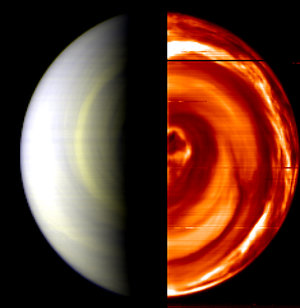
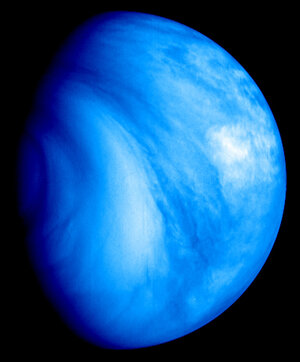
    New night-side infrared images gathered by the Ultraviolet, Visible and Near-Infrared Mapping Spectrometer (VIRTIS) in July 2006, clearly show new details of a complex cloud system.

    The first (false colour) view - the composite of three infrared images acquired by VIRTIS, was taken on 22 July when the spacecraft was flying around the apocentre of its orbit (point of maximum distance from the planet surface) at about 65 000 kilometres altitude. Venus was in the night side.

    Using its capability to observe at 1.7-micrometre wavelenght, VIRTIS could probe at about 15-20 kilometres altitude, below the thick cloud deck situated at about 60 kilometres from the surface. The thermal radiation coming from the oven-hot surface of Venus is represented by the intensity of the colours: the brighter the colour (towards white), the more radiation comes from the surface, so the less cloudy the region in the line of sight between the view and the spacecraft is.

    The edge of the images, taken at a time interval of about 30 minutes from each other, do not precisely match. This is due to the fact that clouds on Venus move very rapidly and constantly vary their shape. Venus’s atmosphere is certainly the most dynamic among the terrestrial planets that have one, taking only four days to completely rotate around the planet.

    "Clouds at Venus present repetitive patterns and recurrent features, but they are very variable in position both on short and long time scales," said Giuseppe Piccioni who, with Pierre Drossart, is the instrument co-Principal Investigator. "This makes meteorology a very complex matter for this planet."

    Since the thermal radiation from the surface of Venus is in practice modulated by the presence of the clouds, taking the negative of the image it is possible to see directly the clouds structure on the night side, and so study its morphology and dynamics.
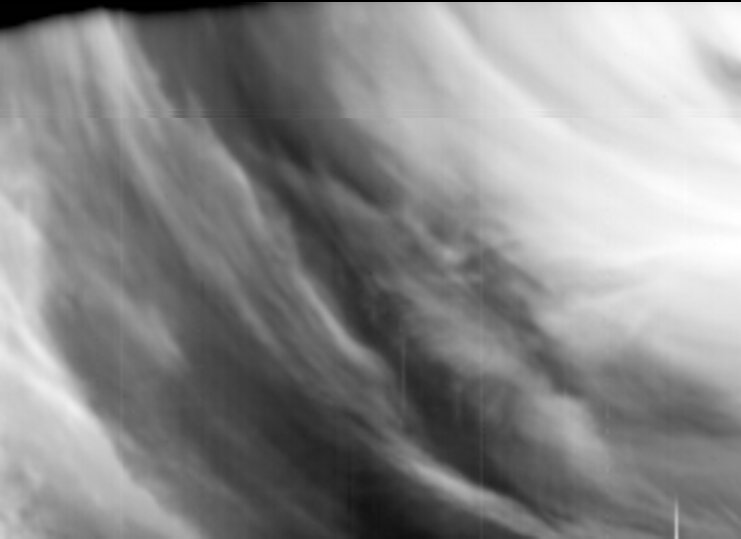
    Cloud structures at Venus

    This was done for this other night-side image, acquired by VIRTIS on 29 July around apocentre from a distance of about 65 000 kilometres from the surface.

    The 2.3-micrometre wavelength used for this image brought the 'view' again down below the cloud deck. The large cloud visible in the centre of the image and extending toward the bottom-right part is about 2000 kilometres long and 500 kilometres wide.

    This cloud presents the familiar and peculiar shape of clouds at Venus. They are usually elongated due to the very high-speed winds – reaching up the formidable velocity of 360 kilometres per hour and being caused by the 'super-rotation' of the atmosphere.

    The very cloudy region visible at the top-right of the image is situated beyond 60º South latitude, and represents the transition to the region where the atmosphere is dominated by the effects of the powerful South double polar vortex.


    For more information

    Hakan Svedhem, ESA Venus Express Project Scientist
    Email: hakan.svedhem @ esa.int

    Giuseppe Piccioni, VIRTIS co-Principal Investigator, IASF-INAF, Rome, Italy
    Email: giuseppe.piccioni @ iasf-roma.inaf.it

    Pierre Drossart, VIRTIS co-Principal Investigator, Observatoire de Paris, France
    Email: pierre.drossart @ obspm.fr

    Rate this

    Views

    Share

    • Currently 0 out of 5 Stars.
    • 1
    • 2
    • 3
    • 4
    • 5
    Rating: 0/5 (0 votes cast)

    Thank you for rating!

    You have already rated this page, you can only rate it once!

    Your rating has been changed, thanks for rating!

    71
    Tweet
    • Feature
    •  ESA astronaut C. Nicollier on voyaging to Venus
    • VOI highlights and press conference
    • ESApod: Venus Express
    • VOI updates
      • Venus Express’ initial orbit matches expectations
        • Venus Express 'talks' to Earth
          • Venus Express main engine burn ended
            • Venus Express reappears from behind Venus
              • Pre-planned thrill - Venus Express disappears behind Venus
                • Venus Express main engine burn starts
                  • Venus Express slews and prepares to ‘brake’
                    • Venus Orbit Insertion timeline
                    • Looking at Venus
                      • ESA’s Venus Express to reach final destination
                      • Related articles
                        • Flying over the cloudy world – science updates from Venus Express
                          • Double vortex at Venus South Pole unveiled!
                            • Venus Express has reached final orbit
                              • Unexpected detail in first-ever Venus south pole images
                                • Venus within ESA probe reach
                                  • And now… straight to Venus!
                                    • Successful Venus Express main engine test
                                      • First light for the Venus Monitoring Camera
                                        • Venus Express performs flawlessly, LEOP complete
                                          • Venus Express mission operations update
                                            • Venus Express en route to probe the planet's hidden mysteries
                                            • Related links
                                            • Venus Express operations
                                            • Webcam from ESOC

    Connect with us

    • RSS
    • Youtube
    • Twitter
    • Flickr
    • G+
    • Facebook
    • Livestream
    • Subscribe
    • App Store
    • LATEST ARTICLES
    • · Proba-V opens its eyes
    • · First new Galileo satellite arrive…
    • · Next destination: space
    • · Leak repaired on International Spa…
    • · After Chelyabinsk: European expert…
    • FAQ

    • Jobs at ESA

    • Site Map

    • Contacts

    • Terms and conditions