• → European Space Agency

      • Space for Europe
      • Space News
      • Space in Images
      • Space in Videos
    • About Us

      • Welcome to ESA
      • DG's News and Views
      • For Member State Delegations
      • Business with ESA
      • ESA Exhibitions
      • ESA Publications
      • Careers at ESA
    • Our Activities

      • Space News
      • Observing the Earth
      • Human Spaceflight
      • Launchers
      • Navigation
      • Space Science
      • Space Engineering
      • Operations
      • Technology
      • Telecommunications & Integrated Applications
    • For Public

    • For Media

    • For Educators

    • For Kids

    • ESA

    • Space Science

    • Our Universe
    • About Space Science
    • ESA's 'Cosmic Vision'
    • Science missions
    • Mission navigator
    • Target groups
    • For Media
    • For Scientists
    • For Kids
    • Multimedia
    • Science images
    • Science videos
    • Animations
    • Downloads
    • Sounds from space
    • Resources
    • Reference section
    • Services
    • FAQs
    • Glossary
    • Help
    • Portal terms of use
    • Comments
    • Follow us
    • RSS feeds
    • ESA Sci on Twitter
    • ESA Space Science Images on Flickr
    • ESA 3D on Flickr

    ESA > Our Activities > Space Science

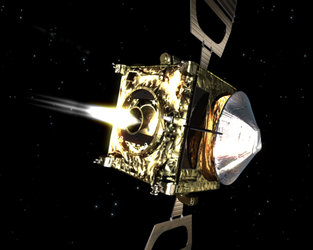
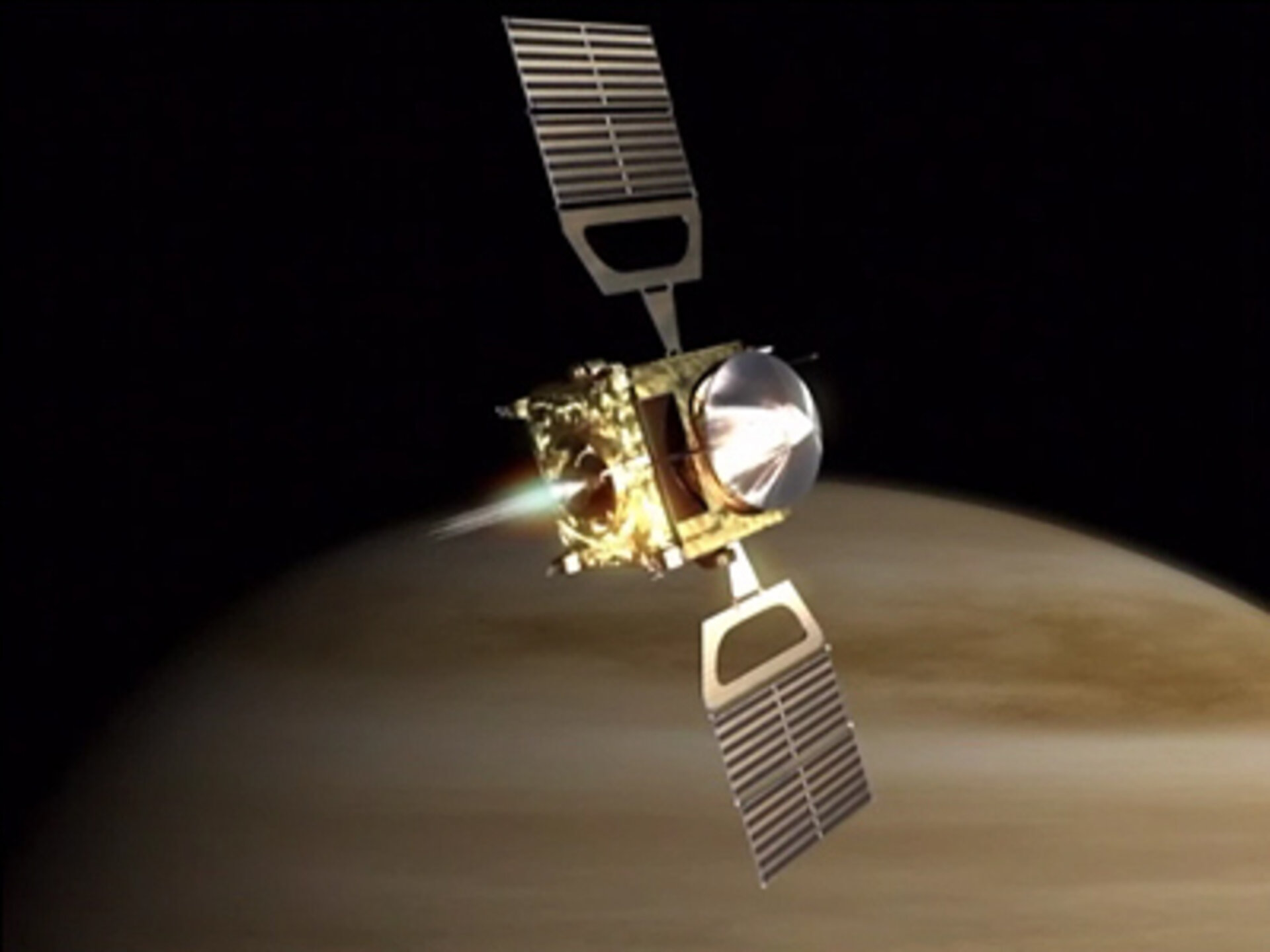
    Venus Express main engine burn starts

    Artist's impression of Venus Express orbit insertion
    11 April 2006

    At 09:17 CEST today, Venus Express started its main engine burn. The burn, to last 50 minutes, will slow down the spacecraft and allow the capture into orbit around Venus. The main engine burn started a few minutes after the firing of the spacecraft thrusters, to make sure the propellant settles in the feed lines to the main engine.

    This thrust is aimed at reducing the initial velocity of 29 000 kilometres per hour (in relation to Venus) by 15 percent, to allow capture by the planet’s gravity. Thanks to this burn, Venus Express will settle into its preliminary, elongated nine-day orbit.

    Only the spacecraft low-gain antenna, carrying a feeble but instantly recognisable signal, is transmitting throughout all VOI manoeuvres. This allows ground controllers to monitor the velocity change during the burn, using NASA’s Deep Space Network’s 70-metre antenna near Madrid, Spain. No other means of communication with the Earth is possible during the capture burn.

    During the burn, at 09:45 CEST, Venus Express will disappear behind the planet and will not be visible from Earth. This is known as its ‘occultation’ period, in which the only signal coming from the spacecraft – the carrier signal from the low gain antenna - will become unavailable for ten minutes.

    Rate this

    Views

    Share

    • Currently 0 out of 5 Stars.
    • 1
    • 2
    • 3
    • 4
    • 5
    Rating: 0/5 (0 votes cast)

    Thank you for rating!

    You have already rated this page, you can only rate it once!

    Your rating has been changed, thanks for rating!

    22
    Tweet
    • Feature
    •  ESA astronaut C. Nicollier on voyaging to Venus
    • VOI highlights and press conference
    • ESApod: Venus Express
    • VOI updates
      • Venus Express’ initial orbit matches expectations
        • Venus Express 'talks' to Earth
          • Venus Express main engine burn ended
            • Venus Express reappears from behind Venus
              • Pre-planned thrill - Venus Express disappears behind Venus
                • Venus Express main engine burn starts
                  • Venus Express slews and prepares to ‘brake’
                    • Venus Orbit Insertion timeline
                    • Looking at Venus
                      • ESA’s Venus Express to reach final destination
                      • Related articles
                        • Venus within ESA probe reach
                          • And now… straight to Venus!
                            • Successful Venus Express main engine test
                              • First light for the Venus Monitoring Camera
                                • Venus Express performs flawlessly, LEOP complete
                                  • Venus Express mission operations update
                                    • Venus Express en route to probe the planet's hidden mysteries
                                    • Related links
                                    • Venus Express operations
                                    • Webcam from ESOC

    Connect with us

    • RSS
    • Youtube
    • Twitter
    • Flickr
    • G+
    • Facebook
    • Livestream
    • Subscribe
    • App Store
    • ESA Science Twitter

    Follow ESA science

    • LATEST ARTICLES
    • · ESA astronaut Timothy Peake set fo…
    • · Space drives e-mobility
    • · Proba-V opens its eyes
    • · First new Galileo satellite arrive…
    • · Next destination: space
    • FAQ

    • Jobs at ESA

    • Site Map

    • Contacts

    • Terms and conditions