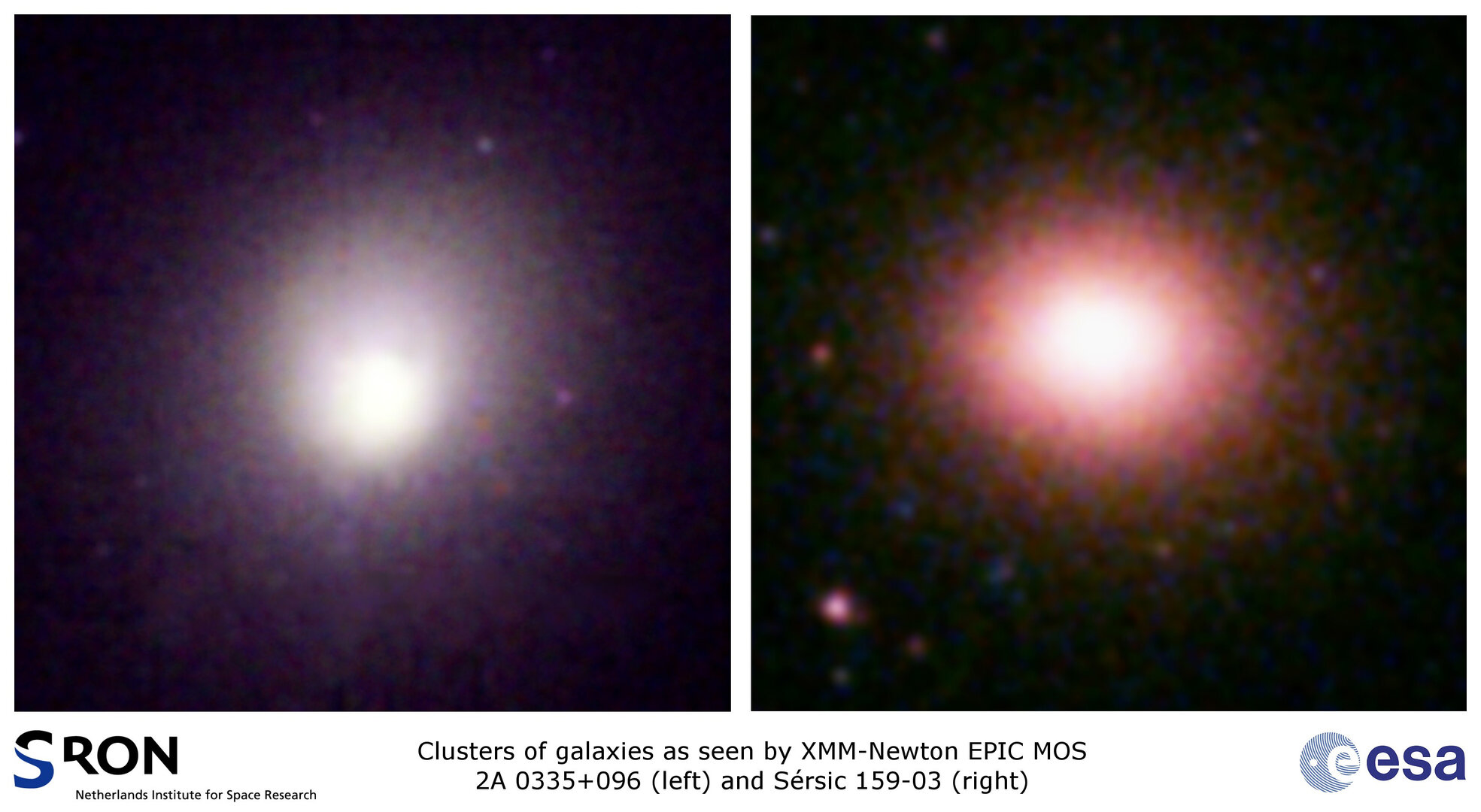
XMM-Newton reveals the origin of elements in galaxy clusters
Deep observations of two X-ray bright clusters of galaxies with ESA’s XMM-Newton satellite allowed a group of international astronomers to measure their chemical composition with an unprecedented accuracy. Knowing the chemical composition of galaxy clusters is of crucial importance to understanding the origin of chemical elements in the Universe.
Clusters, or conglomerates, of galaxies are the largest objects in the Universe. By looking at them through optical telescopes it is possible to see hundreds or even thousands of galaxies occupying a volume a few million light years across. However, such telescopes only reveal the tip of the iceberg. In fact most of the atoms in galaxy clusters are in the form of hot gas emitting X-ray radiation, with the mass of the hot gas five times larger than the mass in the cluster’s galaxies themselves.
Most of the chemical elements produced in the stars of galaxy clusters - expelled into the surrounding space by supernova explosions and by stellar winds - become part of the hot X-ray emitting gas. Astronomers divide supernovae into two basic types: ‘core collapse’ and ‘Type Ia’ supernovae. The ‘core collapse’ supernovae originate when a star at the end of its life collapses into a neutron star or a black hole. These supernovae produce lots of oxygen, neon and magnesium. The Type Ia supernovae explode when a white dwarf star consuming matter from a companion star becomes too massive and completely disintegrates. This type produces lots of iron and nickel.
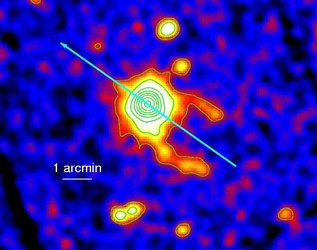
Respectively in November 2002 and August 2003, and for one and a half day each time, XMM-Newton’s made deep observations of the two galaxy clusters called ‘Sersic 159-03’ and ‘2A 0335+096’. Thanks to these data the astronomers could determine the abundances of nine chemical elements in the clusters ‘plasma’ – a gas containing charged particles such as ions and electrons.
These elements include oxygen, iron, neon, magnesium, silicon, argon, calcium, nickel, and - detected for the first time ever in a galaxy cluster - chromium. "Comparing the abundances of the detected elements to the yields of supernovae calculated theoretically, we found that about 30 percent of the supernovae in these clusters were exploding white dwarfs (‘Type Ia’) and the rest were collapsing stars at the end of their lives (‘core collapse’)," said Norbert Werner, from the SRON Netherlands Institute for Space Research (Utrecht, Netherlands) and one of the lead authors of these results.
"This number is in between the value found for our own Galaxy (where Type Ia supernovae represent about 13 percent of the supernovae ‘population’) and the current frequency of supernovae events as determined by the Lick Observatory Supernova Search project (according to which about 42 percent of all observed supernovae are Type Ia)," he continued.
The astronomers also found that all supernova models predict much less calcium than what is observed in clusters and that the observed nickel abundance cannot be reproduced by these models. These discrepancies indicate that that the details of supernova enrichment is not yet clearly understood. Since clusters of galaxies are believed to be fair samples of the Universe, their X-ray spectroscopy can help to improve the supernova models.
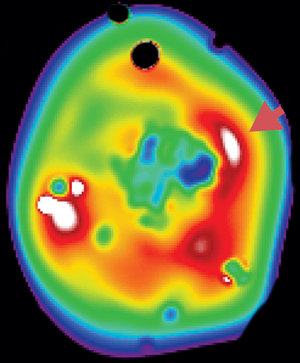
The spatial distribution of elements across a cluster also holds information about the history of clusters themselves. The distribution of elements in 2A 0335+096 indicates an ongoing merger. The distribution of oxygen and iron across Sersic 159-03 indicates that while most of the enrichment by the core collapse supernovae happened long time ago, Type Ia supernovae still continue to enrich the hot gas by heavy elements especially in the core of the cluster.
Note to editors
This work is presented in two papers in the Astronomy & Astrophysics journal. The first one, published in April 2006 and titled ‘XMM-Newton spectroscopy of the cluster of galaxies 2A 035+096’ (A&A Volume 449, Page 475), is by N.Werner , J.S.Kaastra and J.A.M.Bleeker (SRON, Utrecht, The Netherlands), J.de Plaa and J.Vink (SRON and Utrecht University, Utrecht, The Netherlands), T.Tamura (JAXA, Kanagawa, Japan), J.R.Peterson (Stanford University, CA, USA), F.Verbunt (Utrecht University, The Netherlands).
The second article, to appear in 2006 and titled ‘Chemical evolution in Sersic 159-03 observed by XMM-Newton’ (A&A 2006 and astro-ph/0602582), is by J.de Plaa, J.Vink and J.A.M.Bleeker (SRON and Utrecht University, Utrecht, The Netherlands), N.Werner, J.S.Kaastra and M.Mendez (SRON, Utrecht, The Netherlands), A.M.Bykov (A.F. Ioffe Institute for Physics and Technology, St.Petersburg, Russia), M.Bonamente (University of Alabama, Hunstville, AL, USA), J.R. Peterson (Stanford University, CA, USA).
This research is in particular the result of the cooperation between the SRON Utrecht and the Utrecht University in the Netherlands.
For more information
Norbert Werner, SRON Netherlands Institute for Space Research, Utrecht, the Netherlands
Tel: +31 30 2535 721
Email: n.werner @ sron.nl
Jelle de Plaa, SRON Netherlands Institute for Space Research, Utrecht, the Netherlands
Tel: +31 30 253 5712
Email: j.de.plaa @ sron.nl,
Norbert Schartel, ESA XMM-Newton Project Scientist
Norbert.Schartel @ sciops.esa.int