• → European Space Agency

      • Space for Europe
      • Space News
      • Space in Images
      • Space in Videos
    • About Us

      • Welcome to ESA
      • DG's News and Views
      • For Member State Delegations
      • Business with ESA
      • ESA Exhibitions
      • ESA Publications
      • Careers at ESA
    • Our Activities

      • Space News
      • Observing the Earth
      • Human Spaceflight
      • Launchers
      • Navigation
      • Space Science
      • Space Engineering
      • Operations
      • Technology
      • Telecommunications & Integrated Applications
    • For Public

    • For Media

    • For Educators

    • For Kids

    • ESA

    • Space Science

    • Our Universe
    • About Space Science
    • ESA's 'Cosmic Vision'
    • Science missions
    • Mission navigator
    • Target groups
    • For Media
    • For Scientists
    • For Kids
    • Multimedia
    • Science images
    • Science videos
    • Animations
    • Downloads
    • Sounds from space
    • Resources
    • Reference section
    • Services
    • FAQs
    • Glossary
    • Help
    • Portal terms of use
    • Comments
    • ESA Press Releases
    • Follow us
    • RSS feeds
    • ESA Sci on Twitter
    • ESA Space Science Images on Flickr
    • ESA 3D on Flickr

    ESA > Our Activities > Space Science

    Young star rebels against its parent cloud

    Hubble view of star-forming region S106
    15 December 2011

    Hubble’s Wide Field Camera 3 has captured this image of a giant cloud of hydrogen gas illuminated by a bright young star. The image shows how violent the end stages of the star-formation process can be, with the young object shaking up its stellar nursery.

    Despite the celestial colours of this picture, there is nothing peaceful about star forming region Sh 2-106, or S106 for short. A devilish young star, named S106 IR, lies in it and ejects material at high speed, which disrupts the gas and dust around it. The star has a mass about 15 times that of the Sun and is in the final stages of its formation. It will soon quieten down by entering the main sequence, the adult stage of stellar life.

    For now, S106 IR remains embedded in its parent cloud, but it is rebelling against it. The material spewing off the star not only gives the cloud its hourglass shape but also makes the hydrogen gas in it very hot and turbulent. The resulting intricate patterns are clearly visible in this Hubble image.
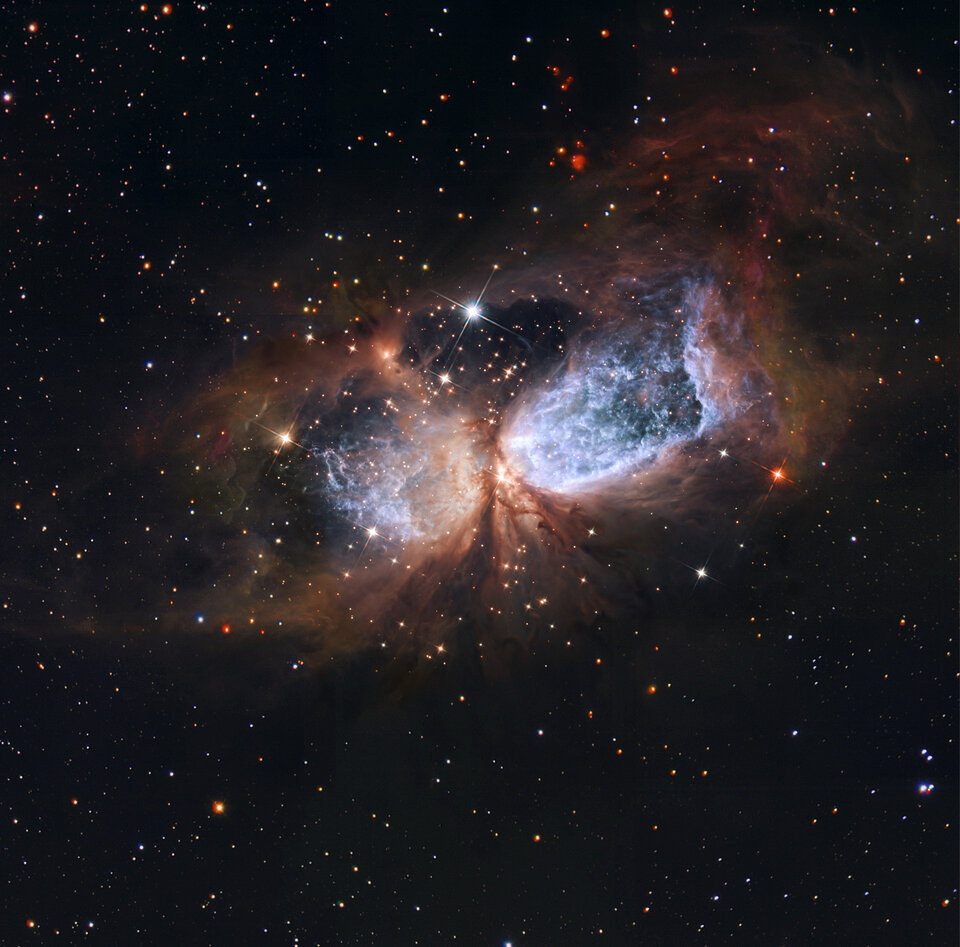
    Hubble/Subaru composite of star-forming region S 106

    The young star also heats up the surrounding gas, making it reach temperatures of 10 000 degrees Celsius. The star’s radiation ionises the hydrogen lobes, making them glow. The light from this glowing gas is coloured blue in this image.

    Separating these regions of glowing gas is a cooler, thick lane of dust, appearing red in the image. This dark material almost completely hides the ionising star from view, but the young object can still be seen peeking through the widest part of the dust lane.

    S106 was the 106th object to be catalogued by the astronomer Steward Sharpless in the 1950s. It is a few thousand light-years distant in the direction of Cygnus (The Swan). The cloud itself is relatively small by the standards of star-forming regions, around 2 light-years along its longest axis. This is about half the distance between the Sun and Proxima Centauri, our nearest stellar neighbour.


    Ground-based view of the area around star-forming region S 106

    This composite picture was obtained with the Wide Field Camera 3 on the NASA/ESA Hubble Space Telescope. It results from the combination of two images taken in infrared light and one which is tuned to a specific wavelength of visible light emitted by excited hydrogen gas, known as H-alpha. This choice of wavelengths is ideal for targetting star-forming regions. The H-alpha filter isolates the light emitted from hydrogen in gas clouds while the infrared light can shine through the dust that often obscures these regions.

    Contact for further information

    Rate this

    Views

    Share

    • Currently 0 out of 5 Stars.
    • 1
    • 2
    • 3
    • 4
    • 5
    Rating: 0/5 (0 votes cast)

    Thank you for rating!

    You have already rated this page, you can only rate it once!

    Your rating has been changed, thanks for rating!

    152
    facebook
    twitter
    reddit
    google plus
    digg
    tumbler
    digg
    blogger
    myspace
    • More about
    • Hubble overview
      • Hubble factsheet
      • JWST overview
      • Related videos
      • Happy Birthday Hubble!
      • Hubblecast at the Hubble ESA Information Centre
      • Where is Hubble now?
      • Track Hubble
      • Hubble on YouTube
      • Hubble's achievements
      • Importance of Hubble's discoveries
      • Related articles
        • New moon found at Pluto
          • Hubble captures bubbles and baby stars
            • Jupiter’s mysterious flashes and missing cloud belts
              • Hubble catches stars on the move
                • Starry-eyed Hubble celebrates 20 years of awe and discovery
                  • Hubble confirms cosmic acceleration with distorted galaxies
                    • Bully galaxy rules the neighbourhood
                      • Where did today’s spiral galaxies come from?
                        • Born in beauty: proplyds in the Orion Nebula
                          • Opening up a colourful cosmic Jewel Box
                            • Hubble highlights two galaxies that are losing it
                              • Rebirth of an icon: Hubble's first images since Servicing Mission 4
                                • Hubble captures rare Jupiter collision
                                  • Historic Hubble Servicing Mission 4 ends with successful landing
                                    • Servicing Mission 4 — the fifth and final visit to Hubble
                                      • On Hubble's 19th birthday, a fountain of youth
                                      • In depth
                                      • Hubble in depth

    Connect with us

    • RSS
    • Youtube
    • Twitter
    • Flickr
    • Google Buzz
    • Subscribe
    • App Store
    • ESA Science Twitter

    Follow ESA science

    • LATEST ARTICLES
    • · CryoSat hits land
    • · Ariane 5 completes seven launches …
    • · Measuring skull pressure without t…
    • · Malargüe station inauguration
    • · The solar wind is swirly
    • FAQ

    • Jobs at ESA

    • Site Map

    • Contacts

    • Terms and conditions