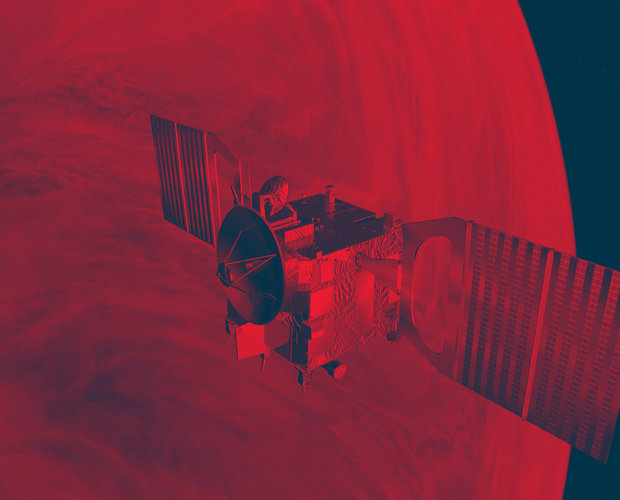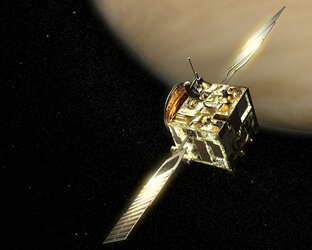
Europe scores new planetary success: Venus Express enters orbit around the Hothouse Planet

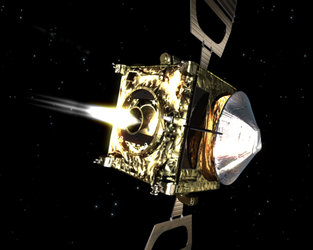
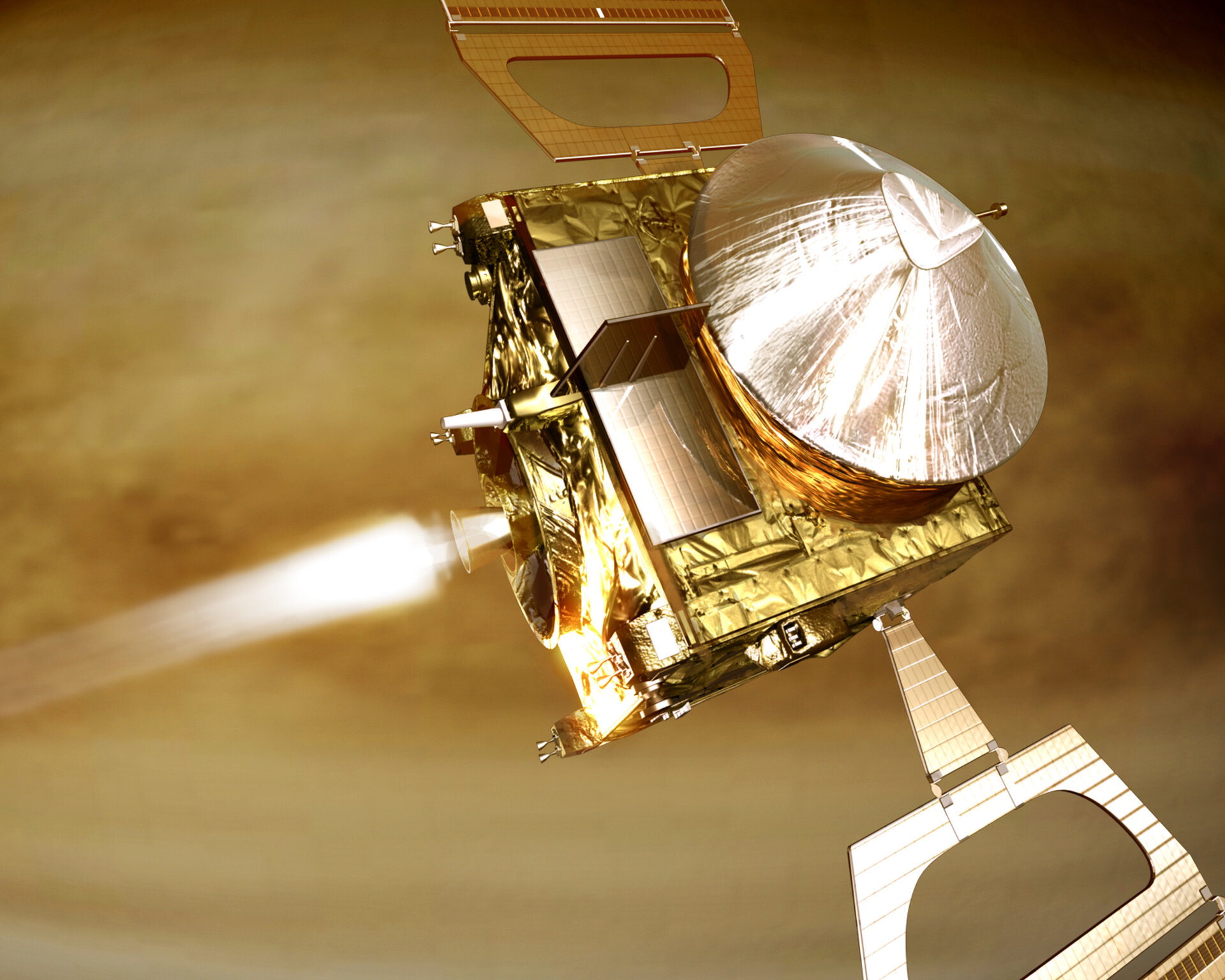
With this firing, the probe reduced its relative velocity toward the planet from 29,000 to about 25,000 km/h and was captured by its gravity field. This orbit insertion manoeuvre was a complete success.
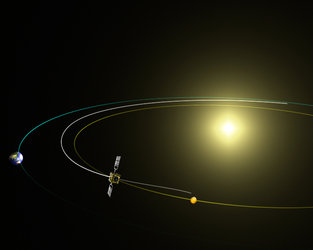
During the next four weeks, the Venus Express probe will perform a series of manoeuvres to reach the scheduled operational orbit for its scientific mission. It will move from its current highly elongated 9-day orbit to a 24-hour polar orbit, culminating at 66,000 kilometres. From this vantage point, the orbiter will conduct an in-depth observation of the structure, chemistry and dynamics of the atmosphere of Venus for at least two Venusian days (486 Earth days).
Enigmatic atmosphere
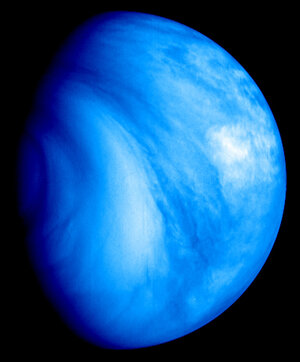
From previous missions to Venus as well as observations directly from Earth, we already know that our neighbouring planet is shrouded in a thick atmosphere where extremes of temperature and pressure conditions are common. This atmosphere creates a greenhouse effect of tremendous proportions as it spins around the planet in four days in an unexplained 'super-rotation' phenomenon.
The mission of Venus Express will be to carry out a detailed characterisation of this atmosphere, using state-of-the-art sensors in order to answer the questions and solve the mysteries left behind by the first wave of explorers. It will also be the first Venus orbiter to conduct optical observations of the surface through 'visibility windows' discovered in the infrared spectrum.
The commissioning of the onboard scientific instruments will begin shortly and the first raw data are expected within days. The overall science payload is planned to be fully operational within two months.
Europe explores the Solar System
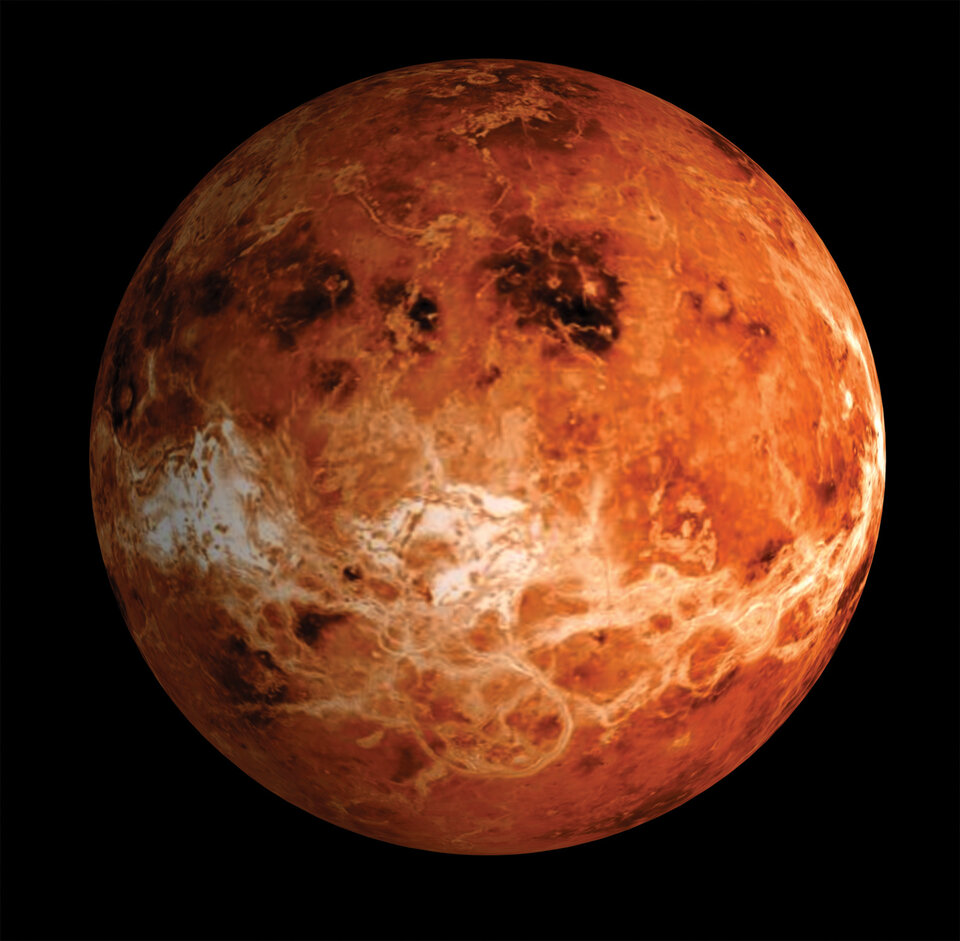
With this latest success, ESA is adding another celestial body to its range of Solar System studies. ESA also operates Mars Express around Mars, SMART-1 around the Moon and is NASA’s partner on the Cassini orbiter around Saturn. In addition, ESA is also operating the Rosetta probe en route to comet 67P/Churyumov-Gerasimenko. It should reach its target and become the first spacecraft ever to enter orbit around a comet nucleus by 2014. Meanwhile, ESA also plans to complete the survey of our celestial neighbours with the launch of the BepiColombo mission to Mercury in 2013.
“With the arrival of Venus Express, ESA is the only space agency to have science operations under way around four planets: Venus, the Moon, Mars and Saturn” underlines Professor David Southwood, the Director of ESA’s science programmes. “We are really proud to deliver such a capability to the international science community.”
“To better understand our own planet, we need to explore other worlds in particular those with an atmosphere,” said Jean-Jacques Dordain, ESA Director General. “We’ve been on Titan and we already are around Mars. By observing Venus and its complex atmospheric system, we will be able to better understand the mechanisms that steers the evolution of a large planetary atmosphere and the change of climates. In the end, it will help us to get better models of what is actually going on in our own atmosphere, for the benefit of all Earth citizens.”
State-of-the-art science package

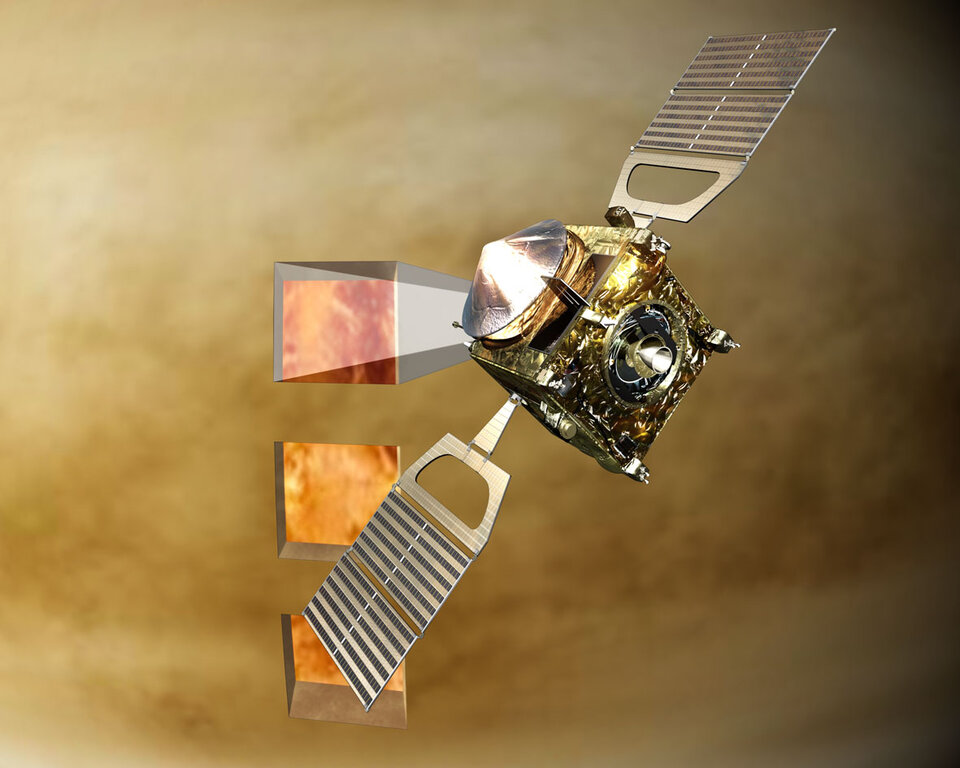
Venus Express was developed for ESA by a European industrial team led by EADS Astrium incorporating 25 main contractors from 14 European countries. Its design is derived from that of its highly successful predecessor, Mars Express, and its payload accommodates seven instruments including upgraded versions of three instruments developed for Mars Express and two for Rosetta.
The PFS spectrometer will determine the temperature and composition profile of the atmosphere at very high resolution. It will also monitor the surface temperature and search for hot spots from possible volcanic activity. The UV/infrared SpicaV/SOIR spectrometer and the VeRa radioscience experiment will probe the atmosphere by observing the occultation of distant starts or the fading of radio signals on the planetary limb. SpicaV/SOIR will be particularly looking for traces of water molecules, molecular oxygen and sulphur compounds, which are suspected to exist in the atmosphere of Venus. The Virtis spectrometer will map the different layers of the atmosphere and provide imagery of the cloud systems at multiple wavelengths to characterise the atmospheric dynamics.
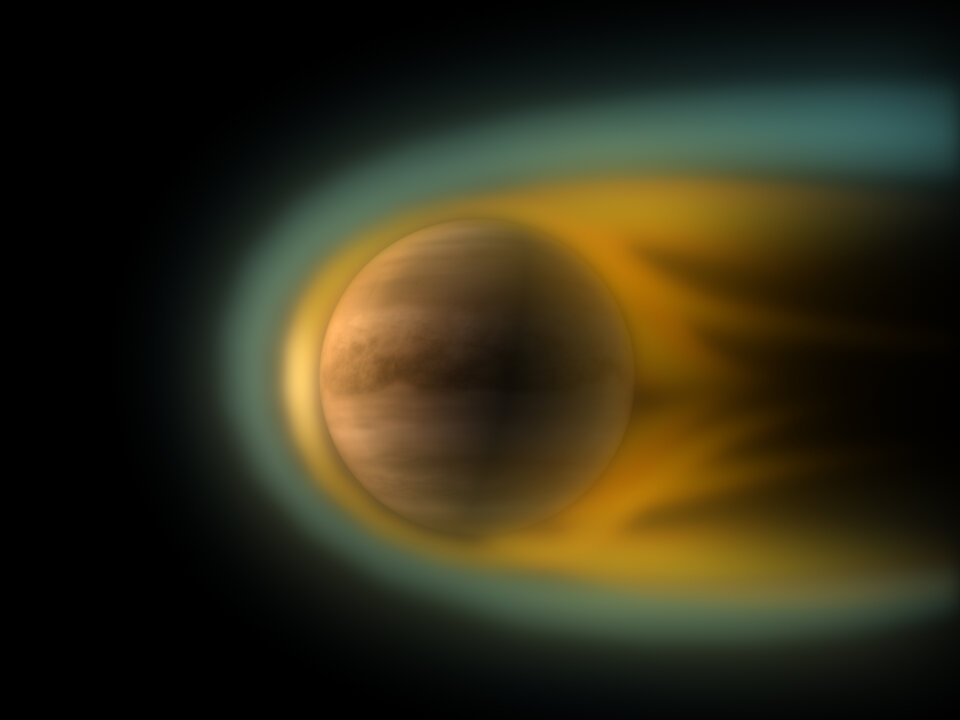
On the outer edge of the atmosphere, the Aspera instrument and a magnetometer will investigate the interaction with the solar wind and plasma it generates in an open environment without the protection of a magnetosphere like the one we have around Earth.
The VMC wide-angle multi-channel camera will provide imagery in four wavelengths, including one of the 'infrared windows' which will make imaging of the surface possible through the cloud layer. It will provide global images and will assist in the identification of phenomena detected by the other instruments.
For further information, please contact:
ESA Media Relations Division
Tel.: +33(0)1.53.69.7155
Fax: +33(0)1.53.69.7690