SMART-1 close-up on Zucchius crater's central peaks
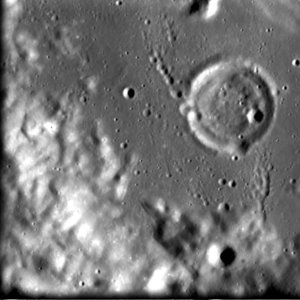
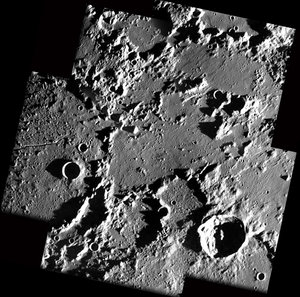
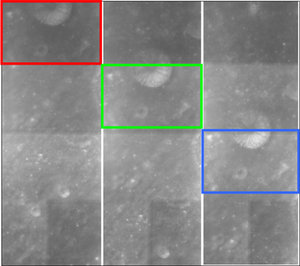
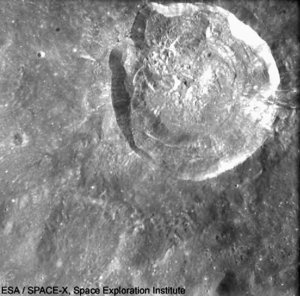
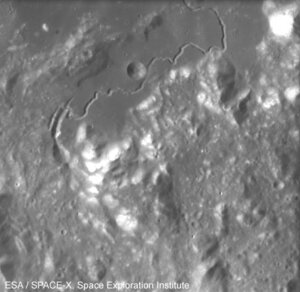
This image, taken by the advanced Moon Imaging Experiment (AMIE) on board ESA’s SMART-1 spacecraft, shows the central peaks of crater Zucchius.
AMIE obtained this image on 14 January 2006 from a distance of about 753 kilometres from the surface, with a ground resolution of 68 metres per pixel.
The imaged area is centred at a latitude of 61.3º South and longitude 50.8º West. Zucchius is a prominent lunar impact crater located near the southwest limb. It has 66 kilometres diameter, but only its inside is visible in this image, as the AMIE field of view is 35 kilometres from this close-up distance.
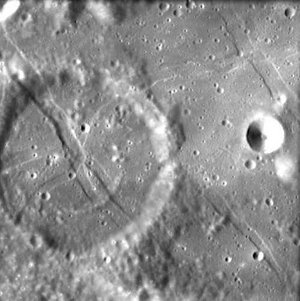
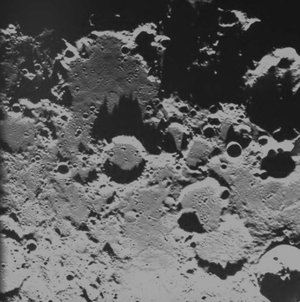
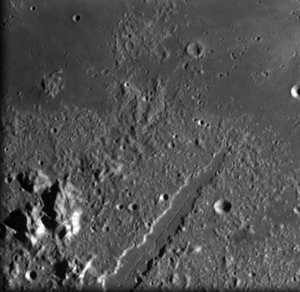
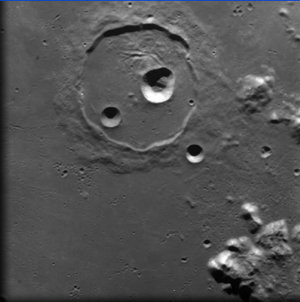
Because of its location, the crater appears oblong-shaped due to foreshortening. It lies just to the south-southwest of Segner crater, and northeast of the much larger Bailly walled-plain. To the southeast is the Bettinus crater, a formation only slightly larger than Zucchius.
Zucchius formed in the Copernican era, a period in the lunar planetary history that goes from 1.2 thousand million years ago to present times. Another example of craters from this period are Copernicus (about 800 milion years old) and Tycho (100 million years old). Craters from the Copernican era show characteristic ejecta ray patterns - as craters age, ejecta rays darken due to weathering by the flowing solar wind.
The hills near the centre of the image are the so-called ‘central peaks’ of the crater, features that form in large craters on the Moon. The crater is formed by the impact of a small asteroid onto the lunar surface. The surface is molten and, similarly to when a drop of water falls into a full cup of coffee, the hit surface bounces back, it solidifies and then 'freezes' into the central peak.
The name of Zucchius crater is due to the Italian Mathematician and astronomer Niccolo Zucchi (1586-1670).
For more information:
Jean-Luc Josset, AMIE Principal Investigator
SPACE-X Space Exploration Institute
Email: jean-luc.josset @ space-x.ch
Bernard H. Foing, ESA SMART-1 Project Scientist
Email: bernard.foing @ esa.int