Planck update in pictures
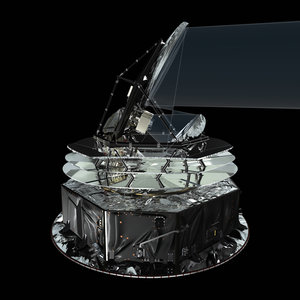
The Planck spacecraft has almost completed its final testing phase and is on its way to being launch-ready. The testing phase began in late March this year, and has taken the spacecraft all over Europe, making it go hot, cold and shaky to test its robustness.
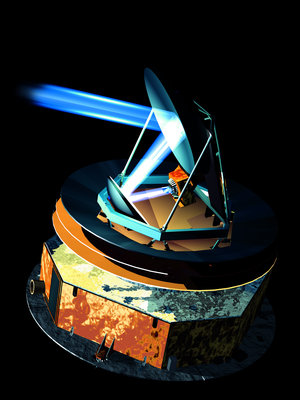
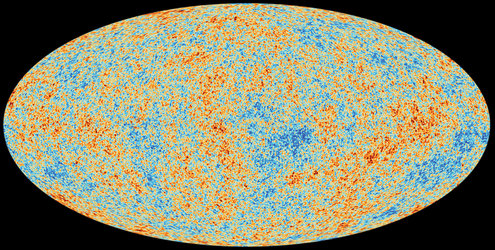
Planck, ESA’s flagship microwave observatory, is scheduled for launch next year. It will survey the Universe at microwave wavelengths, conducting the most precise study yet of the echo of the Big Bang.
At ESTEC

Planck arrived at ESA's European Space Research and Technology Centre (ESTEC) from the facilities of Thales-Alenia Space in Cannes on 28 March 2008 to begin the first of the series of tests. After arrival, the spacecraft was transferred to the Large Space Simulator (LSS) for fine-balance tests.
Fine-balance tests
A spin-stabilised spacecraft, Planck is designed to spin at the rate of 1 rotation/minute during observations.
Once inside the LSS, on Wednesday, 2 April, the spacecraft underwent fine-balance tests. These tests are carried out to check the inertial properties of the spacecraft, to ensure that the spacecraft spins around its nominal spin axis, with minimal disturbance. A dry run was held at first, followed by the actual test during which Planck was spun at 30 rotations per minute under light-vacuum conditions (1 millibar pressure).
At Centre Spatial Liège

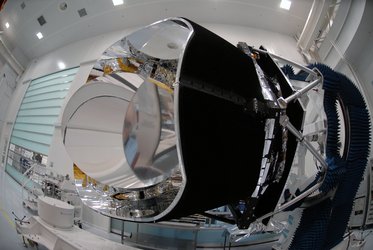
Having completed the fine-balance tests inside the Large Space Simulator, the spacecraft left ESTEC for Centre Spatial Liège (CSL), Belgium. The spacecraft arrived at CSL on 23 April 2008, for thermal and cryogenic spacecraft system tests.
Thermal balance/ thermal vacuum tests

Planck's thermal balance/thermal vacuum (TBTV) tests were carried out successfully at CSL. Prior to these tests, several others, including the system operational validation test, SOVT-1, were performed. The SOVT-1 demonstrated that telemetry was received correctly from the spacecraft, was distributed to the Instrument Data Processing Centres and interpreted correctly by the science teams. This test was managed by the Mission Operations Centre at ESA's European Space Operations Centre, ESOC, in Darmstadt, Germany.

The objective of the TBTV tests was to demonstrate that the spacecraft works nominally at its lower and upper operational temperature limits, and in the cold vacuum conditions that simulate those encountered in space.
The tests also verified that the sophisticated cryogenic cooling system of Planck achieves the correct temperatures (down to a tenth of a degree above absolute zero) and that the instruments demonstrated the required performance.
The spacecraft has been removed from the facility after completion of the test and is now undergoing a final set of functional tests.
Planck is planned to launch in early 2009 atop an Ariane-5 from the Guiana Space Centre in Kourou, French Guiana. It will be launched with ESA's Herschel spacecraft, in a dual launch configuration.