Rosetta delivers Phobos transit animation and 'sees' Mars in stereo
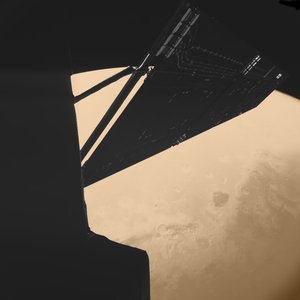
During Rosetta's recent Mars swingby, the OSIRIS cameras captured a series of images of Mars and of Phobos transiting Mars' disk. The OSIRIS team have produced a cool animated sequence and a 3D view of the Red Planet.
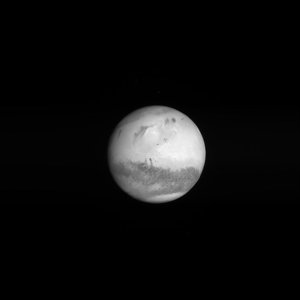
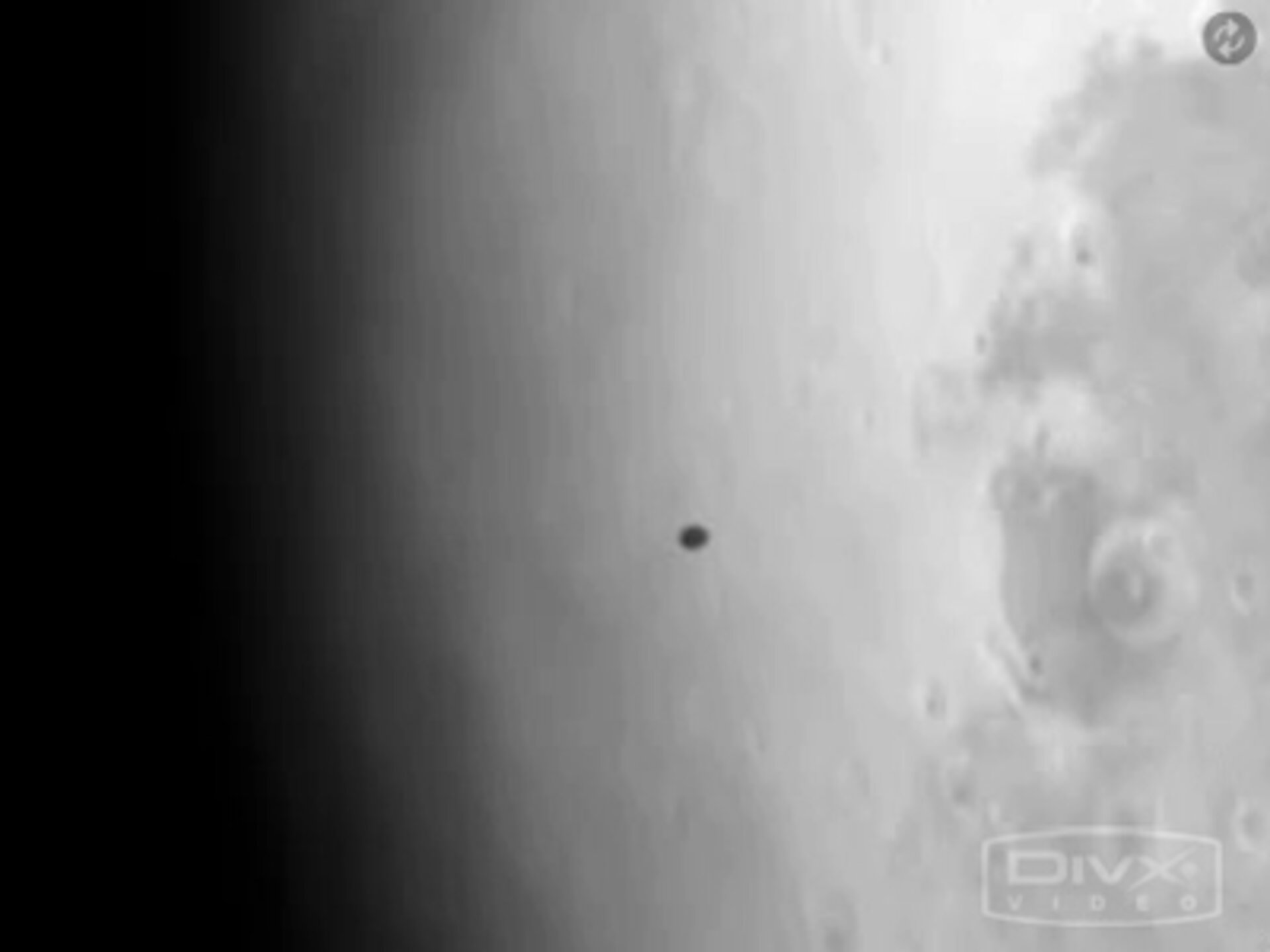
The animated sequences (one faster, one slower) show the shadow of Phobos transiting Mars' disk on 24 February; the images were captured around 22:08 CET, a few hours prior to Rosetta's successful Mars swingby on 25 February.

The movies were produced by combining a series of separate images taken by the Optical, Spectroscopic and Infrared Remote Imaging System (OSIRIS) on board Rosetta.
The background of Mars changes slightly from image to image since the individual images were acquired using different colour filters. Phobos appears dark because it reflects less sunlight than Mars.
Phobos is the inner moon of Mars; Phobos orbits closer to a major planet compared to any other moon in our solar system (less than 6000 km above the surface of Mars), and it is also one of the smallest known moons in the solar system.
Mars in 3D

Although Rosetta's direction relative to Mars was relatively constant during the approach phase, the surface view of Mars changed due to the rotation of the planet.
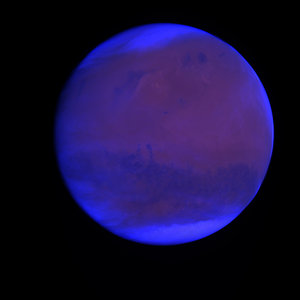
Thus, it was possible to produce a stereoscopic image, or anaglyph, by processing and combining images acquired by OSIRIS at different times.
The image was produced by combining several views of Mars taken from slightly different angles. In this case, the anaglyph was generated using images acquired 6 minutes apart.
To see the 3D effect, use a pair of left-eye red, right-eye blue colour glasses.

The 3D image clearly shows the spherical shape of Mars. However, due to the angle between the different views, Martian topography is not visible stereoscopically.
At closest approach at 03:15 CET on 25 February, Rosetta passed over the planet's surface at a relative speed of 36 191 km/hr. During the swingby, the gravitational energy of Mars helped Rosetta change direction, while the spacecraft was decelerated with respect to the Sun by an estimated 7887 km/hour.
During the swingby, the gravitational energy of Mars helped Rosetta change direction, while the spacecraft was decelerated with respect to the Sun by an estimated 7887 km/hour.
The spacecraft is now on the correct track towards Earth - its next destination planet whose gravitational energy Rosetta will exploit in November this year to gain acceleration and continue on its trek.
Contact for more information
Uwe Keller
OSIRIS Principal Investigator
Max-Planck-Institut für Aeronomie
Email: KELLER @ linmpi.mpg.de
Gerhard Schwehm
ESA Rosetta Mission Manager
Email: gerhard.schwehm @ esa.int