XMM-Newton probes formation of galaxy clusters
ESA’s X-ray observatory, XMM-Newton, has for the first time allowed scientists to study in detail the formation history of galaxy clusters, not only with single arbitrarily selected objects, but with a complete representative sample of clusters.
Knowing how these massive objects formed is a key to understanding the past and future of the Universe.
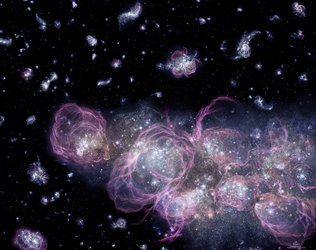
Scientists currently base their well-founded picture of cosmic evolution on a model of structure formation where small structures form first and these then make up larger astronomical objects.
Galaxy clusters are the largest and most recently formed objects in the known Universe, and they have many properties that make them great astrophysical ‘laboratories’. For example, they are important witnesses of the structure formation process and important ‘probes’ to test cosmological models.

To successfully test such cosmological models, we must have a good observational understanding of the dynamical structure of the individual galaxy clusters from representative cluster samples.
For example, we need to know how many clusters are well evolved. We also need to know which clusters have experienced a recent substantial gravitational accretion of mass, and which clusters are in a stage of collision and merging. In addition, a precise cluster mass measurement, performed with the same XMM-Newton data, is also a necessary prerequisite for quantitative cosmological studies.
The most easily visible part of galaxy clusters, i.e. the stars in all the galaxies, make up only a small fraction of the total of what makes up the cluster. Most of the observable matter of the cluster is composed of a hot gas (10-100 million degrees) trapped by the gravitational potential force of the cluster. This gas is completely invisible to human eyes, but because of its temperature, it is visible by its X-ray emission.
This is where XMM-Newton comes in. With its unprecedented photon-collecting power and capability of spatially resolved spectroscopy, XMM-Newton has enabled scientists to perform these studies so effectively that not only single objects, but also whole representative samples can be studied routinely.
XMM-Newton produces a combination of X-ray images (in different X-ray energy bands, which can be thought of as different X-ray ‘colours’), and makes spectroscopic measurements of different regions in the cluster.
While the image brightness gives information on the gas density in the cluster, the colours and spectra provide an indication of the cluster’s internal gas temperature. From the temperature and density distribution, the physically very important parameters of pressure and ‘entropy’ can be also derived. Entropy is a measure of the heating and cooling history of a physical system.
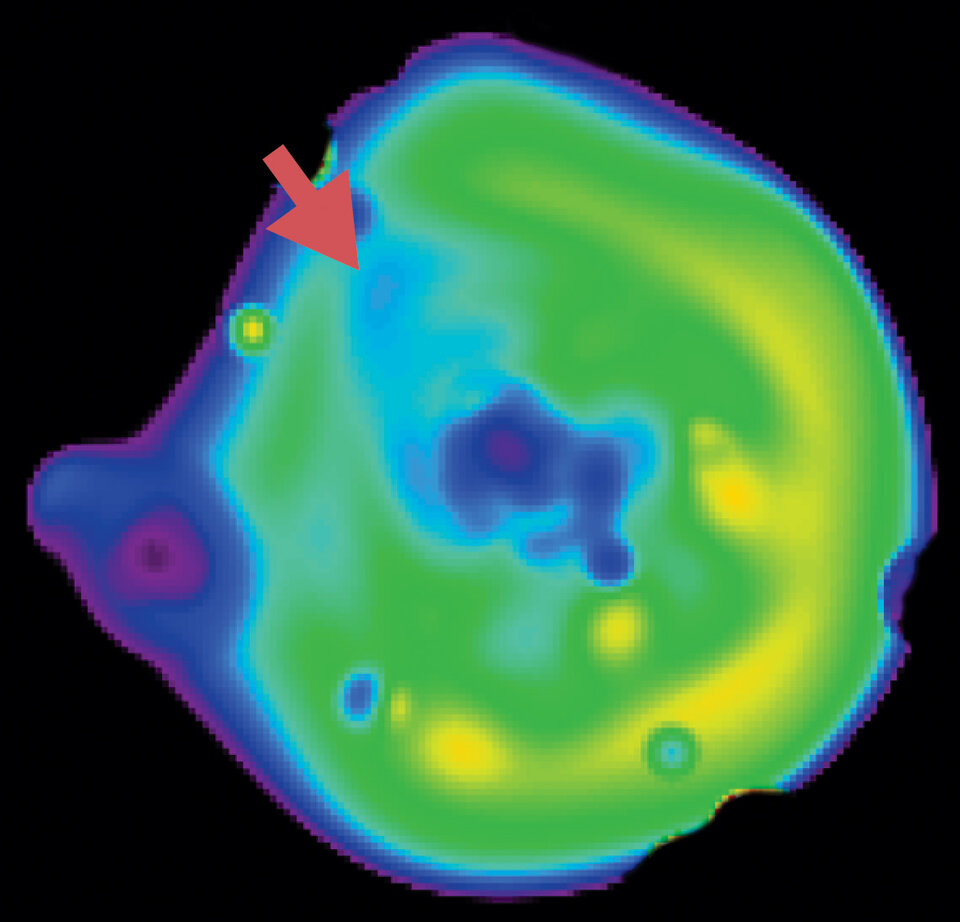
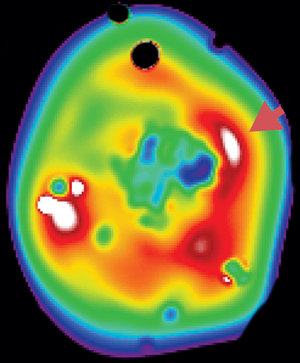
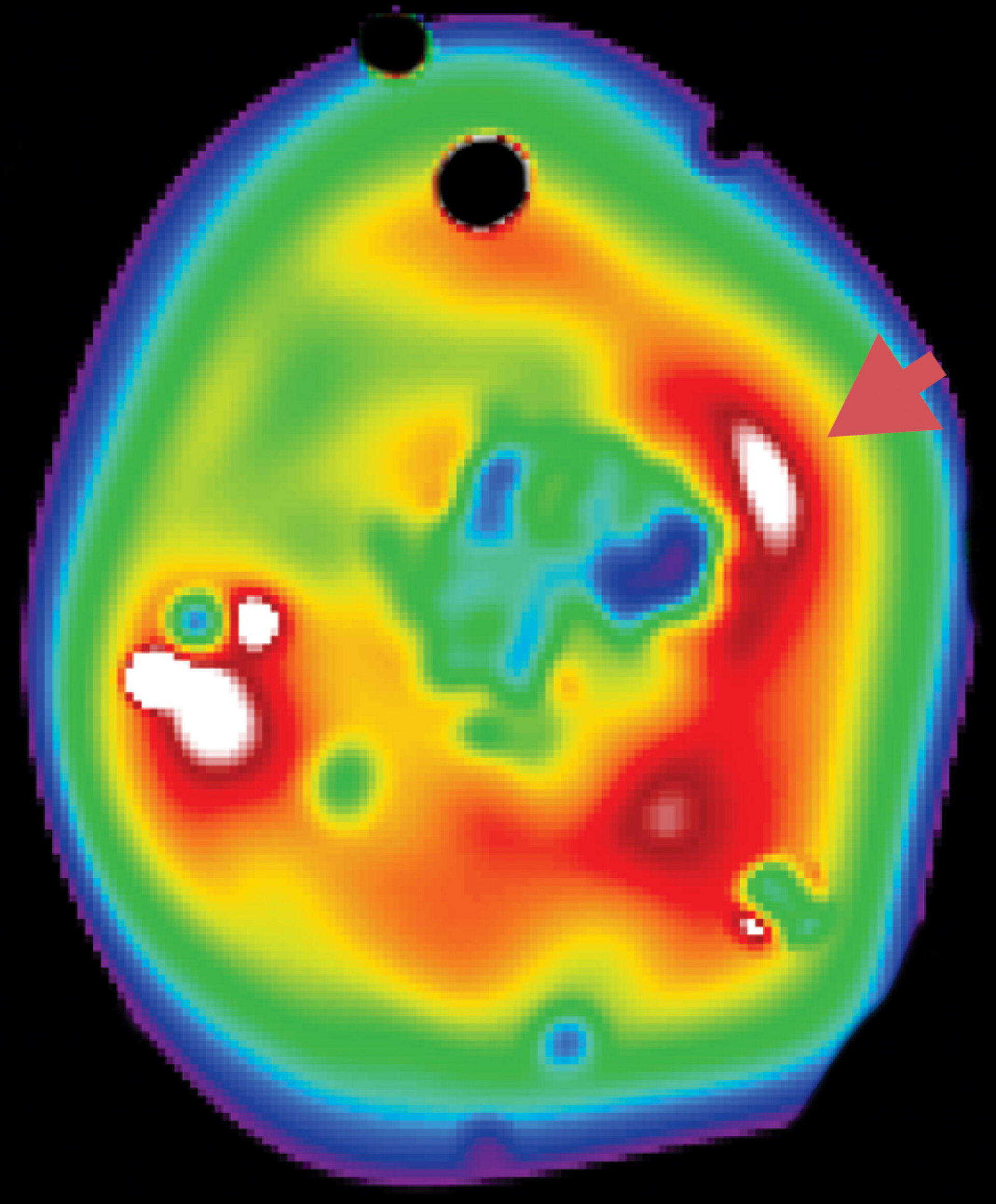
The accompanying three images illustrate the use of entropy distribution in the ‘X-ray luminous’ gas as a way of identifying various physical processes. Entropy has the unique property of decreasing with radiative cooling, increasing due to heating processes, but staying constant with compression or expansion under energy conservation.
The latter ensures that a ‘fossil record’ of any heating or cooling is kept even if the gas subsequently changes its pressure adiabatically (under energy conservation).
These examples are drawn from the REFLEX-DXL sample, a statistically complete sample of some of the most X-ray luminous clusters found in the ROSAT All-Sky Survey. ROSAT was an X-ray observatory developed in the 1990s in co-operation between Germany, USA and UK.
The images provide views of the entropy distribution coded in colour where the values increase from blue, green, yellow to red and white.
For more information:
Norbert Schartel, ESA XMM-Newton Project Scientist
E-mail: norbert.schartel @ sciops.esa.int
Prof. Hans Boehringer, Dr Alexis Finoguenov and Yu-Ying Zhang
Max Planck Institute for Extraterrestrial Physics
E-mail: hxb @ mpe.mpg.de
The findings will appear in Journal of Astronomy and Astrophysics (in press), and a preprint can be obtained from http://xxx.uni-augsburg.de/archive/astro-ph with the number astro-ph/0507452.