News

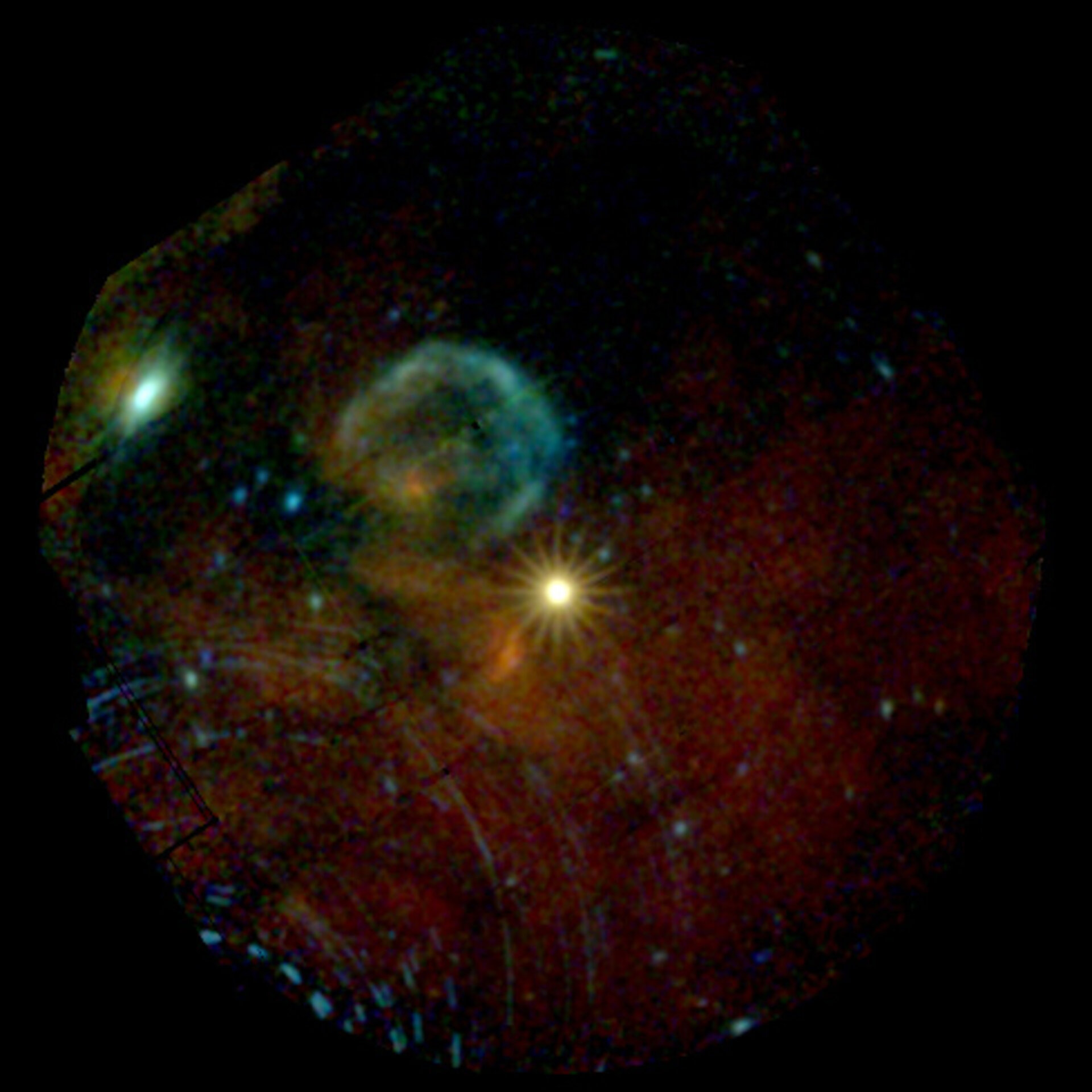
XMM-Newton’s anniversary view of supernova SN 1987A


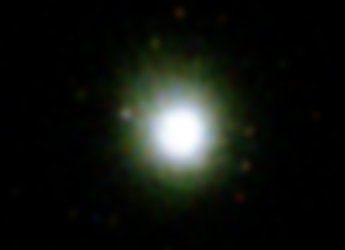
XMM-Newton view of supernova SN 1987A
 
XMM-Newton view of supernova SN 1987A
 
 
23 February 2007
 
Twenty years after the first detection of SN 1987A, the nearest supernova ever detected since the invention of the telescope, XMM-Newton provided a fresh-new view of this object. The source keeps brightening - XMM-Newton confirms.
 
The supernova SN 1987A in the Large Magellanic Cloud is the nearest supernova detected since the invention of the telescope. Almost 20 years after its discovery on 23 February 1987, XMM-Newton observed the stellar remnant in X-rays on 17 January 2007. Continuously brightening since the first detection in X-rays by ROSAT in 1992, it now outshines all other X-ray sources in its immediate neighbourhood and it is more than ten times brighter as compared to the first-light observations of XMM-Newton in January 2000.
 
 
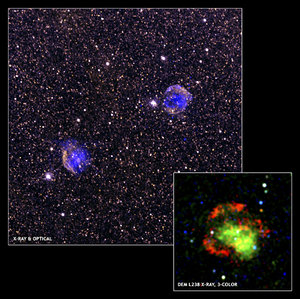
30 Doradus in LMC
   
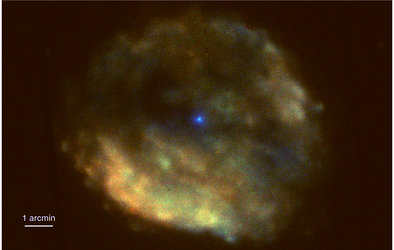
Earlier XMM-Newton view of supernova SN 1987A
 
SN 1987A provides the unique opportunity for detailed studies of the earliest stages of a supernova remnant.

Observations across the whole electromagnetic spectrum revealed a detailed picture of the circumstellar medium produced by the stellar wind from the massive pregenitor star during its 'supergiant' phases.

The X-rays we see mainly originate from the interaction of the supernova shock with this circumstellar medium. Their detailed analysis will gain further insights into the physics of the explosion and may reveal eventually the presence of a central compact object like a neutron star.
 
 
For more information
 
Frank Haberl , XMM-Newton's EPIC Principal Investigator
Email: fwh @ mpe.mpg.de

Norbert Schartel, ESA XMM-Newton Project Scientist
Email: norbert.schartel @ sciops.esa.int



More about...

 •  XMM-Newton overview (http://www.esa.int/esaSC/120385_index_0_m.html)

Related articles

 •  XMM-Newton reveals a magnetic surprise (http://www.esa.int/esaSC/SEM01WBE8YE_index_0.html)
 •  First X-ray detection of a colliding-wind binary beyond the Milky Way (http://www.esa.int/esaSC/SEMPYIO2UXE_index_0.html)
 •  Universe contains more calcium than expected (http://www.esa.int/esaSC/SEMMMC4ENXE_index_0.html)
 •  X-ray evidence supports possible new class of supernova (http://www.esa.int/esaSC/SEM26FSVYVE_index_0.html)
 •  Black hole boldly goes where no black hole has gone before (http://www.esa.int/esaSC/SEML0QZTIVE_index_0.html)
 •  Supernova leaves behind mysterious object (http://www.esa.int/esaSC/SEM30QVT0PE_index_0.html)
 •  XMM-Newton spots the greatest of great balls of fire (http://www.esa.int/esaSC/SEMWD1AATME_index_0.html)
 •  XMM-Newton reveals the origin of elements in galaxy clusters (http://www.esa.int/esaSC/SEM94Q8ATME_index_0.html)
 •  XMM-Newton 'spare-time' provides impressive sky survey (http://www.esa.int/esaSC/SEMA7OOFGLE_index_0.html)
 •  XMM-Newton digs into the secrets of fossil galaxy clusters (http://www.esa.int/esaSC/SEMCFFOFGLE_index_0.html)
 •  XMM-Newton reveals a tumbling neutron star (http://www.esa.int/esaSC/SEMSIWNFGLE_index_0.html)
 •  Cannibal stars like their food hot, XMM-Newton reveals (http://www.esa.int/esaSC/SEM7T6OVGJE_index_0.html)
 •  ‘Deep impact’ of pulsar around companion star (http://www.esa.int/esaSC/SEMK6HMVGJE_index_0.html)

Related links

 •  Hubble - supernova's 20th anniversary (http://www.spacetelescope.org/news/html/heic0704.html)