Ensuring autonomous access to space for Europe
In brief
- At the European Space Agency’s (ESA) Ministerial Council that concluded earlier today, vital decisions were taken to implement the European space transportation strategy and help realise the industrial potential in this sector.
- The Agency’s Member States committed over €4.4 billion to programmes proposed by ESA’s Directorate of Space Transportation.
- The European Space Agency received funding covering three space transportation pillars:
- Securing access to space upgrading and launching more Ariane 6 and Vega rockets.
- Securing future space transportation through the European Launcher Challenge, the Future Launchers Preparatory Programme and Space Rider.
- Maintaining and enhancing ground infrastructure and test facilities to support launches.
In-depth
Over the course of two days ministers from the European Space Agency’s (ESA) Member States, Associate States and Cooperating States came together to ensure space activities continue to serve European citizens and contribute to elevate the future of Europe. At ESA’s Ministerial Council (CM25) that concluded today, vital decisions were taken to implement the Agency’s Strategy 2040 and help realise the potential of Europe’s space transportation industry with funding amounting to over €4.4 billion, fully implementing the decisions of principle taken by the ESA Council in November 2023 in Seville, Spain.
“Europe’s independent access to space has been secured by ESA for the last 50 years, it has never been as crucial as it is today” comments ESA’s Director of Space Transportation Toni-Tolker Nielsen, “ESA Member States have defined clear directions and taken the decisions required for ESA to execute them: secure our autonomous and resilient access to space for Europe while we prepare the next generation of space transportation services together with European industry.”
Securing access to space

Europe now has two rockets it relies on for access to space: the heavy-lift Ariane 6, and Vega-C for lighter payloads. Autonomous access to space for Europe is a cornerstone of ESA’s Strategy 2040 building on our reliable and competitive launch systems, operated from Europe’s spaceport in French Guiana. Upgrades are being worked on for both Ariane 6 and Vega to reduce costs, to make the launch systems more robust and launch more often, increasing global competitiveness. This provides institutional missions with dependable European launchers that function as critical enablers, upholding Europe’s autonomy and ensuring assured launch capability. Both Vega-C and Ariane 6 will benefit from the more powerful P160C rocket motor that will replace the current P120C.
Securing the future of space transportation

Europe’s space transportation is innovating and preparing the next generation of European launch systems and services.
Member States at CM25 confirmed major investments in the European Launcher Challenge. Five European launch service providers pre-selected by ESA ahead of CM25 will receive ESA support for their respective ramp-up phases so as to accelerate the service deployment to European institutional users. In addition they will receive co-funding for upgrading their launch capacity.
With the Future Launchers Preparatory Programme, ESA will be developing and demonstrating technologies that will define the next generation of space transportation: reusability, advanced propulsion, in-space manufacturing, refuelling in space and other logistical elements supporting a future orbital infrastructure with transportation hubs and propellant depots.

Space Rider is Europe’s operational capability to return from space. An uncrewed robotic laboratory roughly the size of two minivans, it will be launched on Vega-C and stay in low orbit for about two months, performing a variety of experiments before returning to Earth.
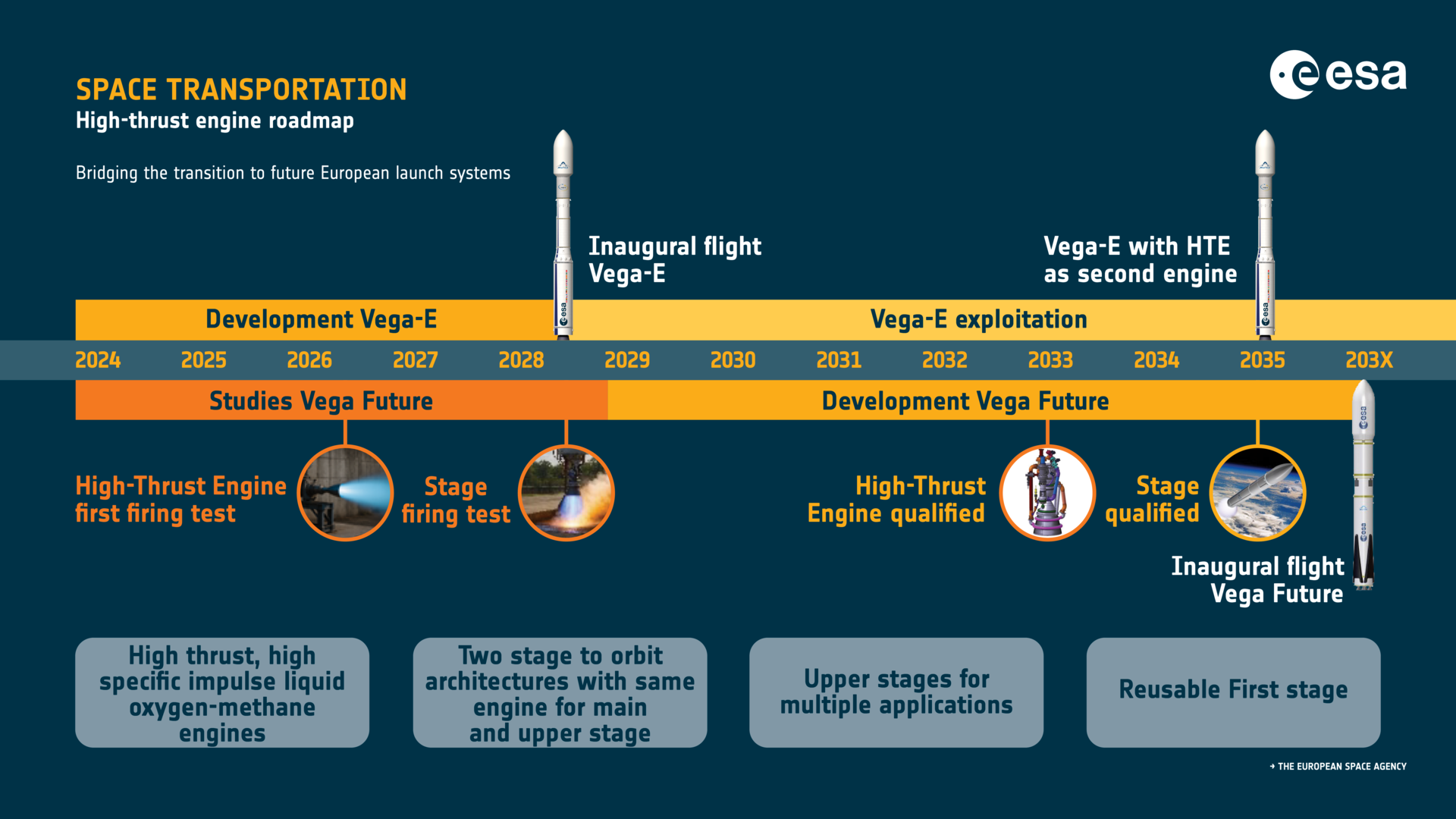
Development of a new High Thrust Engine will proceed, aiming to develop a 60-tonne class cryogenic rocket engine, based on oxygen-methane propulsion, to be used with future European launchers.
Maintaining and enhancing ground infrastructure
Our work ensures that Europe’s ground infrastructure can launch more and support future missions. This infrastructure is as strategic as the rockets themselves and will be upgraded and maintained over the next years and includes elements outside of the launch zone such as test facilities, and support facilities.

Europe’s Spaceport in French Guiana remains central to guaranteeing European access to space. To maintain and strengthen this position, maintenance and upgrades this decade will reinforce versatility, cyber-security, sustainability, and resilience of the Spaceport. These include upgrades to service facilities for launch campaigns and returns to Earth such as payload processing facilities, telemetry stations, control centres, weather stations, fire stations, as well as infrastructure and logistics.
By investing in both launch systems and the ground infrastructure that supports them, Europe ensures a reliable, competitive, and autonomous space transportation capability for the future.

In addition, during a side event of CM25 a cooperation agreement was signed between the Portuguese Space Agency and the European Space Agency for the development of a space hub on the Santa Maria island of the Azores, Portugal, including the construction of facilities for a Space Rider landing site.
Secure, autonomous, more
Through the decisions and funding at the occasion of this ESA Council of Ministers in supporting the three pillars, Europe secures autonomous access to space, nurtures future European space transportation services and will modernise critical infrastructure to position Europe as a key player in space transportation. Member States have underscored their commitment to Europe’s independent access to space as they forge the next chapter of European space transportation.