


Cutting-edge infrared space telescope Roman set to launch
The NASA-led Nancy Grace Roman Space Telescope is set to launch on 30 August 2026 at 07:26 EDT / 12:26 BST / 13:26 CEST from NASA’s Kennedy Space Center in Florida, USA.
With its wide field of view and advanced optical design, the Roman telescope will conduct detailed scans of the sky in visible to near-infrared light. In doing so, Roman will help reveal the nature of dark energy and dark matter and find new exoplanets.
“ESA is contributing essential hardware to Roman, including the spacecraft's star trackers, batteries, detectors for the coronagraph instrument, and communications support through its deep-space ground station network,” says Bethan James, ESA’s Roman Project Scientist. “Through the Mission of Opportunity programme, Europe contributes scientific expertise, helping guide and maximise the mission's scientific return.”
ESA will also enable data download from Roman using the new 35-metre antenna in New Norcia, Australia.

Looking back at the early Universe
Roman will conduct fast, detailed scans of the sky in infrared light. This will reveal a lot about the early Universe and how it expanded over time.
“It will combine Hubble-quality imaging with a field of view more than 200 times larger, allowing it to study billions of stars, millions of galaxies, thousands of exoplanets, and vast regions of previously unexplored space,” explains Bethan. “This will enable astronomers to address some of the biggest open questions in astrophysics, from the nature of dark energy to the abundance of planets throughout our Milky Way galaxy.”
Dark matter and dark energy

About 25% of the Universe appears to be made up of invisible dark matter. The presence of dark matter can only be ‘seen’ by how it affects the apparent shape of galaxies. Light from a distant galaxy is bent and distorted due to the presence of clumps of dark matter, making the galaxy look slightly warped. This effect is called weak gravitational lensing.
One of Roman’s main tasks will be to scan about 12% of the sky high above our galactic plane to look for the lensing effect in millions of distant galaxies. By studying tiny changes in the shapes of galaxies, Roman will help astronomers accurately map the distribution of ordinary and dark matter across the history of the Universe and trace how galaxies evolved.
Roman will investigate how the Universe has expanded over time. The expansion appears to be speeding up, and dark energy seems to be the culprit. Scientists think that dark energy makes up about 70% of the Universe and yet its nature remains a mystery. Like ESA's Euclid, Roman will use multiple methods to help us understand what dark energy is and how it has evolved over time.
In one method, Roman will look for exploding stars known as supernovas, in distant galaxies, especially type Ia supernovas. Because these explosions peak at a predictable brightness, astronomers can use them to measure cosmic distances, which in turn provide insights into how fast the Universe is expanding.
In another method, Roman will map how galaxies cluster together in time and space to test the effect of dark energy on them. Roman will study baryonic acoustic oscillations – imprints of sound waves that once rippled through the very early Universe.

As the Universe cooled, these ripples froze in place. Over time clusters of galaxies formed along the frozen ripples. Eventually, as the Universe expanded, the ripples stretched, and the distance between the surrounding galaxies increased. By looking at how galaxies are distributed across cosmic distances, astronomers can study how the Universe expanded over time. This will further shine a light on the nature of dark energy.
Exoplanets
Another task of Roman will be to look for exoplanets including planetary systems like our own. Using its deep and wide field of view, Roman will peer into the heart of our own galaxy. By doing so, it will track the amount of light coming from millions of stars and study how the intensity of light changes over time.
Roman will keep an eye on microlensing events that may reveal over 1200 new worlds. At the same time, the telescope is expected to reveal more than 100 000 transiting planets that dim the light of their host stars when the planets cross in front of them. Roman’s advanced coronagraph instrument will allow astronomers to directly image some of the exoplanets in detail by blocking the host stars’ light, even when the planet is over 100 million times fainter than its host star.
Extreme cosmic objects
Roman is so sensitive that it will also detect extreme events, such as the birth of black holes when neutron stars merge, and tidal disruption events. The mission will also observe active galaxies hosting extremely bright quasars at their centres and several faint faraway quasars from the period of reionisation.
Wide-eyed telescope in space
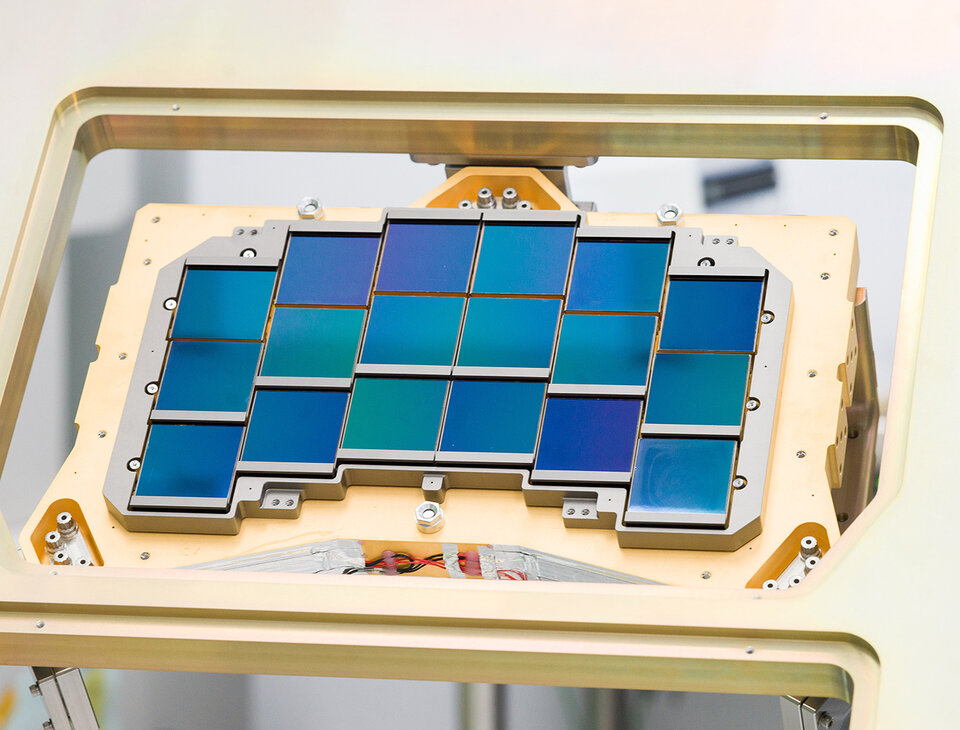
The Roman Telescope is equipped with a primary mirror of 2.4 m in diameter. The telescope has two main instruments: the Wide Field Instrument (WFI) and a Coronagraph Instrument. The WFI is a 300-megapixel multi-band visible and near-infrared camera capable of obtaining extremely crisp images and very sensitive spectroscopic data.
The Coronagraph Instrument is a high-performance technology demonstrator that blocks out starlight to look for faint planets around them. The instrument could be capable of directly imaging reflected starlight from Jupiter-sized exoplanets in Jupiter-like orbits around their host stars.
“Whenever astronomy opens a new window on the Universe, history has shown that some of the most important discoveries are the ones we never anticipated,” remarks Bethan. “With its unprecedented combination of depth, area and image quality, Roman has every opportunity to surprise us.”

Follow the launch live here
Roman is scheduled to launch on a SpaceX Falcon Heavy rocket from NASA’s Kennedy Space Center in Florida, USA on 30 August 2026 at 07:26 EDT /12:26 BST / 13:26 CEST. Watch the launch live via NASA’s YouTube channel. Follow NASA for updates.
For more information, please contact:
ESA Media Relations
Email: media@esa.int