ESA’s Hera targets early arrival at Didymos asteroids
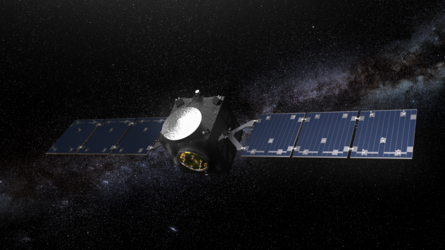
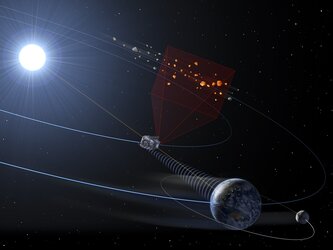
Launched one year ago, on 7 October 2024, the European Space Agency’s Hera mission is roughly halfway to its destination – the Didymos binary asteroid system.
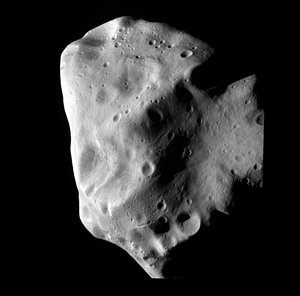
At Didymos, Hera will study the aftermath of NASA’s Double Asteroid Redirection Test (DART) mission, which struck the asteroid’s small moon Dimorphos in 2022, and help humankind learn how to reliably change the trajectory of an asteroid.
Thanks to the spacecraft’s good performance, and some clever planning by teams on Earth, Hera is on track to arrive at Didymos in November 2026 – a month earlier than originally planned.
Hera’s busy first year in space
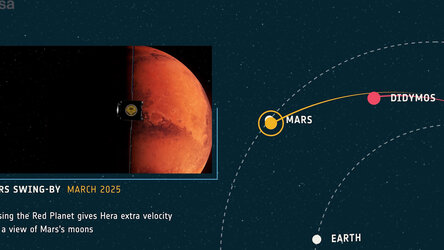
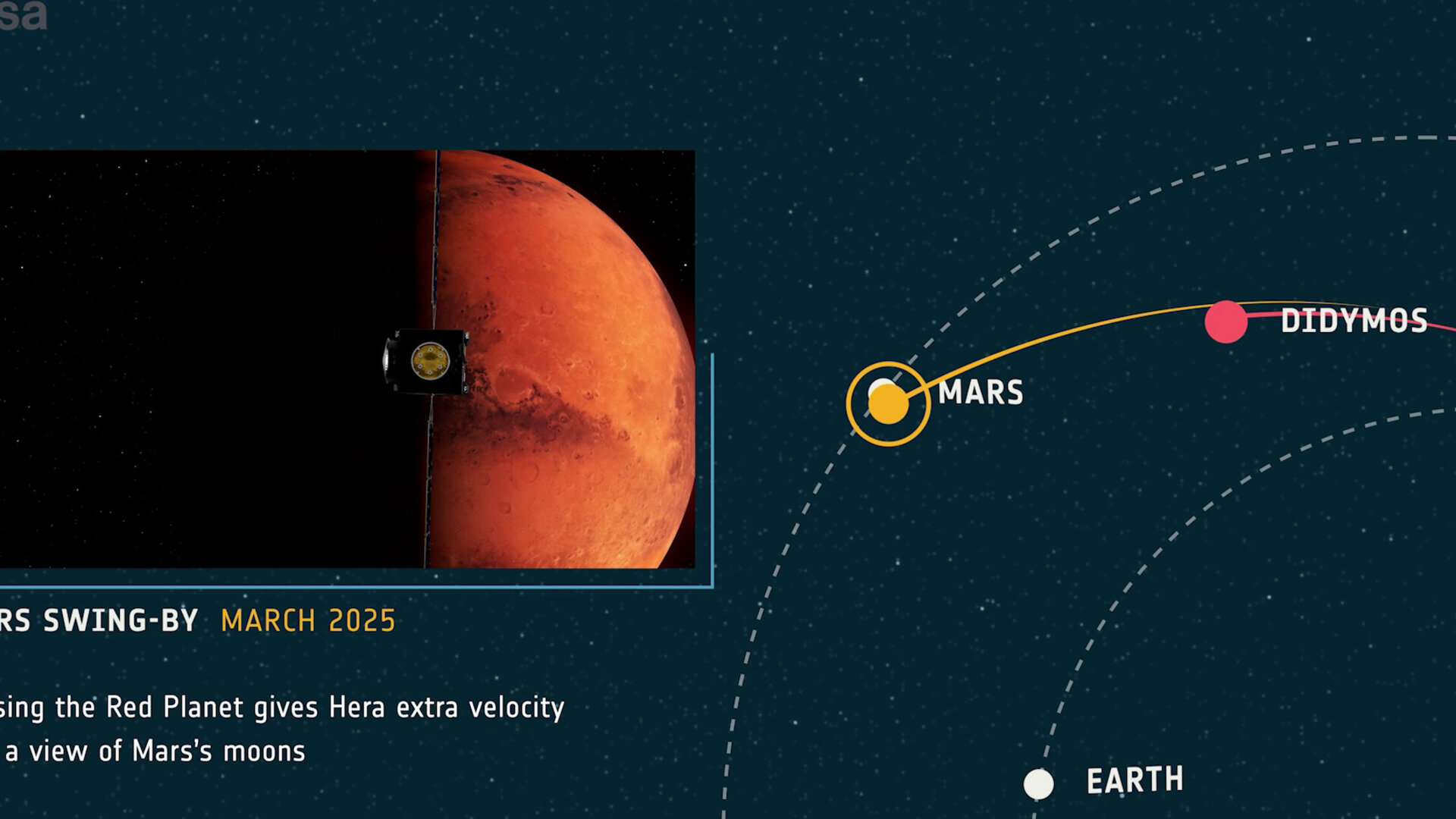
Following a successful launch, Hera’s first major engine burn sent the spacecraft racing towards Mars. A successful Mars flyby in March 2025 curved the spacecraft’s trajectory towards Didymos and gave the team a unique chance to test Hera’s instruments on a planetary body at close range.
Shortly after the Mars flyby, the team began imaging faint asteroids to prepare the spacecraft’s main camera for its first glimpse of Didymos next year.
“Hera is the first interplanetary mission for some of the younger members of the team, and I have been impressed by their ability to prioritise, overcome challenges, and be creative given the mission’s very busy schedule,” said Lisa Savarieau, Hera Spacecraft Operations Engineer at ESA’s European Space Operations Centre (ESOC) in Germany.
“We are also benefiting greatly from the support of ESOC veterans with decades of experience flying missions to challenging destinations across the Solar System, such as Rosetta.”


Access the video
“Hera is proving to be a flexible and dynamic spacecraft,” said Sylvain Lodiot, Head of Outer Solar System and Planetary Defence Missions Operations at ESA.
“The reliability of the propulsion system, in particular, has enabled the team to design a new more aggressive manoeuvre plan that involves ‘braking’ later and harder during the approach to Didymos. This will allow Hera to arrive at the asteroids a month earlier than we had initially planned.”
‘Self-driving’ technology tested on Earth and in space
When NASA’s DART spacecraft impacted the asteroid Dimorphos in 2022, it altered its orbit around the larger asteroid Didymos and scattered debris into the surrounding environment.
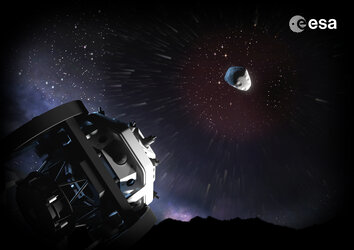
One of Hera’s most important innovations is its autonomous ‘self-driving’ navigation system, which it will need to safely navigate this uncertain environment while too far from Earth to receive real-time commands.
The new navigation system will combine data from Hera’s various sensors to keep the asteroid within the camera’s field of view – a particularly demanding task given that this small celestial body remains largely unexplored.

Access the video
ESA and the industrial teams at OHB in Germany and GMV in Spain have tested the technology in space, during Hera’s departure from Earth and flyby of Mars, and on the ground, during the most complex navigation test ever performed for an ESA spacecraft at the Hera avionics bench at OHB in Bremen.
European CubeSat control centre takes shape
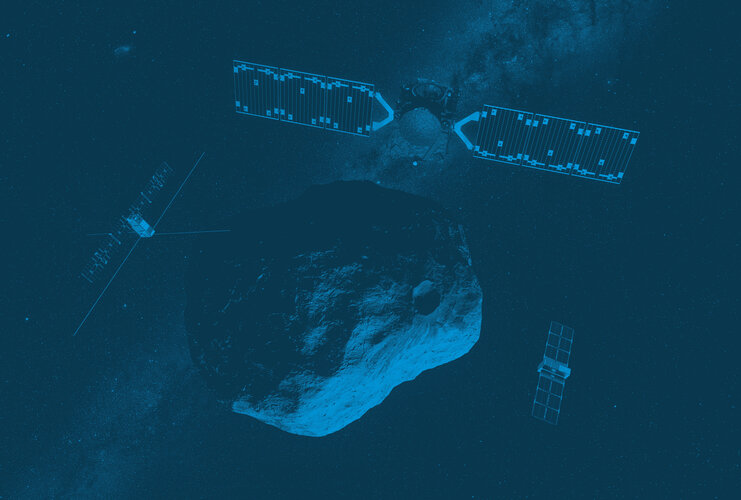
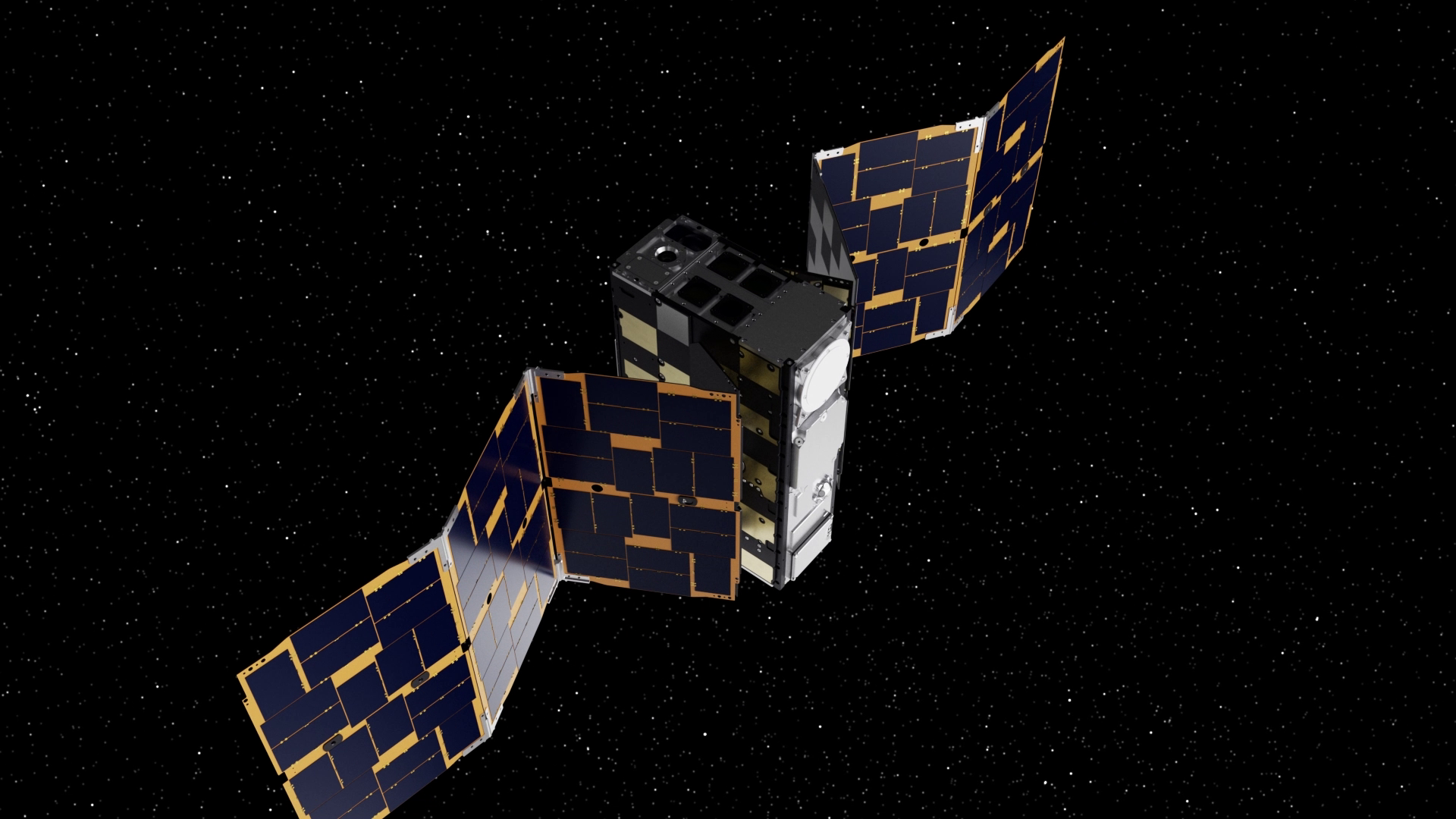
Hera isn’t travelling to the Didymos and Dimorphos asteroids alone. Two suitcase-sized CubeSats, Milani and Juventas, are hitching a ride and will be deployed to perform their own close-up investigations. During the cruise, the Hera control team regularly wakes up the CubeSats and to check their health and test the Inter Satellite Link that will be used to relay their data and commands to and from Earth via the main Hera spacecraft.
Access the video
On the ground, Spacebel is overseeing the development of a dedicated control centre for Hera’s CubeSats at ESA’s European Space Security and Education Centre in Belgium.
The facility will link together the Hera control team at ESOC in Germany, with the CubeSat operators – Tyvak in Italy will fly Milani, while GomSpace in Luxembourg will fly Juventas – and the French space agency, CNES, in Toulouse, who will support the CubeSats’ mission planning.
Operating the tiny CubeSats near the asteroids will be very challenging. Due to the extremely weak gravity, even solar radiation pressure – the push of sunlight – will be enough to significantly impact their trajectory. The Hera mission will be the first to attempt to keep three independently operated spacecraft safely coordinated in this kind of environment.
The risk of collision between spacecraft or with one of the asteroids is real, but together, the teams have carefully designed manoeuvre plans to keep them safe.
Next steps for Hera
Hera is currently out of contact with Earth, hidden behind the Sun until approximately 24 October. In late November, the spacecraft will reach its farthest point from the Sun: engineers will need to carefully balance warming Hera’s internal systems against the reduction in available solar power.
Current activities include in-flight communication tests between Hera and the deep-space antennas of the Japanese Aerospace Exploration Agency (JAXA). JAXA is an important partner on the Hera mission, and the tests would enable the Japanese antennas to support the flow of commands and data to and from Hera, if necessary.
The next major milestone will come in February 2026, when Hera will perform a second deep-space manoeuvre to line it up for rendezvous with Didymos in November.
“Hera’s first year in space has been incredibly successful and action packed,” says Hera mission manager Ian Carnelli. “The spacecraft is in excellent health, the teams on Earth are putting in great effort to prepare for arrival at Didymos, and we are looking forward to the day that Hera begins the next phase of humankind’s shared mission to learn how to reliably protect our planet from dangerous asteroids.”
Access the video