Space Safety at ESA
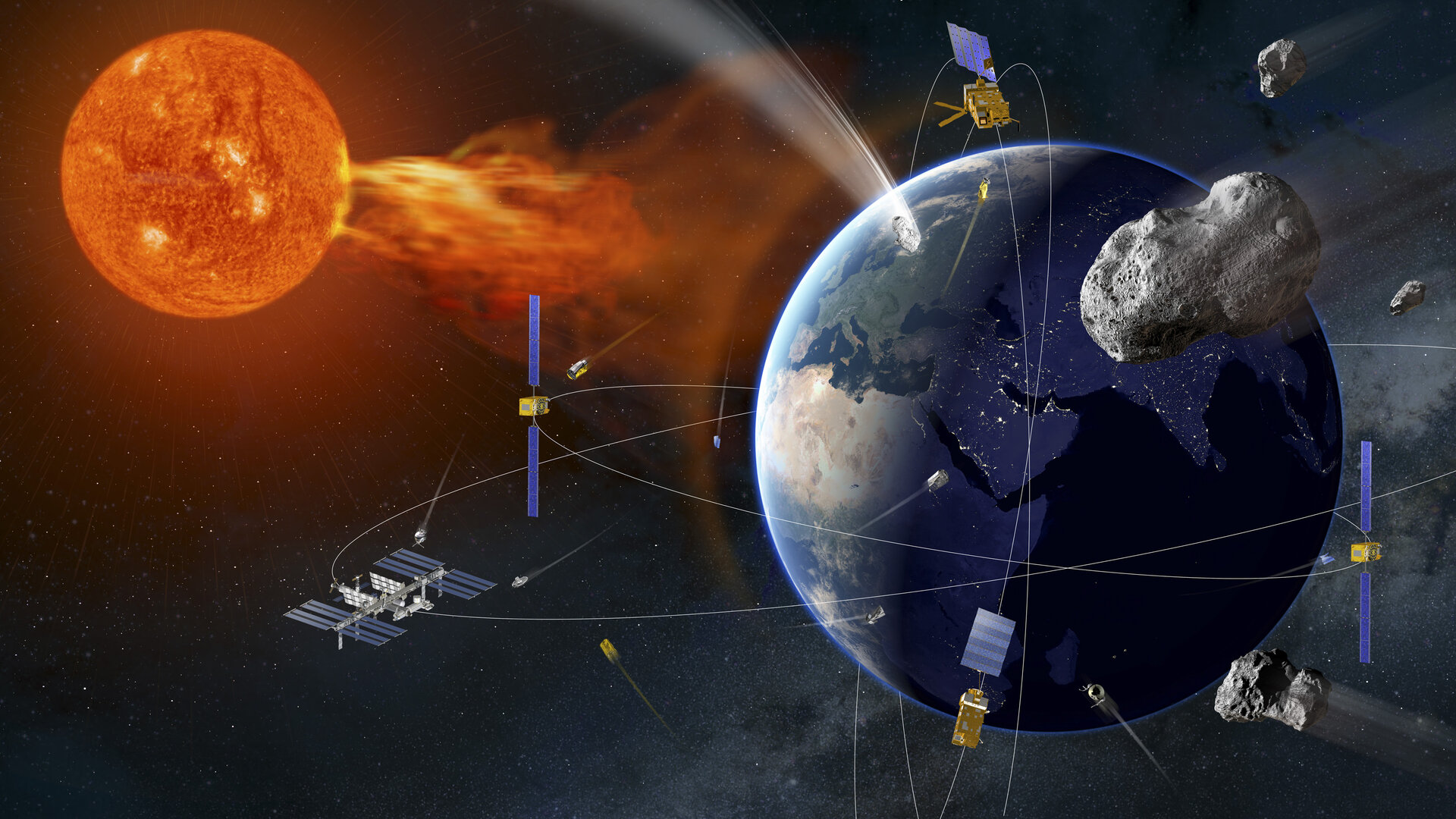
ESA’s Space Safety programme is dedicated to protecting our planet and its people from natural threats from space as well as humanmade ones. Beyond keeping us on Earth and astronauts in space safe, there is critical infrastructure both on the ground and in space at risk of sudden disaster, potentially derailing everyday life.
The Agency aims to keep European citizens safe while stimulating the sustainable use of space and supporting the European space industry to pioneer new technologies. The ambitious plans of the Space Safety programme include daring, first-ever missions in space as well as a kaleidoscope of activities on the ground to respond to these hazards through mitigation, prevention and protection measures.
Explore all ESA Space Safety Programme activities for CM25.
Defending our planet against asteroids
Through ESA’s planetary defence efforts, Europe is a fundamental contributor to a global planetary defence system that is capable of providing early warning of dangerous near-Earth objects (NEOs) larger in size, about three weeks in advance, and able to deflect asteroids smaller than 1 km if known more than two years in advance.
Observation capabilities
The most effective way to find and observe asteroids is by having dedicated telescopes continuously watching the night skies for faint glimmers that betray their presence. Until 2030, ESA is building a new network of Flyeye telescopes that will scan the skies for rogue rocks, automatically flagging any that could pose an impact risk and bringing them to the attention of human researchers.
Some NEOs can’t be detected from the ground as they are hidden by the glare of the Sun. ESA is preparing the Neomir mission to have a space-based telescope watching for potential impactors coming from the direction of the Sun, like the Chelyabinsk object of 2013 that no one was able to see coming.
In addition to ESA’s own two Test Bed Telescopes and Optical Ground Station, ESA operates the Schmidt telescope at the Calar Alto observatory in Spain for near-Earth object observations.

Threat assessment
Founded in 2013, ESA’s Near-Earth Object Coordination Centre (NEOCC) has been the central access point to a network of European asteroid data sources and information providers. The collected measurements are used every day to provide orbit determination, impact monitoring, data provision and risk analysis. If an asteroid is determined to be potentially dangerous, emergency response agencies across the globe are informed of impact risk and given support and advice from the NEOCC and other organisations.
ESA is currently chairing the international Space Mission Planning Advisory Group (SMPAG). If a potential threat is determined by the International Asteroid Warning Network (IAWN), a space-based response might be required and planned by SMPAG.
Mitigation through asteroid deflection
ESA’s Hera mission is humankind’s first probe to rendezvous with a binary asteroid system. As part of the international double-spacecraft mission, NASA first crashed its DART spacecraft into the smaller of the two bodies, modifying its orbit around the primary asteroid, ‘Didymos’. Hera will follow up with a detailed post-impact survey that turns the asteroid deflection experiment into a repeatable planetary defence technique.
Timely knowledge about the physical properties of an asteroid is key to be able to deflect it. We must be capable of swiftly launching reconnaissance missions before we might have to do so in the future. ESA mission Ramses will do exactly this as it is quickly dispatched to observe Apophis during its once-in-a-lifetime close approach in April 2029.
More on ESA’s planetary defence efforts.
Resisting the Sun’s volatile emissions
We live near a raging star that is prone to outbursts with the potential to disrupt and damage vital infrastructure – satellites for navigation, telecommunications, internet and much else, plus power grids and networks on ground. Solar storms can’t be stopped. But their effects can be mitigated if space weather is forecast and ‘nowcast’ timely and accurately.
On the ground: space weather services
The ESA Space Weather Service Network builds and matures the monitoring services needed for an independent European space weather system. The services deliver essential, actionable information for a range of industries, including power grids, telecommunications, navigation and satellite operations.

In space: collecting valuable operational data
ESA has multiple missions in space that watch the Sun and the magnetosphere as part of heliophysics science missions, with more on the way. To optimise the value of the space weather forecasts and ‘nowcasts’, dedicated space weather missions are needed to add crucial operational data into the service network.
ESA’s space weather cornerstone mission Vigil will greatly improve our ability to predict and prepare for hazardous solar events by continuously sending data from deep space to feed into space weather forecasting services. The reliable advance warning will give operators of satellites, power grids and telecommunication systems time to take protective measures, and give human space explorers time to get to safety.
Other aspects of space weather will be monitored by ESA’s Aurora mission and nanosatellites as part of the Distributed Space Weather Sensor System. All missions together will monitor the space environment near Earth and the impact of space weather events on our local environment.
More on ESA’s space weather efforts.

Facing the complex space debris challenge
The problem of space debris is all too human. Space debris are all non-functional, human-made objects, including no longer functioning spacecraft or fragments of them, in orbit or re-entering Earth's atmosphere. If current behaviours and trends in orbit continue, crucial orbital regions will become entirely unusable, with many millions of debris pieces already swirling around.
Every year, ESA publishes the Space Environment Report, which gives an overview of the global space activities and the current number and volume of space debris and re-entries, as well as the effect of debris mitigation efforts.
Dealing with increased space traffic and debris
As certain orbits around Earth are getting more and more congested – with both satellites and debris – space traffic management is a fast-growing focus area to ensure the safe use of space for all. Automation is an essential element to deal with the increased frequency of events, and ESA is preparing the Cream mission to demonstrate collision avoidance technology in space that can make autonomous decisions.
ESA has built and deployed the Laser Ranging Test-bed at Izaña, Tenerife, to improve tracking capabilities. The station is vital for collision avoidance and a testbed for new technologies around optical communication and space traffic control, including future tests to see if lasers can nudge space debris off a collision trajectory.
Zero debris: cleaning up our act together
The Agency is at the forefront of the push for a Zero Debris future in space. While the Zero Debris approach sets out the Agency’s vision for the near future, the ESA Space Debris Mitigation Requirements is the standard set for new ESA missions to adhere to.
The 2030 targets require new, bolder requirements and technologies and to have true impact, it must be a community effort to prevent the proliferation of space debris. Therefore, ESA facilitated the creation of the Zero Debris Charter. The Charter is written and supported by a diverse community in Europe and beyond that is committed to collaborate and co-create a sustainable future in space. The work is ongoing to turn the jointly defined technological zero debris ‘to do list’ into reality.

Inventing the future
To reduce the amount of space debris in space and prevent any new debris from coming into existence, ESA’s Space Safety programme is working on various new technologies and space missions to demonstrate them in action.
- ESA’s cornerstone ClearSpace-1 mission will be the first ever to remove a piece of unprepared and uncooperative debris from orbit, demonstrating rendezvous and close proximity operations. Many of the same technologies and skills will be necessary for in-orbit servicing.
- ESA’s RISE mission is a commercial in-orbit servicing mission that will demonstrate that it can safely rendezvous with and dock to a geostationary client satellite.
- ESA is commissioning zero-debris spacecraft platforms in various sizes to be developed to ensure the technologies are matured for future, zero debris compliant ESA missions. European industry is supported as they adapt their production lines to build zero-debris satellites, showing the global space sector the way forward.
- The De-Orbiting Kit is a suite of equipment that is installed before launch to allow a satellite to execute a controlled re-entry from low-Earth orbit at the satellite’s end-of-life.
- The CAT in-orbit mission demonstrates a standardised interface (to be built into future ESA Copernicus missions) to show how it can re-enter an incapacitated satellite safely. This establishes a standardised, low-cost way of removing objects if they happen to become uncontrollable in space.
- ESA’s Draco mission will collect unique measurements during an actual reentry and breakup of a satellite from the inside. A capsule especially designed to survive the destruction will transmit the valuable telemetry shortly after.
Towards sustainable spaceflight
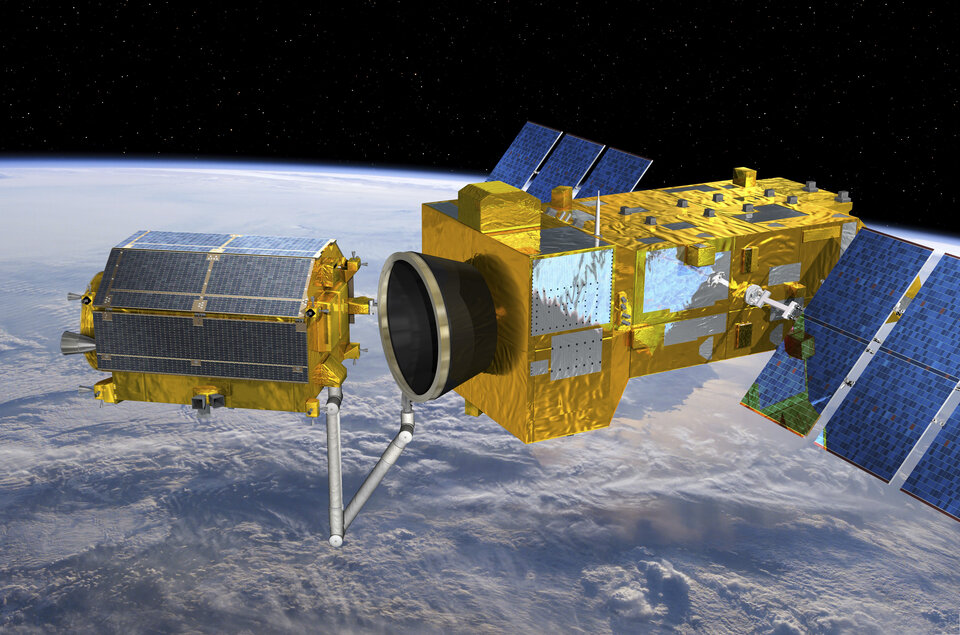
The safeguarding of the future of spaceflight goes beyond preventing and mitigating space debris alone and must also protect Earth’s limited resources and the environment. In the long term, the goal can be nothing less than the peak of sustainability: a truly circular economy in space.
Removing debris from orbit is one piece of the puzzle, but more in-orbit servicing technology development is needed to move away from single use satellites. Instead, the norm should become to service, refuel, upgrade and even recycle spacecraft directly in space. The zero-debris satellites of the future are also modular for easy replacement, with standardised interfaces to ease in-orbit servicing, and other ways of extending a satellite’s life no one has thought of yet.
Greener ways to build and run satellites can be determined through a data-based ecodesign approach. ESA provides tools and technologies to European industry to assess the entire lifecycle of a satellite to help find ways to improve them.
The ESA Space Safety programme leads the push towards the sustainable use of space and supports European industry as it pursues opportunities and adapts while keeping us safe from hazards in and from space.