• → European Space Agency

      • Space for Europe
      • Space News
      • Space in Images
      • Space in Videos
    • About Us

      • Welcome to ESA
      • DG's News and Views
      • For Member State Delegations
      • Business with ESA
      • ESA Exhibitions
      • ESA Publications
      • Careers at ESA
    • Our Activities

      • Space News
      • Observing the Earth
      • Human Spaceflight
      • Launchers
      • Navigation
      • Space Science
      • Space Engineering
      • Operations
      • Technology
      • Telecommunications & Integrated Applications
    • For Public

    • For Media

    • For Educators

    • For Kids

    • ESA

    • Space Science

    • Our Universe
    • About Space Science
    • ESA's 'Cosmic Vision'
    • Science missions
    • Mission navigator
    • Target groups
    • For Media
    • For Scientists
    • For Kids
    • Multimedia
    • Science images
    • Science videos
    • Animations
    • Downloads
    • Sounds from space
    • Resources
    • Reference section
    • Services
    • FAQs
    • Glossary
    • Help
    • Portal terms of use
    • Comments
    • ESA Press Releases
    • Follow us
    • RSS feeds
    • ESA Sci on Twitter
    • ESA Space Science Images on Flickr
    • ESA 3D on Flickr

    ESA > Our Activities > Space Science

    Wolf-Rayet bubble

    Fire burn and cauldron bubble

    29 October 2012

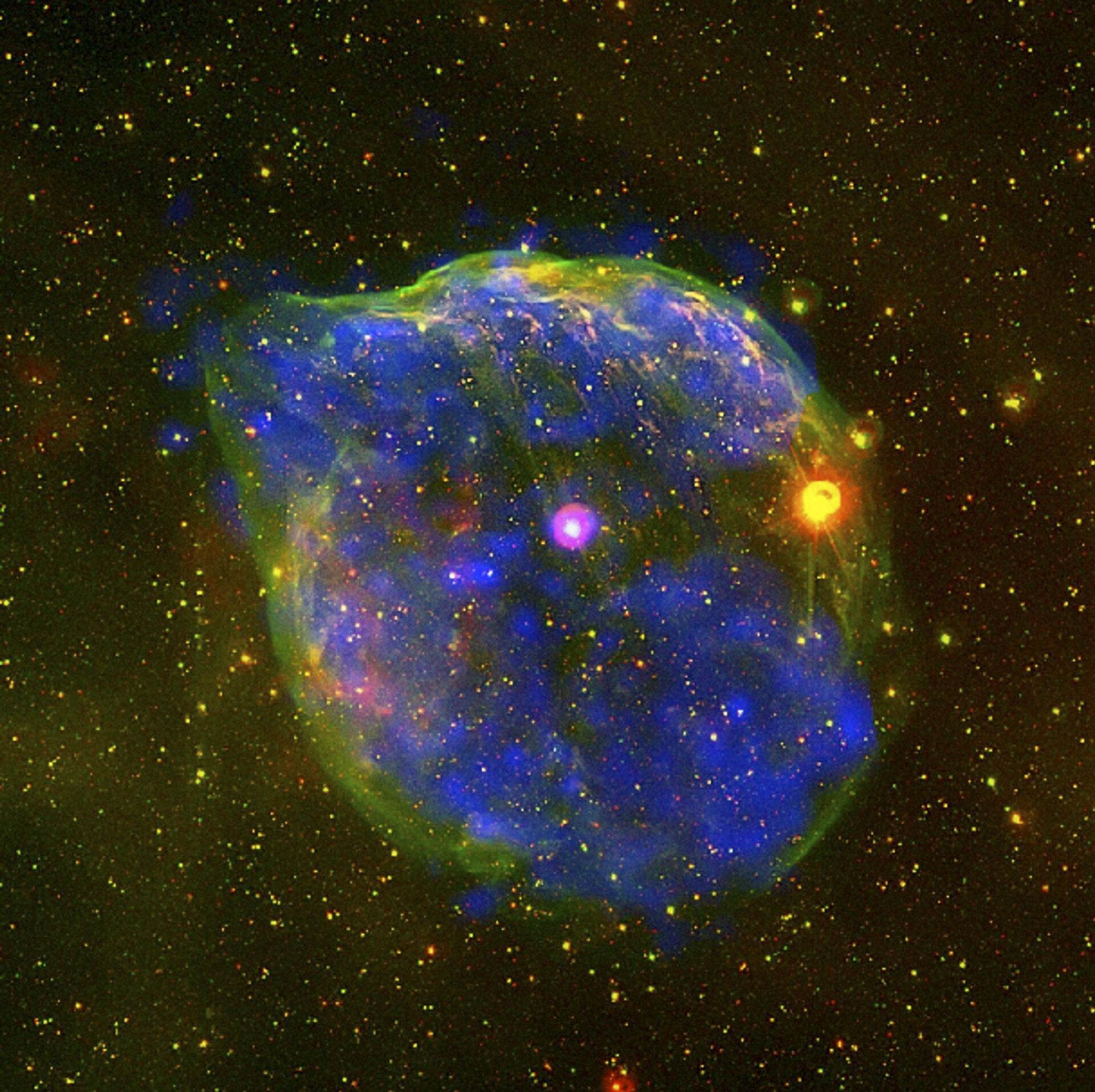
    The cosmic cauldron has brewed up a Halloween trick in the form of a ghostly face that glows in X-rays, as seen by ESA’s XMM-Newton space telescope. The eerie entity is a bubble bursting with the fiery stellar wind of a ‘live fast, die young’ star.

    The bubble lies 5000 light-years from Earth in the constellation of Canis Major, the ‘greater dog’, and can be imagined to take on a dog- or wolf-like face.

    It spans nearly 60 light-years across and was blown by the powerful stellar wind of the Wolf-Rayet star HD 50896 – the pink star near the centre of the image that makes up one of the object’s piercing eyes.

    Wolf-Rayet bubbles are the result of a hot, massive star – typically greater than 35 the mass of our Sun – expelling material through a strong stellar wind. This star’s howling wind is a million-degree plasma potion that emits X-rays, represented in blue in this image.

    Where this fierce wind ploughs into surrounding material it is lit up in red tones as seen in the ‘cheek’ of the face.

    The green halo is a result of a shock wave racing out from the star and colliding with the layers of stellar material already ejected into space.

    A ‘blow-out’ of X-ray emission at the top left gives the wolf an ear, and a denser region to the bottom right can be likened to a snout.

    The witching hour will soon come for this bubble and its star. The bubble will burst and disperse into the surrounding environment, while the star will end its life in a dramatic supernova explosion.

    X-Ray Emission from the Wolf-Rayet Bubble S 308 by J. Toala et al is published in the Astrophysical Journal 755, 77 (2012).

    Rate this

    Views

    Share

    • Currently 0 out of 5 Stars.
    • 1
    • 2
    • 3
    • 4
    • 5
    Rating: 0/5 (0 votes cast)

    Thank you for rating!

    You have already rated this page, you can only rate it once!

    Your rating has been changed, thanks for rating!

    104
    facebook
    twitter
    reddit
    google plus
    digg
    tumbler
    digg
    blogger
    myspace
    • Archive
      • Image of the week archive
      • Space Live
        Space Live
        Space science image gallery
      • More about
        • XMM-Newton overview
          • XMM-Newton factsheet
            • XMM-Newton operations
            • Related articles
              • Aftermath of a stellar explosion
                • X-raying stellar winds in a high-speed collision
                  • A magnetic monster’s dual personality
                    • X-raying the beating heart of a newborn star
                      • The dark heart of a cosmic collision
                        • XMM-Newton uncovers a celestial Rosetta stone
                          • XMM-Newton discovers a new class of black holes
                            • Giant eruption reveals 'dead' star
                              • XMM-Newton exclusive photo: Messier 82
                              • In depth
                              • XMM-Newton in-depth
                              • Follow us
                              • ESA Space Science Image of the Week on Flickr
                              • ESA 3D on Flickr
                              • ESA Sci on Twitter

    Connect with us

    • RSS
    • Youtube
    • Twitter
    • Flickr
    • Google Buzz
    • Subscribe
    • App Store
    • ESA Science Twitter

    Follow ESA science

    • LATEST ARTICLES
    • · CryoSat hits land
    • · Ariane 5 completes seven launches …
    • · Measuring skull pressure without t…
    • · Malargüe station inauguration
    • · The solar wind is swirly
    • FAQ

    • Jobs at ESA

    • Site Map

    • Contacts

    • Terms and conditions