• → European Space Agency

      • Space for Europe
      • Space News
      • Space in Images
      • Space in Videos
    • About Us

      • Welcome to ESA
      • DG's News and Views
      • For Member State Delegations
      • Business with ESA
      • ESA Exhibitions
      • ESA Publications
      • Careers at ESA
    • Our Activities

      • Space News
      • Observing the Earth
      • Human Spaceflight
      • Launchers
      • Navigation
      • Space Science
      • Space Engineering
      • Operations
      • Technology
      • Telecommunications & Integrated Applications
    • For Public

    • For Media

    • For Educators

    • For Kids

    • ESA

    • Launch Special

    • Herschel

    • Planck

    • ESA Science

    • About Herschel

      • Herschel at a glance
      • Science objectives
      • Herschel highlights
      • History of infrared astronomy
    • The infrared Universe

      • Why the infrared?
      • More about the infrared
      • The infrared revolution
    • Spacecraft and telescope

      • Vital stats
      • The largest infrared space telescope
      • Instruments
      • Cutting-edge spacecraft
    • The mission

      • Journey
      • Early operations
      • Operating Herschel
    • Meet the team

      • Herschel Project Scientist: An interview with Göran Pilbratt
      • Herschel and Planck Programme Manager: An interview with Thomas Passvogel
    • Multimedia
    • Herschel images
    • Herschel videos

    ESA > Our Activities > Space Science > Herschel

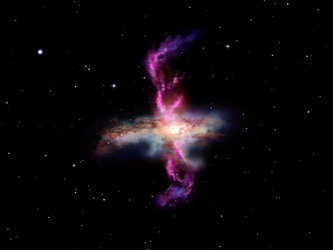
    An artist’s impression showing a galaxy with a molecular outflow

    Raging storms sweep away galactic gas

    9 May 2011

    ESA’s Herschel infrared space observatory has detected raging winds of molecular gas streaming away from galaxies. Suspected for years, these outflows may have the power to strip galaxies of gas and halt star formation in its tracks.

    The winds that Herschel has detected are extraordinary. The fastest is blowing at a speed of more than 1000 km/s, or about 10 000 times faster than the wind in a terrestrial hurricane.

    This is the first time that such molecular gas outflows have been unequivocally observed in a sample of galaxies. This is an important discovery because stars form from molecular gas, and these outflows are robbing the galaxy of the raw material it needs to make new stars. If the outflows are powerful enough, they could even halt star formation altogether.

    ...some galaxies could completely expel their star-forming gas in as little as a million years...

    “With Herschel, we now have the chance to really study what these outflows mean for galactic evolution,” says Eckhard Sturm from the Max-Planck-Institut für extraterrestrische Physik in Germany, the lead author of this work.

    Dr Sturm and colleagues used Herschel’s Photodetector Array Camera and Spectrometer to study 50 galaxies. This first paper focuses on six of their sample.

    They infer that 1200 times the mass of our Sun is being lost each year from the galaxies with the most vigorous outflows. That is enough to strip them of their entire reserves of star-forming gas within one million to 100 million years. In other words, some galaxies could completely expel their star-forming gas in as little as a million years. Inhibiting star formation in a galaxy is known as negative feedback.

    These winds could be generated by the intense emission of light and particles from young stars, or by shockwaves from the explosion of old stars. Alternatively, they may be triggered by the radiation given off as matter swirls around a black hole at the centre of the galaxy.
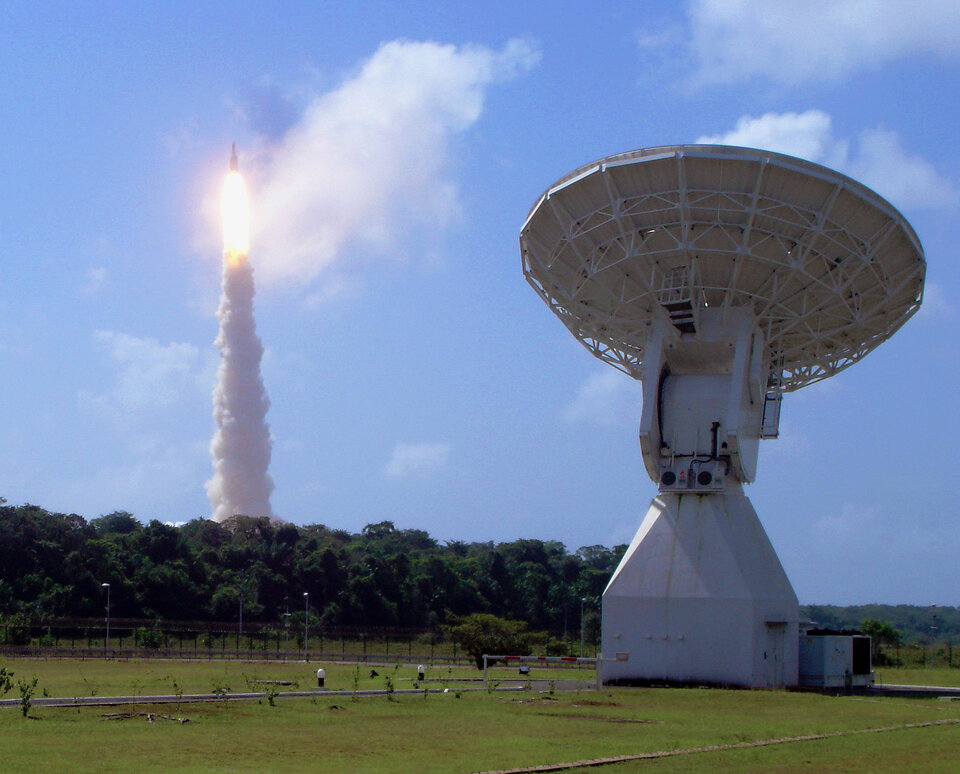

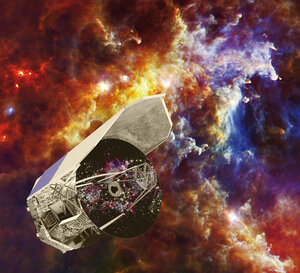
    Herschel and Planck launched on the same Ariane-5 ECA

    The fastest winds appear to be coming from the galaxies that contain the brightest ‘active galactic nuclei’, in which a giant black hole is feeding from its surroundings. Dr Sturm and colleagues are now testing this idea with the other galaxies in their sample. The results could be a step towards explaining how some elliptical galaxies are formed.

    Elliptical galaxies are vast islands of stars that have now stopped producing appreciable numbers of new stars because they have exhausted their gas supplies.

    As smaller galaxies interact and merge with each other, more food is supplied to the central black hole in the combined nucleus, making it larger and more active. This could result in a more powerful wind, which removes the molecular gas and prevents any further star formation taking place, thus leading to an elliptical galaxy.

    “By catching molecular outflows in the act, Herschel has finally yielded long-sought-after evidence that powerful processes with negative feedback do take place in galaxies and dramatically affect their evolution,” adds Göran Pilbratt, ESA's Herschel Project Scientist.

    Contact for further information

    Rate this

    Views

    Share

    • Currently 0 out of 5 Stars.
    • 1
    • 2
    • 3
    • 4
    • 5
    Rating: 0/5 (0 votes cast)

    Thank you for rating!

    You have already rated this page, you can only rate it once!

    Your rating has been changed, thanks for rating!

    206
    Tweet
    • Herschel: ESA's giant infrared observatory
    • More about
    • Herschel overview
      • Other Herschel First Science Stories
      • Online Showcase of Herschel Images OSHI
      • Herschel on YouTube
      • Inside Herschel
      • Herschel mission objectives
      • Related articles
        • Raging storms sweep away galactic gas
          • Herschel links star formation to sonic booms
            • Herschel finds less dark matter but more stars
              • Andromeda’s once and future stars
                • Recipe for water: just add starlight
                  • Herschel and Planck win the French Grand Prix
                    • Herschel finds a hole in space
                      • Herschel reveals the hidden side of star birth
                        • Herschel takes the temperature of an interstellar cloud
                          • Tracing the Milky Way’s hidden reservoirs of gas
                            • Herschel resolves the cosmic infrared fog
                              • Baby stars in the Rosette cloud
                                • Inside the dark heart of the Eagle
                                  • Herschel views deep-space pearls on a cosmic string
                                  • Read more
                                    • Observations: Seeing in infrared wavelengths
                                      • Why infrared astronomy is a hot topic
                                        • L2, the second Lagrangian Point
                                        • Herschel in depth
                                        • In depth
                                        • This story in depth

    Connect with us

    • RSS
    • Youtube
    • Twitter
    • Flickr
    • G+
    • Facebook
    • Livestream
    • Subscribe
    • App Store
    • LATEST ARTICLES
    • · ESA astronaut Timothy Peake set fo…
    • · Space drives e-mobility
    • · Proba-V opens its eyes
    • · First new Galileo satellite arrive…
    • · Next destination: space
    • FAQ

    • Jobs at ESA

    • Site Map

    • Contacts

    • Terms and conditions