Recipe for water: just add starlight
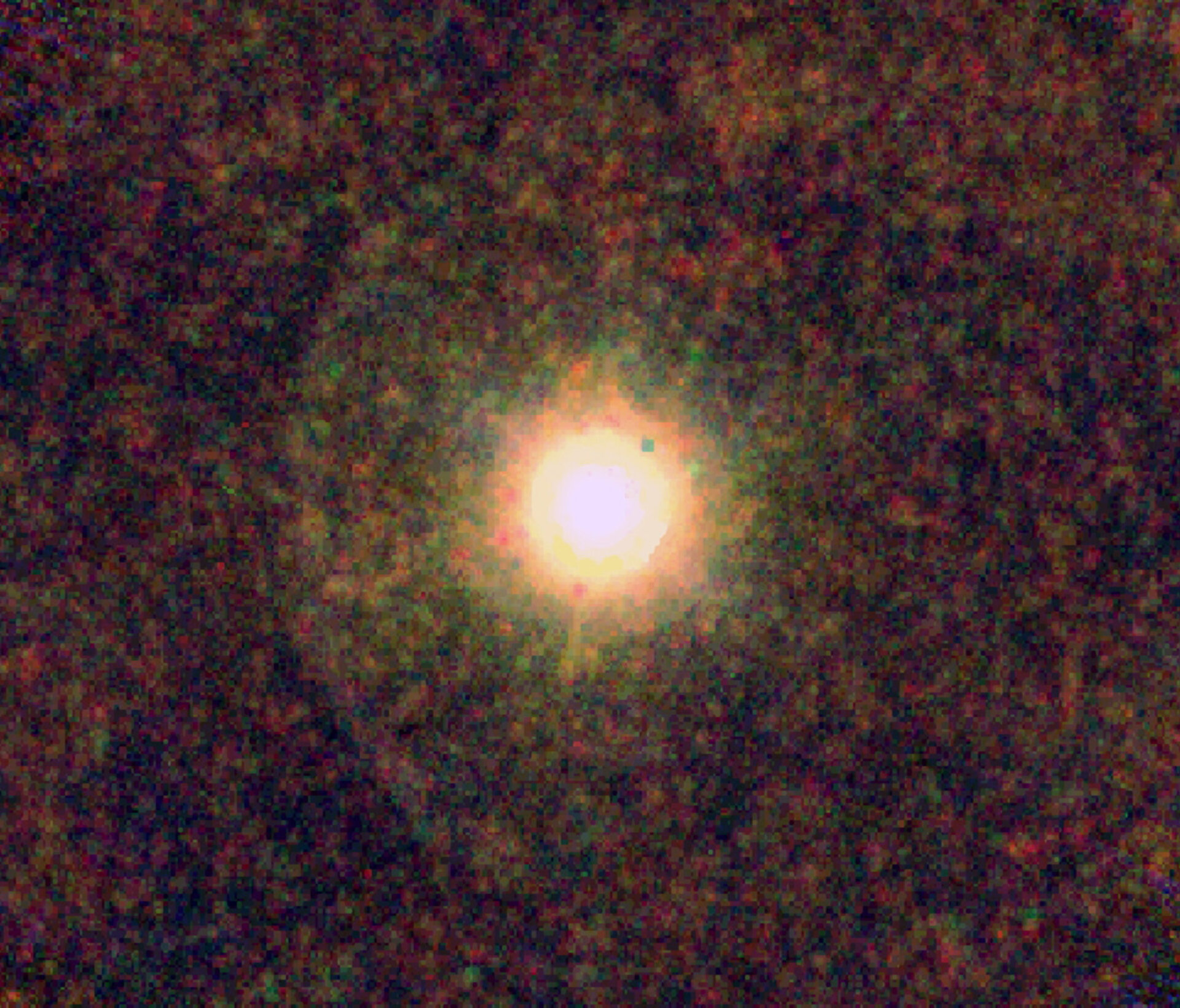
ESA’s Herschel infrared space observatory has discovered that ultraviolet starlight is the key ingredient for making water in space. It is the only explanation for why a dying star is surrounded by a gigantic cloud of hot water vapour.
Every recipe needs a secret ingredient. When astronomers discovered an unexpected cloud of water vapour around the old star IRC+10216 in 2001, they immediately began searching for the source. Stars like IRC+10216 are known as carbon stars and are thought not to make much water. Initially they suspected the star’s heat must be evaporating comets or even dwarf planets to produce the water.
Now, Herschel’s PACS and SPIRE instruments have revealed that the secret ingredient is ultraviolet light, because the water is too hot to have come from the destruction of icy celestial bodies.

“This is a good example of how better instruments can change our picture completely,” says Leen Decin, Katholieke Universiteit Leuven, Belgium, the lead author of the paper about this work. The superb sensitivity of Herschel’s instruments has revealed that the water around IRC+10216 varies in temperature from about –200°C to 800°C, which indicates that it is being formed much closer to the star than comets can stably exist.
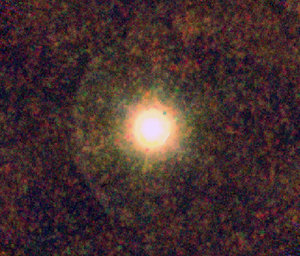
IRC+10216 is a red giant star, hundreds of times the Sun’s size, although only a few times its mass. If it replaced the Sun in our Solar System, it would extend beyond the orbit of Mars.
It is 500 light years away and while it is barely detectable at visible wavelengths, even in the largest telescopes, it is the brightest star in the sky at some infrared wavelengths. This is because it is surrounded by a huge envelope of dust that absorbs almost all its visible radiation and re-emits it as infrared light. It is in the envelope that the water vapour has been found. But how did the water get there?
The vital clue was found by Herschel. Observations had already revealed the clumpy structure in the dusty envelope around IRC+10216. The Herschel water detection made the astronomers realise that ultraviolet light from surrounding stars can reach deep into the envelope between the clumps and break up molecules such as carbon monoxide and silicon monoxide, releasing oxygen atoms. The oxygen atoms then attach themselves to hydrogen molecules, forming water.
“This is the only mechanism that explains the full range of the water’s temperature,” says Decin. The closer to the star the water is formed, the hotter it will be.
Decin and her colleagues now plan to extend the observations to other carbon stars. “We are very hopeful that Herschel will find the same situations around those stars too,” she says.
On Earth, carbon compounds and water are the key ingredients for life. Now, thanks to Herschel, we know that both can be made around IRC+10216, and that the secret ingredient for water is ultraviolet light from surrounding stars.
The vital clue was found by Herschel. Observations had already revealed the clumpy structure in the dusty envelope around IRC+10216. The Herschel water detection made the astronomers realise that ultraviolet light from surrounding stars can reach deep into the envelope between the clumps and break up molecules such as carbon monoxide and silicon monoxide, releasing oxygen atoms. The oxygen atoms then attach themselves to hydrogen molecules, forming water.
“This is the only mechanism that explains the full range of the water’s temperature,” says Decin. The closer to the star the water is formed, the hotter it will be.
Decin and her colleagues now plan to extend the observations to other carbon stars. “We are very hopeful that Herschel will find the same situations around those stars too,” she says.
On Earth, carbon compounds and water are the key ingredients for life. Now, thanks to Herschel, we know that both can be made around IRC+10216, and that the secret ingredient for water is ultraviolet light from surrounding stars.