• → European Space Agency

      • Space for Europe
      • Space News
      • Space in Images
      • Space in Videos
    • About Us

      • Welcome to ESA
      • DG's News and Views
      • For Member State Delegations
      • Business with ESA
      • ESA Exhibitions
      • ESA Publications
      • Careers at ESA
    • Our Activities

      • Space News
      • Observing the Earth
      • Human Spaceflight
      • Launchers
      • Navigation
      • Space Science
      • Space Engineering
      • Operations
      • Technology
      • Telecommunications & Integrated Applications
    • For Public

    • For Media

      • Media
      • ESA TV
      • Videos for professionals
      • Photos
    • For Educators

    • For Kids

    • ESA

    • Space Science

    • Our Universe
    • About Space Science
    • ESA's 'Cosmic Vision'
    • Science missions
    • Mission navigator
    • Target groups
    • For Media
    • For Scientists
    • For Kids
    • Multimedia
    • Science images
    • Science videos
    • Animations
    • Downloads
    • Sounds from space
    • Resources
    • Reference section
    • Services
    • FAQs
    • Glossary
    • Help
    • Portal terms of use
    • Comments
    • Follow us
    • RSS feeds
    • ESA Sci on Twitter
    • ESA Space Science Images on Flickr
    • ESA 3D on Flickr

    ESA > Our Activities > Space Science

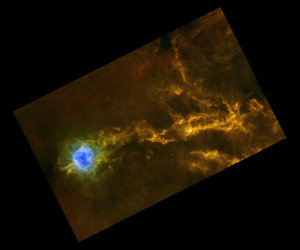
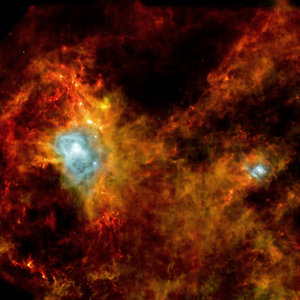
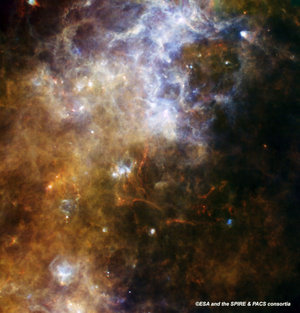
    Dense filaments of gas in IC5146

    Herschel links star formation to sonic booms

    13 April 2011

    ESA’s Herschel space observatory has revealed that nearby interstellar clouds contain networks of tangled gaseous filaments. Intriguingly, each filament is approximately the same width, hinting that they may result from interstellar sonic booms throughout our Galaxy.

    The filaments are huge, stretching for tens of light years through space and Herschel has shown that newly-born stars are often found in the densest parts of them. One filament imaged by Herschel in the Aquila region contains a cluster of about 100 infant stars.

    Such filaments in interstellar clouds have been glimpsed before by other infrared satellites, but they have never been seen clearly enough to have their widths measured. Now, Herschel has shown that, regardless of the length or density of a filament, the width is always roughly the same.

    The Polaris filament network

    “This is a very big surprise,” says Doris Arzoumanian, Laboratoire AIM Paris-Saclay, CEA/IRFU, the lead author on the paper describing this work. Together with Philippe André from the same institute and other colleagues, she analysed 90 filaments and found they were all about 0.3 light years across, or about 20 000 times the distance of Earth from the Sun. This consistency of the widths demands an explanation.

    Comparing the observations with computer models, the astronomers concluded that filaments are probably formed when slow shockwaves dissipate in the interstellar clouds. These shockwaves are mildly supersonic and are a result of the copious amounts of turbulent energy injected into interstellar space by exploding stars. They travel through the dilute sea of gas found in the Galaxy, compressing and sweeping it up into dense filaments as they go.

    Interstellar clouds are usually extremely cold, about 10 degrees Kelvin above absolute zero, and this makes the speed of sound in them relatively slow at just 0.2 km/s, as opposed to 0.34 km/s in Earth’s atmosphere at sea-level.

    These slow shockwaves are the interstellar equivalent of sonic booms. The team suggests that as the sonic booms travel through the clouds, they lose energy and, where they finally dissipate, they leave these filaments of compressed material.


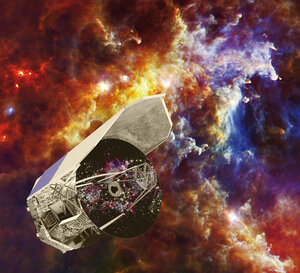
    Herschel telescope mirror at ESTEC

    “This is not direct proof, but it is strong evidence for a connection between interstellar turbulence and filaments. It provides a very strong constraint on theories of star formation,” says Dr André.

    The team made the connection by studying three nearby clouds, known as IC5146, Aquila, and Polaris, using Herschel’s SPIRE and PACS instruments.

    “The connection between these filaments and star formation used to be unclear, but now thanks to Herschel, we can actually see stars forming like beads on strings in some of these filaments,” says Göran Pilbratt, the ESA Herschel Project Scientist.

    Contact for further information

    Rate this

    Views

    Share

    • Currently 0 out of 5 Stars.
    • 1
    • 2
    • 3
    • 4
    • 5
    Rating: 0/5 (0 votes cast)

    Thank you for rating!

    You have already rated this page, you can only rate it once!

    Your rating has been changed, thanks for rating!

    246
    Tweet
    • Herschel: ESA's giant infrared observatory
    • More about
    • Herschel overview
      • Other Herschel First Science Stories
      • Online Showcase of Herschel Images OSHI
      • Herschel on YouTube
      • Inside Herschel
      • Herschel mission objectives
      • Related articles
        • Raging storms sweep away galactic gas
          • Herschel links star formation to sonic booms
            • Herschel finds less dark matter but more stars
              • Andromeda’s once and future stars
                • Recipe for water: just add starlight
                  • Herschel and Planck win the French Grand Prix
                    • Herschel finds a hole in space
                      • Herschel reveals the hidden side of star birth
                        • Herschel takes the temperature of an interstellar cloud
                          • Tracing the Milky Way’s hidden reservoirs of gas
                            • Herschel resolves the cosmic infrared fog
                              • Baby stars in the Rosette cloud
                                • Inside the dark heart of the Eagle
                                  • Herschel views deep-space pearls on a cosmic string
                                  • Read more
                                    • Observations: Seeing in infrared wavelengths
                                      • Why infrared astronomy is a hot topic
                                        • L2, the second Lagrangian Point
                                        • Herschel in depth
                                        • In depth
                                        • This story in depth

    Connect with us

    • RSS
    • Youtube
    • Twitter
    • Flickr
    • G+
    • Facebook
    • Livestream
    • Subscribe
    • App Store
    • ESA Science Twitter

    Follow ESA science

    • LATEST ARTICLES
    • · Earth Explorers take centre stage …
    • · The fast winds of Venus are gettin…
    • · ExoMars 2016 set to complete const…
    • · Herschel ends operations as orbiti…
    • · Europe’s largest spaceship reache…
    • FAQ

    • Jobs at ESA

    • Site Map

    • Contacts

    • Terms and conditions