• → European Space Agency

      • Space for Europe
      • Space News
      • Space in Images
      • Space in Videos
    • About Us

      • Welcome to ESA
      • DG's News and Views
      • For Member State Delegations
      • Business with ESA
      • ESA Exhibitions
      • ESA Publications
      • Careers at ESA
    • Our Activities

      • Space News
      • Observing the Earth
      • Human Spaceflight
      • Launchers
      • Navigation
      • Space Science
      • Space Engineering
      • Operations
      • Technology
      • Telecommunications & Integrated Applications
    • For Public

    • For Media

    • For Educators

    • For Kids

    • ESA

    • ESA Science

    • Mars Express

    • Europe goes to Mars

      • Europe reclaims a stake in Mars exploration
      • Space age transforms our knowledge about Mars
    • About Mars Express

      • Mars Express mission facts
      • Mars Express instruments
      • The mission
      • The spacecraft
      • The launcher
    • About Mars

      • Geography of Mars
      • Water on early Mars?
      • Signatures of life
      • Facts about Mars
    • Meet the team

      • International collaboration
      • Project Manager
      • Project Scientist
      • Mars Lead Scientist
      • Principal Investigators
      • Operations
      • Industry
    • Multimedia
    • VideoTalk
    • Mars Express images
    • Mars Express videos
    • HRSC videos
    • Animation in 11 languages
    • Download wallpapers
    • Download screensavers
    • 3D Flash 'model'
    • Make a model
    • Services
    • Comments

    ESA > Our Activities > Space Science > Mars Express

    Hebes Chasma, a trough in the Grand Canyon of Mars

    Hebes Chasma
    28 March 2008

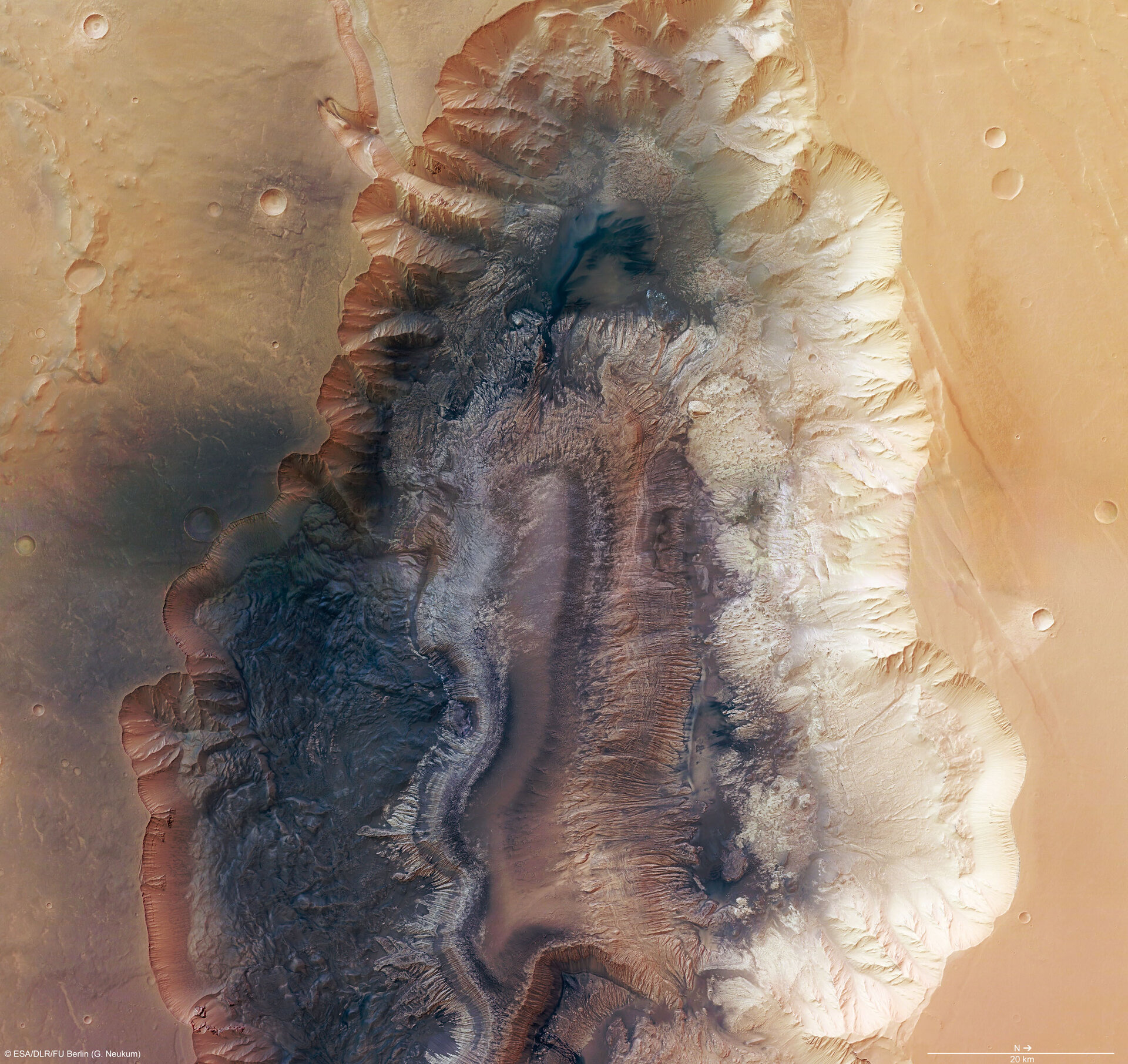
    Hebes Chasma is an enclosed trough, almost 8000 m deep, in Valles Marineris, the Grand Canyon of Mars, where water is believed to have flowed. The High Resolution Stereo Camera (HRSC) on ESA’s Mars Express studied the area providing new pictorial clues to its history.
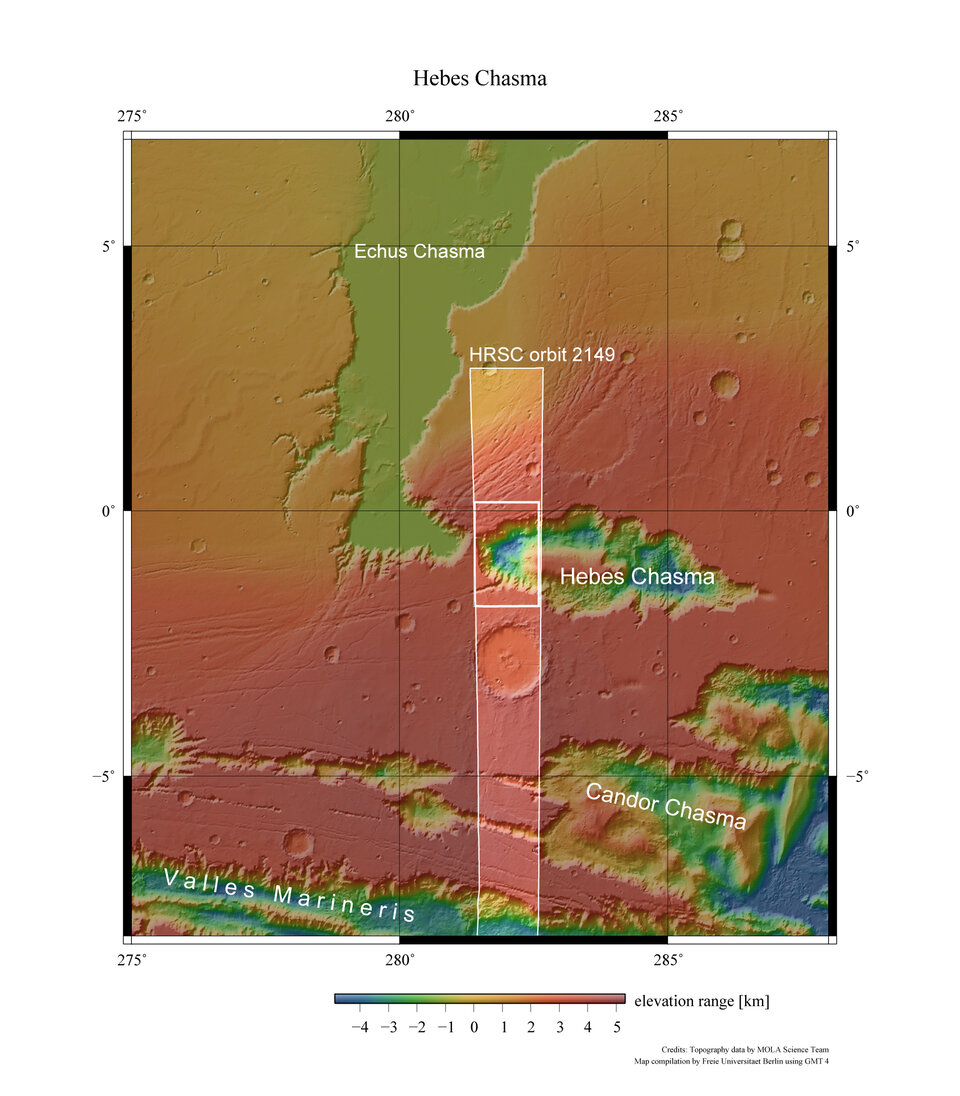
    Hebes Chasma context map
    Hebes Chasma context map

    Hebes Chasma is located at approximately 1° south and 282° east. Image data was obtained on 16 September 2005 with a ground resolution of approximately 15 m/pixel.


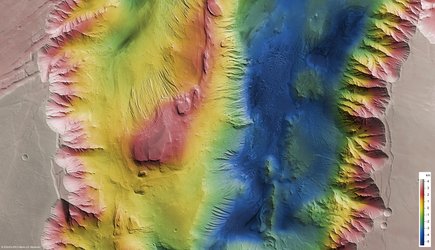
    Hebes Chasma, colour-coded elevation model
    Hebes Chasma, colour-coded elevation model

    Hebes Chasma is an enclosed, almost 8000 m-deep trough in the most northern part of Valles Marineris, the 3000-km long “Grand Canyon of Mars”.

    Hebes Chasma, perspective view
    Hebes Chasma, perspective view

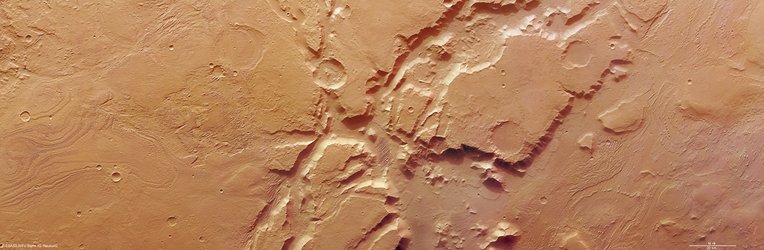
    The steep flanks of the trough show branched incisions and small veins of rock. Below the flanks, run-off and material from larger landslides is visible.
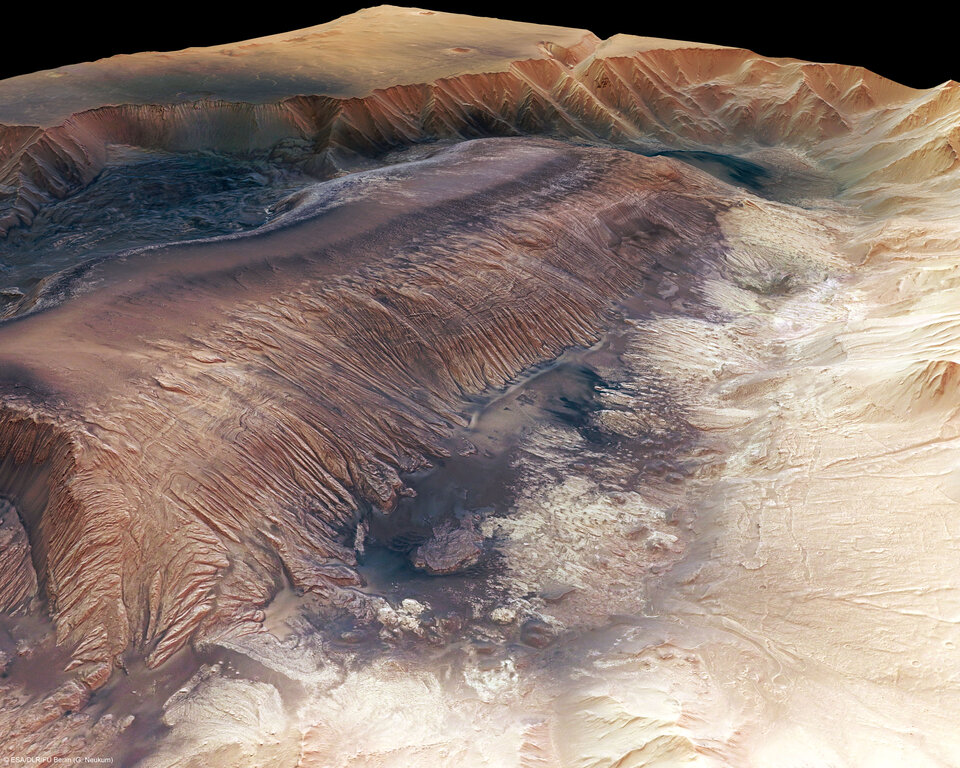
    Hebes Chasma, perspective view
    Hebes Chasma, perspective view

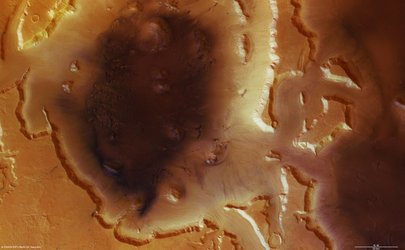
    A flat-topped mountain is located in the centre of Hebes Chasma (3). It reaches 8000 m above the graben floor and rises to almost the same height as the plain surrounding the trough.

    Hebes Chasma, perspective view
    Hebes Chasma, perspective view

    The mountain is made up of numerous rock layers stacked on top of each other, perhaps made out of remnants of an older plateau, sediments from a lake, wind-blown sediments or volcanic rocks. The rock layers were exposed by erosion.

    Hebes Chasma, false-colour nadir view
    Hebes Chasma, false-colour nadir view

    Latest data acquired by the OMEGA spectrometer on-board Mars Express has revealed water-bearing minerals such as gypsum in some areas of Hebes Chasma. This is proof that at least significant quantities of water once existed in Hebes Chasma.
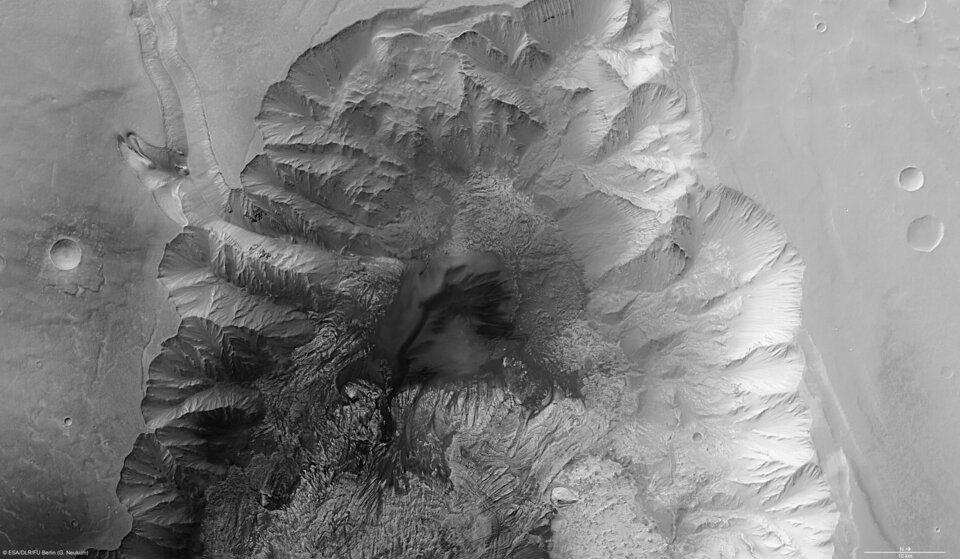
    Hebes Chasma
    Hebes Chasma

    The origin of Hebes Chasma is thought to be connected to the nearby Tharsis Region, which was uplifted in the course of intense volcanism. The uplift created tremendous amounts of stress in the crust forming a series of faults oriented radially.
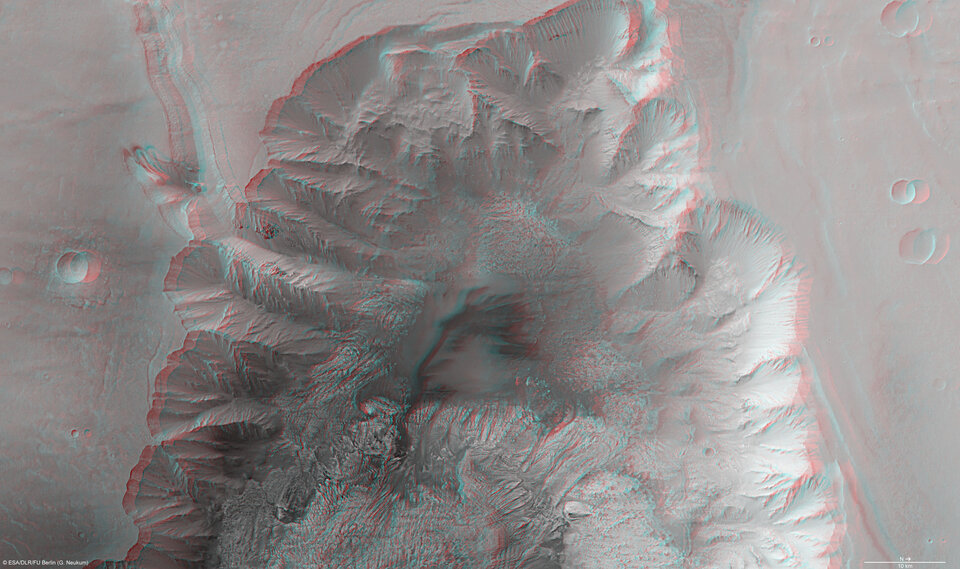
    3D view of Hebes Chasma
    3D view of Hebes Chasma

    The colour scenes have been derived from the three HRSC-colour channels and the nadir channel. The perspective views have been calculated from the digital terrain model derived from the stereo channels. The anaglyph image was calculated from the nadir and one stereo channel, stereoscopic glasses are required to view it.
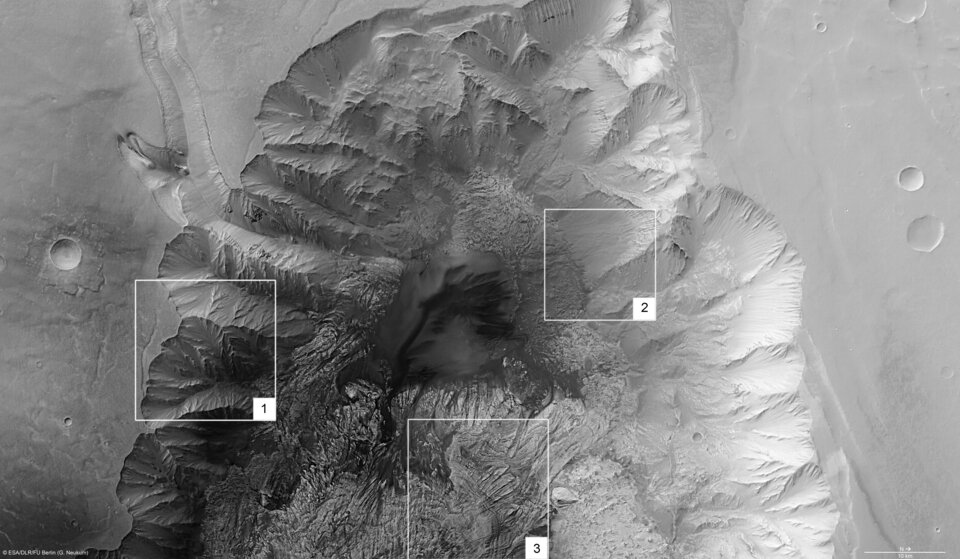
    Hebes Chasma, annotated nadir view
    Hebes Chasma, annotated nadir view

    The black and white high resolution images were derived from the nadir channel which provides the highest detail of all channels.

    For more information on Mars Express HRSC images, please read our updated FAQ (frequently asked questions).
    Rate this

    Views

    Share

    • Currently 0 out of 5 Stars.
    • 1
    • 2
    • 3
    • 4
    • 5
    Rating: 0/5 (0 votes cast)

    Thank you for rating!

    You have already rated this page, you can only rate it once!

    Your rating has been changed, thanks for rating!

    245
    Tweet
    • Mars Express image browser
    • Related articles
      • Icy Promethei Planum
        • Deep valleys of Candor Chasma
          • ESA presents Mars in 3D
            • Traces of the martian past in the Terby crater
              • Noctis Labyrinthus, labyrinth of the night
                • Hummocky and shallow Maunder crater
                  • The mysterious ridges at the mouth of Tiu Valles
                    • Impact Craters in Tyrrhena Terra
                      • Tectonic signatures at Aeolis Mensae
                        • Breathtaking views of Deuteronilus Mensae on Mars
                          • The first hiking maps of Mars
                            • Cydonia's 'Face on Mars' in 3D animation
                              • Spacecraft fleet zeroing in on Martian water reserves
                              • Related links
                              • High Resolution Stereo Camera
                                • Behind the lens...
                                  • Frequently asked questions
                                  • For specialists
                                  • ESA Planetary Science archive (PSA)
                                  • NASA Planetary Data System
                                  • HRSC data viewer

    Connect with us

    • RSS
    • Youtube
    • Twitter
    • Flickr
    • G+
    • Facebook
    • Livestream
    • Subscribe
    • App Store
    • LATEST ARTICLES
    • · ESA astronaut Timothy Peake set fo…
    • · Space drives e-mobility
    • · Proba-V opens its eyes
    • · First new Galileo satellite arrive…
    • · Next destination: space
    • FAQ

    • Jobs at ESA

    • Site Map

    • Contacts

    • Terms and conditions