• → European Space Agency

      • Space for Europe
      • Space News
      • Space in Images
      • Space in Videos
    • About Us

      • Welcome to ESA
      • DG's News and Views
      • For Member State Delegations
      • Business with ESA
      • ESA Exhibitions
      • ESA Publications
      • Careers at ESA
    • Our Activities

      • Space News
      • Observing the Earth
      • Human Spaceflight
      • Launchers
      • Navigation
      • Space Science
      • Space Engineering
      • Operations
      • Technology
      • Telecommunications & Integrated Applications
    • For Public

    • For Media

    • For Educators

    • For Kids

    • ESA

    • ESA Science

    • Mars Express

    • Europe goes to Mars

      • Europe reclaims a stake in Mars exploration
      • Space age transforms our knowledge about Mars
    • About Mars Express

      • Mars Express mission facts
      • Mars Express instruments
      • The mission
      • The spacecraft
      • The launcher
    • About Mars

      • Geography of Mars
      • Water on early Mars?
      • Signatures of life
      • Facts about Mars
    • Meet the team

      • International collaboration
      • Project Manager
      • Project Scientist
      • Mars Lead Scientist
      • Principal Investigators
      • Operations
      • Industry
    • Multimedia
    • VideoTalk
    • Mars Express images
    • Mars Express videos
    • HRSC videos
    • Animation in 11 languages
    • Download wallpapers
    • Download screensavers
    • 3D Flash 'model'
    • Make a model
    • Services
    • Comments

    ESA > Our Activities > Space Science > Mars Express

    Martian 'dust devil' tracks

    Promethei Terra, southern highlands of Mars

    12 October 2004

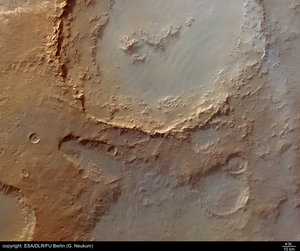
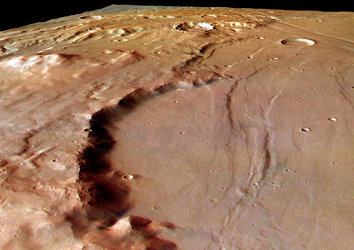
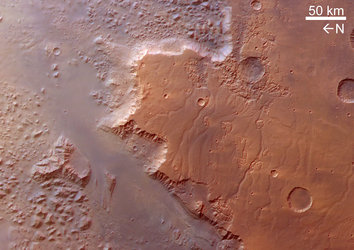
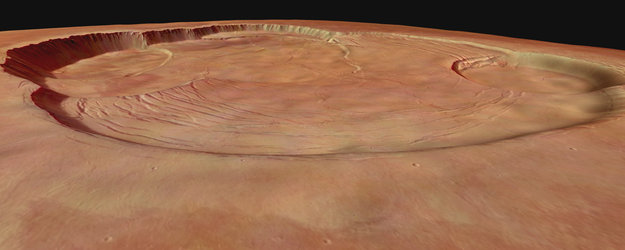
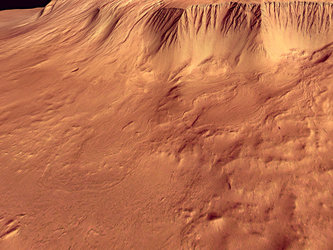
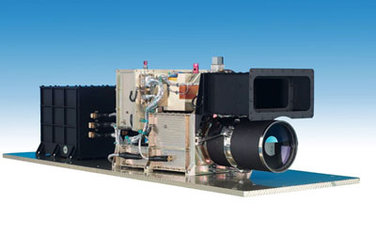
    These images, taken by the High Resolution Stereo Camera (HRSC) on board ESA’s Mars Express spacecraft, show a part of the southern highlands of Mars, called Promethei Terra.

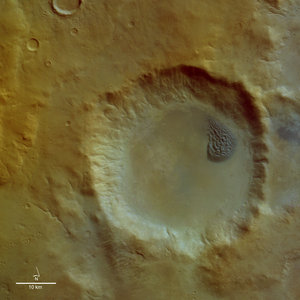
    Colour view of impact crater in Promethei Terra

    The images were taken during orbit 368 in May 2004 with a ground resolution of approximately 14 metres per pixel.

    The displayed region is centred around longitude 118° East and latitude 42° South.

    The images show an area in the Promethei Terra region, east of the Hellas Planitia impact basin.


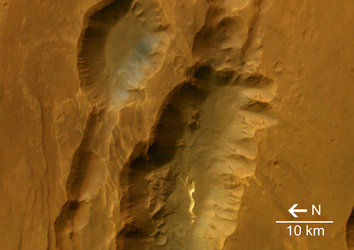
    Close-up view of crater and Martian dunes

    The smooth surface is caused by a layer of dust or volcanic ash that is up to several tens of metres thick.

    This layer has covered all landforms, and even young impact craters have lost their contours due to in-fill and collapse of their fragile crater walls. This layer has been removed by the wind at some ridges and crater walls.

    Close-up view of Promethei Terra craters

    Although the above close-up image was taken at high resolution and shows very fine detail like the dunes seen in the close-up image at right, this dust covering layer leads to a slightly fuzzy appearance.

    Impact crater in Promethei Terra, black and white view

    The large impact crater in the southern part of the image is 32 kilometres wide and up to 1200 metres deep.

    The dark crater floor is most likely the result of ‘deflation’, the geological term for the lifting and removal of loose material.

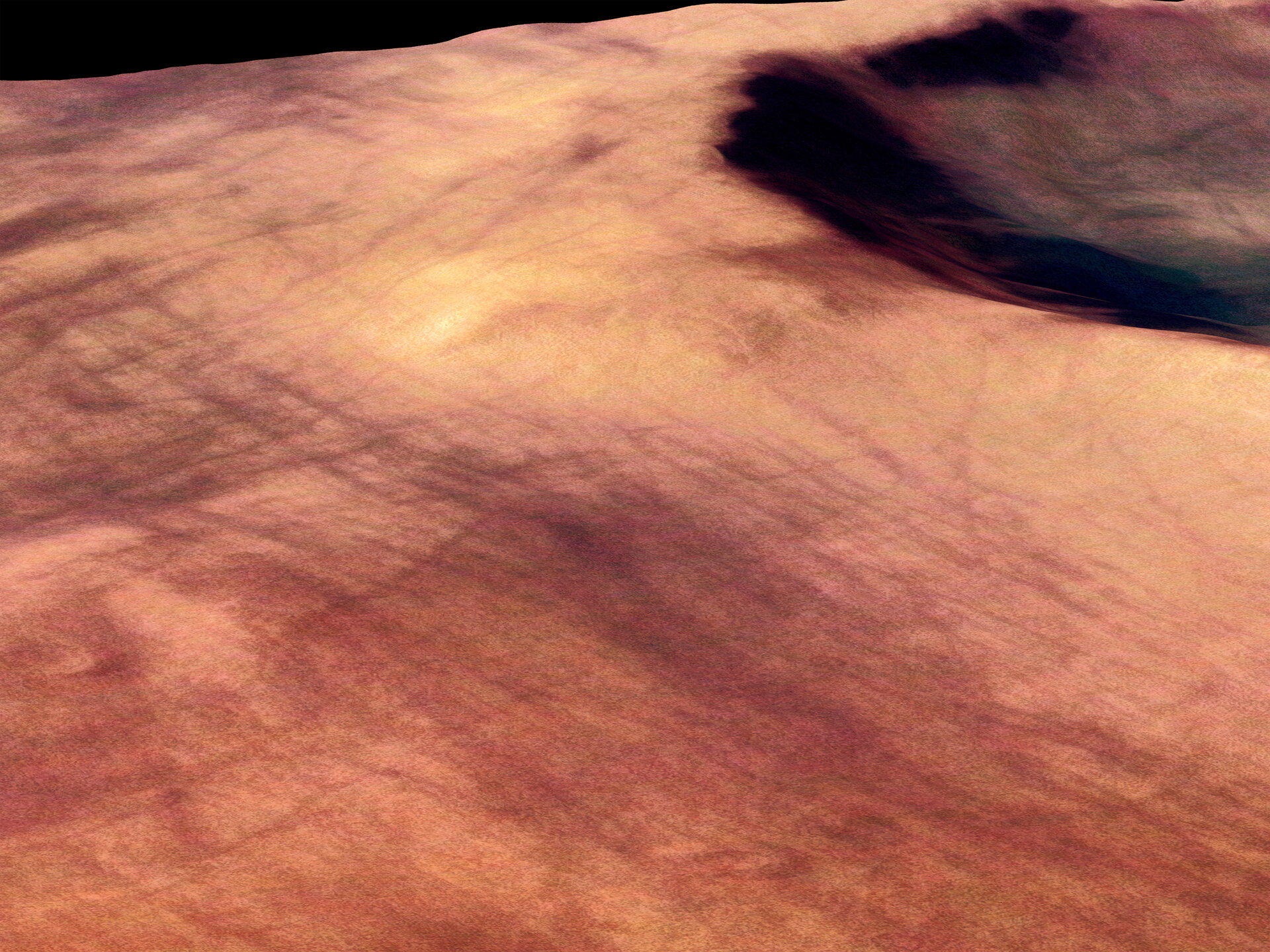
    The dust removed here has accumulated in the southern part of the crater, forming a thick layer. The numerous dark tracks to the north-western and west are ‘dust devil’ tracks.

    These atmospheric ‘eddies’, like tornadoes on Earth, remove the uppermost dust layers which have a slightly different colour to the now-exposed surface. The tracks can be more than 20 kilometres long and contrast prominently with the lighter-coloured surroundings.

    Dust devil tracks provide short-lived evidence of the ongoing geological and atmospheric activity on Mars, which consists mainly of the transport of dust by wind.

    Another sign for this ‘aeolian’ (wind-related) activity in the area is the existence of small dune fields that have formed in some of the depressions. They can be seen in the crater in the north and in its surroundings (see lower close-up view).

    The dust devils are not limited by geomorphological boundaries: for example, their tracks cross the crater rim. Dust devil tracks can also be seen on the thick dust layer in the southern part of the crater.

    Due to the thickness of the dust layer, no darker material is exposed here. The dust devil tracks show two distinct directions of movement: east to west and south-east to north-west.

    3D image of the Promethei Terra region

    The colour images have been processed using the nadir (vertical view) and three colour channels, and the perspective views have been calculated from the digital terrain model derived from the stereo channels. The 3D anaglyph image has been created from the nadir and one stereo channel.

    For more information on Mars Express HRSC images, you might like to read our updated 'Frequently Asked Questions'.
    Rate this

    Views

    Share

    • Currently 5 out of 5 Stars.
    • 1
    • 2
    • 3
    • 4
    • 5
    Rating: 5/5 (1 votes cast)

    Thank you for rating!

    You have already rated this page, you can only rate it once!

    Your rating has been changed, thanks for rating!

    152
    Tweet
    • Looking at Mars
    • Mars Express image browser
    • Recent images
      • Crater Hale in Argyre basin
        • Coprates Catena’s ‘collapsed’ structures
          • Martian moon Phobos in detail
            • Tithonium Chasma, Valles Marineris, on Mars
              • Rim of Crater Huygens on Mars
                • Promethei Terra, southern highlands of Mars
                  • Ophir Chasma, part of Valles Marineris
                    • Solis Planum, Thaumasia region
                      • Eos Chasma, part of Valles Marineris
                        • Crater dunes in Argyre Planitia
                          • The eroded valleys of Dao and Niger Valles
                            • Olympus Mons caldera in perspective
                              • Escarpment and landslides of Olympus Mons
                                • View of deposits in Melas Chasma on Mars
                                • High Resolution Stereo Camera
                                  • Behind the lens...

    Connect with us

    • RSS
    • Youtube
    • Twitter
    • Flickr
    • G+
    • Facebook
    • Livestream
    • Subscribe
    • App Store
    • LATEST ARTICLES
    • · ESA astronaut Timothy Peake set fo…
    • · Space drives e-mobility
    • · Proba-V opens its eyes
    • · First new Galileo satellite arrive…
    • · Next destination: space
    • FAQ

    • Jobs at ESA

    • Site Map

    • Contacts

    • Terms and conditions