|  |  |  |  |
| |  | |  | |
 |
Exploration Strategy Why explore?Europe's journey of explorationStrategic plan 2020European themesContext Context analysisRelated ESA programmesThe global space exploration strategyInternational plansReference Architecture Architecture studiesInternational exploration architecture Events Past EventsServices
|  |  |  |  | | | International exploration architecture
In the first half of 2008 representatives from the National Aeronautics and Space Administration (NASA) and the European Space Agency (ESA) were engaged in detailed assessment of exploration architecture concepts developed independently. The NASA-ESA comparative exploration architecture study was intended to assess the degree to which their lunar exploration architecture concepts could complement, augment, or enhance one another. Technical teams from each agency engaged in a series of joint, qualitative assessments of the potential scientific and exploration benefits that would arise from collaboration between the ESA capabilities under study and NASA’s Ares I and V space transportation systems and lunar surface exploration architecture concepts.
NASA is currently studying these architecture concepts to support the return of humans to the Moon before 2020. Consistent with the principles of the Global Exploration Strategy -- a framework for coordinating the space exploration plans of 14 participating agencies from around the world -- NASA is pursuing its lunar exploration plans under an “open architecture” approach, which will maximize opportunities for international and commercial participation. NASA’s architecture concept calls for the transportation of astronauts and hardware to the Moon using the Ares I and Ares V launch vehicles, the Orion crew exploration vehicle and the Altair lunar lander, all of which are currently under development.
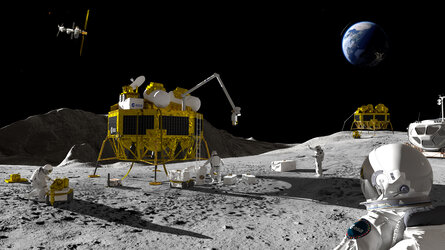
ESA is currently studying scenarios and associated architectures for human space exploration, building upon its extensive human spaceflight experience, including its contributions to the International Space Station programme. ESA’s studies are currently at a conceptual stage. Some of the scenarios assessed as part of this joint study included: potential future use of an automated, Ariane 5 based, lunar cargo landing system; European developed communication and navigation systems; ESA-developed human-rated systems, such as an Ariane 5 crew transportation capability and orbital outposts; and ESA-developed dedicated lunar surface elements, such as habitation and mobility systems.
 | | | Deep drilling on lunar surface | Findings from the study included a significant mutual interest in the potential development of lunar cargo landing systems, communication and navigation systems, lunar orbital infrastructures, and lunar surface systems such as habitats or mobility systems. The study also identified the significant value to be gained from redundant human crew transportation capability.
For any enquiries or to provide feedback please contact: architecture@esa.int Last update: 13 February 2009 | |
|  | Related links NASA's plans to explore Moon, Mars and beyond
|