ESA    Life in Space    Expanding Frontiers    Improving Daily Life    Protecting the Environment    Benefits for Europe  
   
Media Centre
Press ReleasesESA TelevisionLaunch Media CornerExhibitions
Services
CalendarPublicationsFrequently asked questionsESA-sponsored ConferencesHelpSite CreditsPortal terms of useCommentsSubscribe Bookmark and Share


Tectonic signatures at Aeolis Mensae
 
28 June 2007

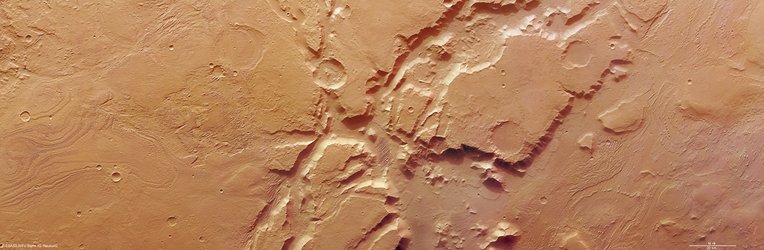
Tectonic transition zone, Aeolis Mensae
Download:
 HI-RES JPEG (Size: 23 800 kb)  HI-RES TIFF (Size: 51 100 kb)
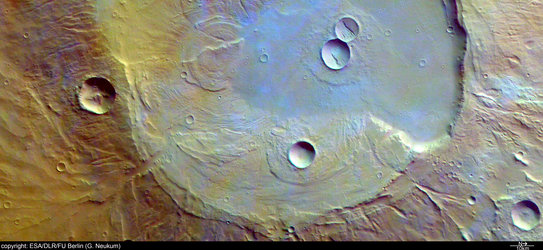
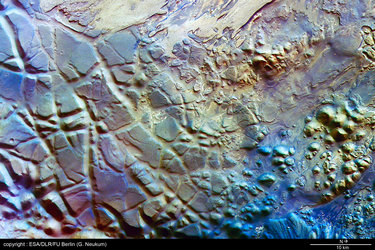
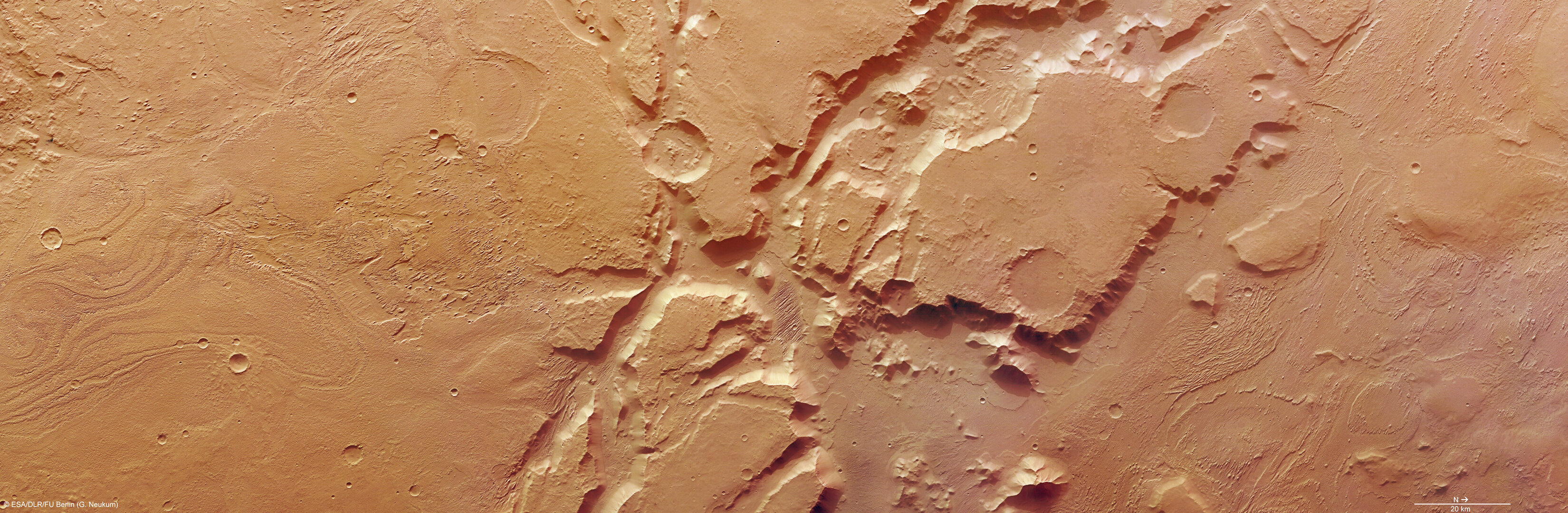
Mars Express’ High Resolution Stereo Camera (HRSC) has provided snapshots of the Aeolis Mensae region on the Red Planet. This area, well-known for its features that reflect the result of the activity of wind on the arid planet, lies on a tectonic transition zone, characterised by incised valleys and unexplained linear features.

Illuminated by the Sun from the west (right hand side in the image), the pictures are of a ground resolution of approximately 13 meters per pixel. The region, imaged on 26 and 29 March 2007, during Mars Express orbit number 4136 and 4247, is located at approximately 6° South and 145° East.
This colour picture, a mosaic of pictures derived from orbits 4136 and 4147, has been derived from the three HRSC colour channels in combination with the nadir channel.

Credits: ESA/DLR/FU Berlin (G. Neukum)


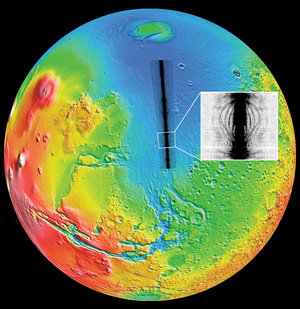
Aeolis Mensae context map
Download:
 HI-RES JPEG (Size: 1430 kb)  HI-RES TIFF (Size: 5124 kb)
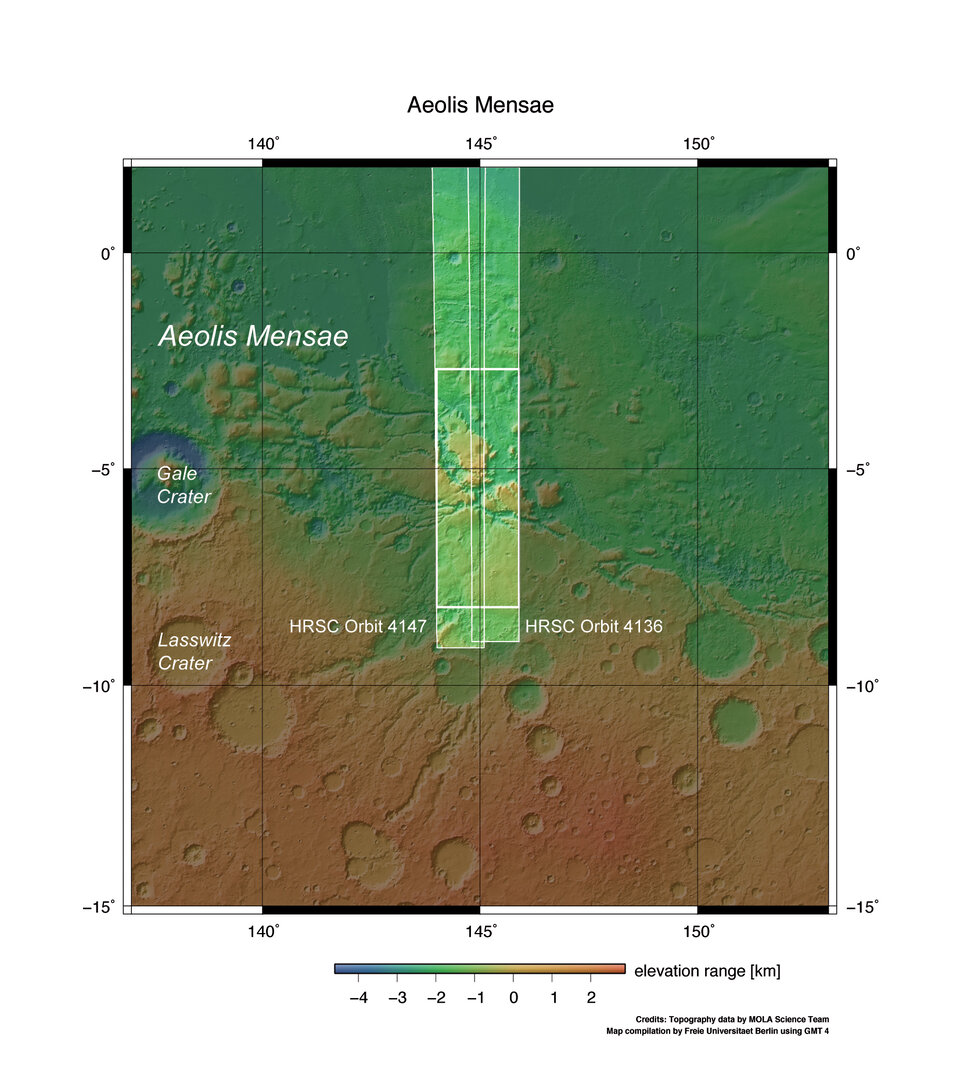
Mars Express’ High Resolution Stereo Camera (HRSC) has provided snapshots of the Aeolis Mensae region on the Red Planet. This area, well-known for its features that reflect the result of the activity of wind on the arid planet, lies on a tectonic transition zone, characterised by incised valleys and unexplained linear features.

The region, imaged on 26 and 29 March 2007, during Mars Express orbit number 4136 and 4247, is located at approximately 6° South and 145° East.

The morphology of the terrain, which lies close to the volcanic region of Elysium, is characterised by an extensive transition zone or the so-called ‘global crustal dichotomy boundary’ which separates the southern highlands and northern lowlands. It exhibits clod-shaped or lumpy relief separated by valleys and intermediated graben structures, or elongated, trench-like erosional features.

Credits: FU Berlin/ MOLA


Aeolis Mensae North
Download:
 HI-RES JPEG (Size: 4773 kb)  HI-RES TIFF (Size: 33 749 kb)
Mars Express’ High Resolution Stereo Camera (HRSC) has provided snapshots of the Aeolis Mensae region on the Red Planet.

The region, imaged on 26 and 29 March 2007, during Mars Express orbit number 4136 and 4247, is located at approximately 6° South and 145° East.

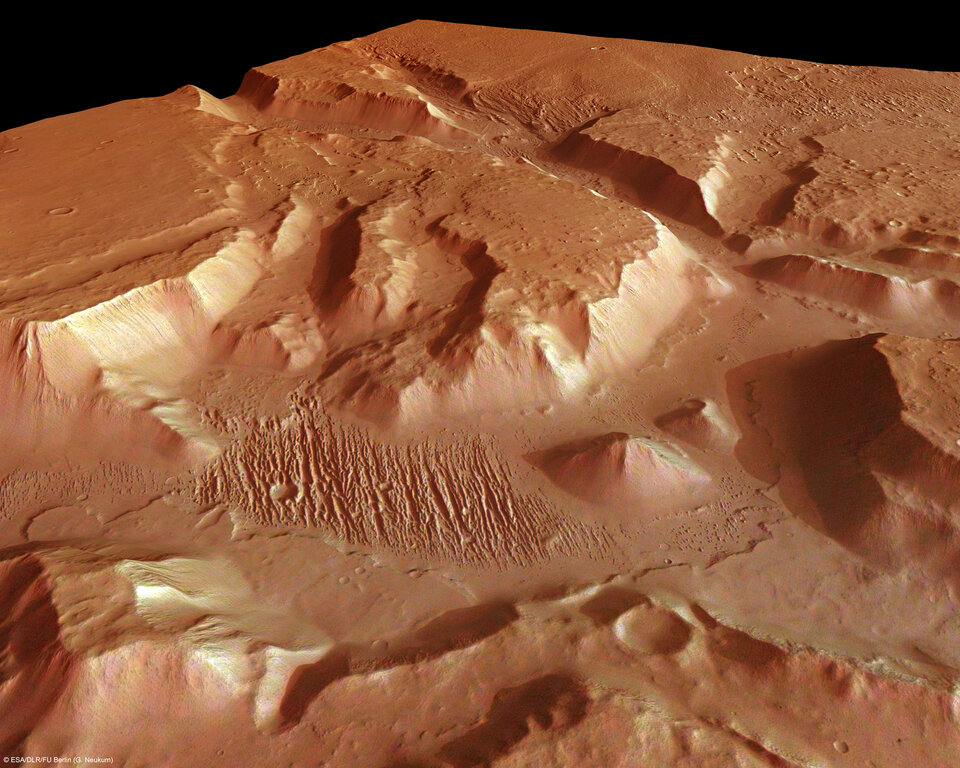
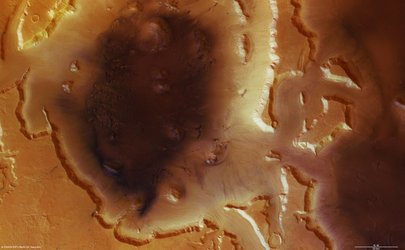
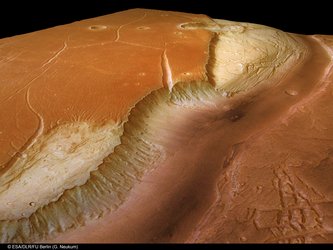
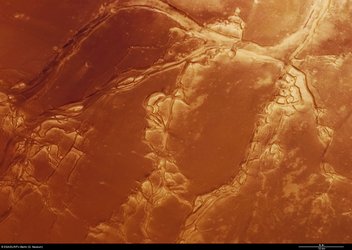
Deep valleys are incised into the highlands in the northern part of the scene showing linear features on the floor of the valley.

This perspective view was obtained from a Digital Terrain Model derived from the HRSC stereo channels.

Credits: ESA/DLR/FU Berlin (G. Neukum)


Aeolis Mensae North
Download:
 HI-RES JPEG (Size: 4230 kb)  HI-RES TIFF (Size: 30 867 kb)
Mars Express’ High Resolution Stereo Camera (HRSC) has provided snapshots of the Aeolis Mensae region on the Red Planet.

The region, imaged on 26 and 29 March 2007, during Mars Express orbit number 4136 and 4247, is located at approximately 6° South and 145° East.

Deep valleys are incised into the highlands in the northern part of the scene showing linear features on the floor of the valley. Similar linear features are also seen in the lower part of the picture but the morphology is different from the region in the upper part in that there are no incisions. Also, the area is far less cratered and hence the erosion must be of a relatively recent origin.

Scientists have reason to believe that the valleys might primarily originate from tectonic activity, possibly also modelled locally by subsequent fluid or mass wasting activity.

This perspective view was obtained from a Digital Terrain Model derived from the HRSC stereo channels.

Credits: ESA/DLR/FU Berlin (G. Neukum)


Aeolis Mensae South
Download:
 HI-RES JPEG (Size: 13 087 kb)  HI-RES TIFF (Size: 26 800 kb)
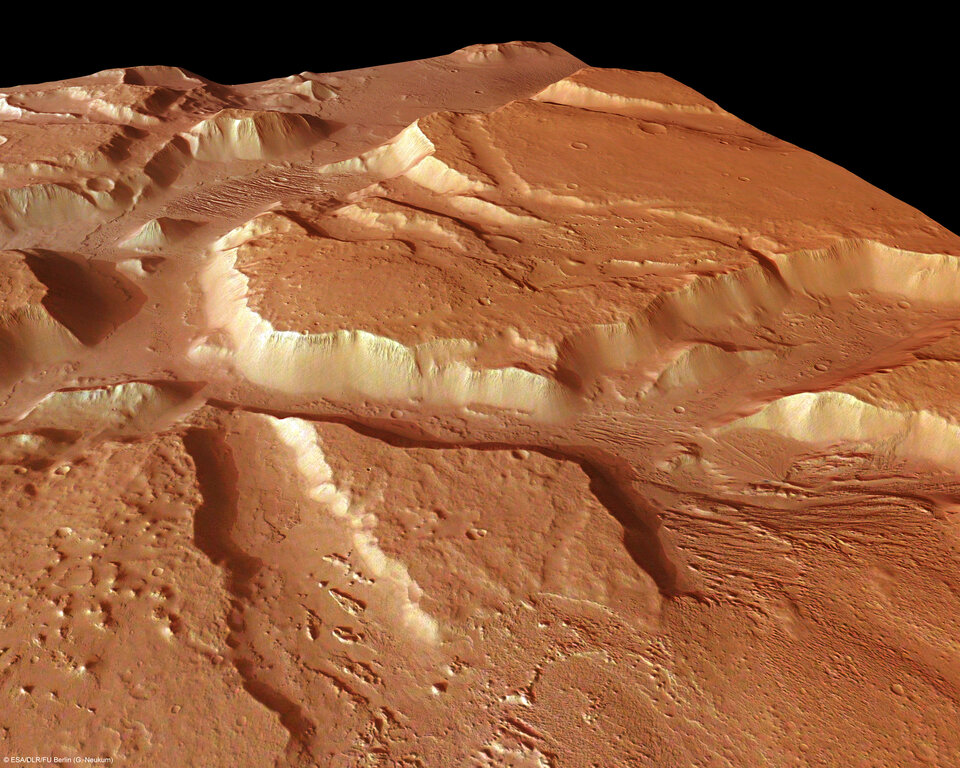
Mars Express’ High Resolution Stereo Camera (HRSC) has provided snapshots of the Aeolis Mensae region on the Red Planet.

The region, imaged on 26 and 29 March 2007, during Mars Express orbit number 4136 and 4247, is located at approximately 6° South and 145° East.

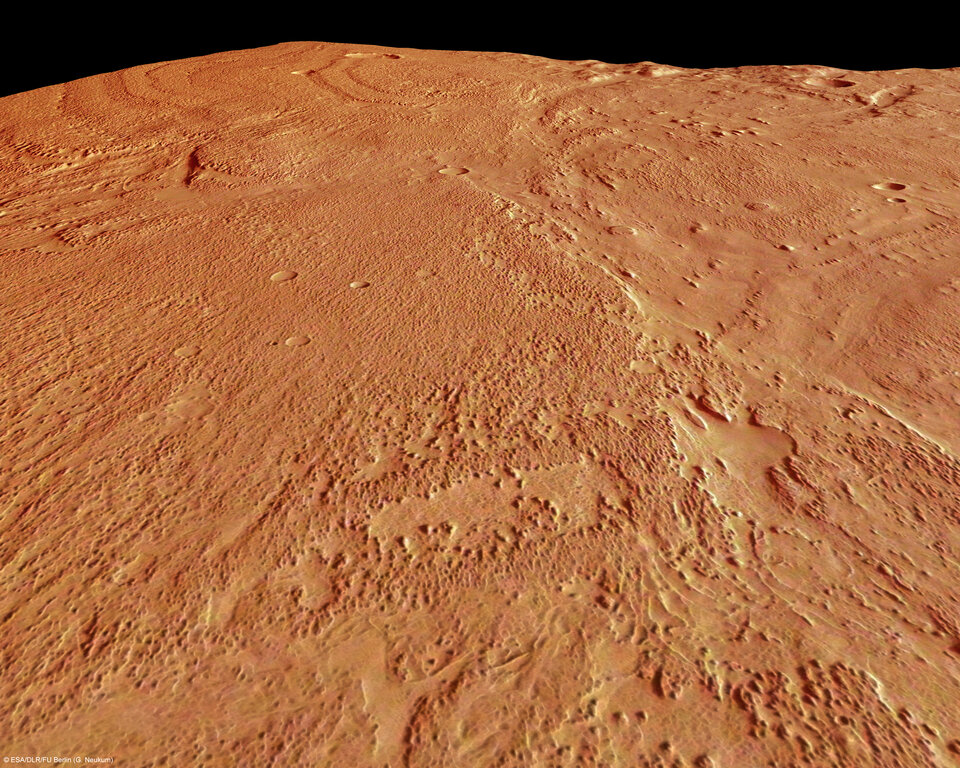
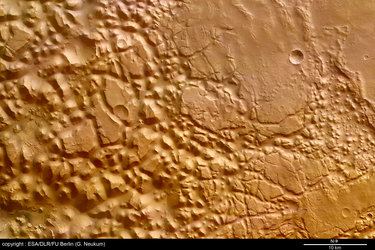
The morphology of the terrain, which lies close to the volcanic region of Elysium, is characterised by an extensive transition zone or the so-called ‘global crustal dichotomy boundary’ which separates the southern highlands and northern lowlands. It exhibits clod-shaped or lumpy relief separated by valleys and intermediated graben structures, or elongated, trench-like erosional features.

Aeolis Mensae is located between the border of the northern plains and the southern highlands, indicated by the transition zone. Between the highlands and the plains there is a large average difference in elevation, of about 3000 metres. The origin of this dichotomy is currently a subject of discussion.
Credits: ESA/DLR/FU Berlin (G. Neukum)


Aeolis Mensae
Download:
 HI-RES JPEG (Size: 14 351 kb)  HI-RES TIFF (Size: 18 500 kb)
Mars Express’ High Resolution Stereo Camera (HRSC) has provided snapshots of the Aeolis Mensae region on the Red Planet.

The region, imaged on 26 and 29 March 2007, during Mars Express orbit number 4136 and 4247, is located at approximately 6° South and 145° East.

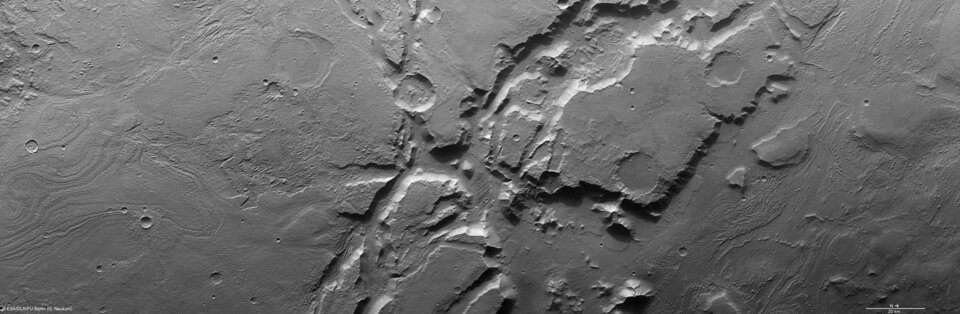
Deep valleys are incised into the highlands in the northern part of the scene showing linear features on the floor of the valley. Similar linear features are also seen in the lower part of the picture but the morphology is different from the region in the upper part in that there are no incisions. Also, the area is far less cratered and hence the erosion must be of a relatively recent origin.

Scientists have reason to believe that the valleys might primarily originate from tectonic activity.

This black and white high resolution image was derived from the nadir channel, which provides the highest level of detail. It is a mosaic of pictures derived from orbits 4136 and 4147.
Credits: ESA/DLR/FU Berlin (G. Neukum)


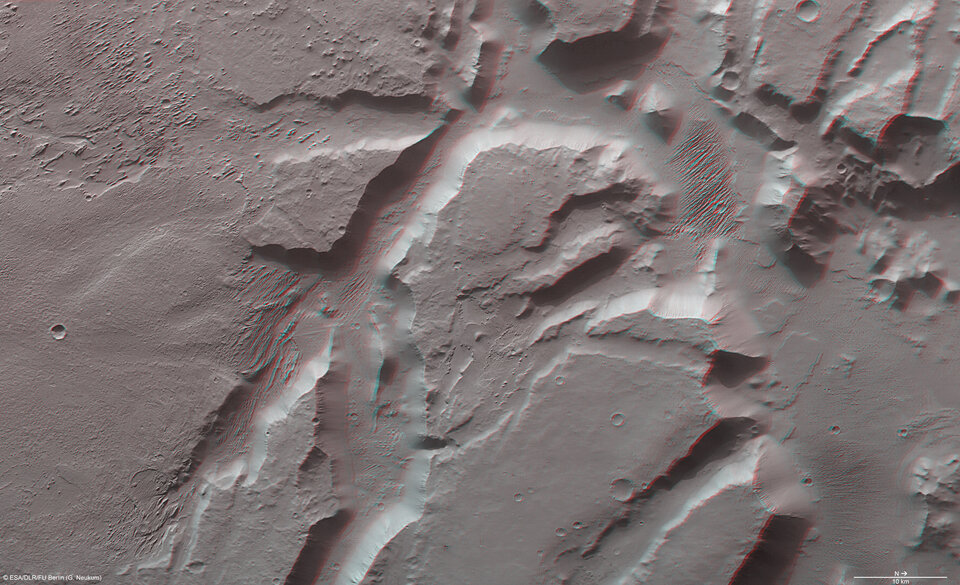
Aeolis Mensae North, anaglyph image
Download:
 HI-RES JPEG (Size: 5018 kb)  HI-RES TIFF (Size: 34 410 kb)
Mars Express’ High Resolution Stereo Camera (HRSC) has provided snapshots of the Aeolis Mensae region on the Red Planet.

The region, imaged on 26 and 29 March 2007, during Mars Express orbit number 4136 and 4247, is located at approximately 6° South and 145° East.

Deep valleys are incised into the highlands in the northern part of the scene showing linear features on the floor of the valley. Similar linear features are also seen in the lower part of the picture but the morphology is different from the region in the upper part in that there are no incisions. Also, the area is far less cratered and hence the erosion must be of a relatively recent origin.

Scientists have reason to believe that the valleys might primarily originate from tectonic activity.

This 3D (anaglyph) image was calculated by putting together data from the nadir channel and one of the stereo channels.

Credits: ESA/DLR/FU Berlin (G. Neukum)


Aeolis Mensae South, anaglyph image
Download:
 HI-RES JPEG (Size: 21 257 kb)  HI-RES TIFF (Size: 33 600 kb)
Mars Express’ High Resolution Stereo Camera (HRSC) has provided snapshots of the Aeolis Mensae region on the Red Planet.

The region, imaged on 26 and 29 March 2007, during Mars Express orbit number 4136 and 4247, is located at approximately 6° South and 145° East.

The morphology of the terrain, which lies close to the volcanic region of Elysium, is characterised by an extensive transition zone or the so-called ‘global crustal dichotomy boundary’ which separates the southern highlands and northern lowlands. It exhibits clod-shaped or lumpy relief separated by valleys and intermediated graben features, or elongated, trench-like structures, which are eroded landforms.

Aeolis Mensae is located at the border of the northern plains and the southern highlands, indicated by the transition zone. Between the highlands and the plains there is a large average difference in elevation, of about 3000 metres. The origin of this dichotomy is currently a subject of discussion.

This 3D (anaglyph) image was calculated by putting together data from the nadir channel and one of the stereo channels.

Credits: ESA/DLR/FU Berlin (G. Neukum)


Mars Express image browser
Related articles
Breathtaking views of Deuteronilus Mensae on MarsThe first hiking maps of MarsCydonia's 'Face on Mars' in 3D animationSpacecraft fleet zeroing in on Martian water reservesMars Express scientists find a different Mars underneathKasei Valles outflow channel systemGranicus and Tinjar VallesChaotic terrain in Iani ChaosAncient caldera in Apollinaris PateraHeavily eroded Aram ChaosLava tubes on Pavonis Mons
Related links
High Resolution Stereo Camera


   Copyright 2000 - 2010 © European Space Agency. All rights reserved.