Where are the supermassive black holes hiding?
European and American scientists, on a quest to find super-massive black holes hiding in nearby galaxies, have found surprisingly few. Either the black holes are better hidden than scientists realised or they are lurking only in the more distant universe.
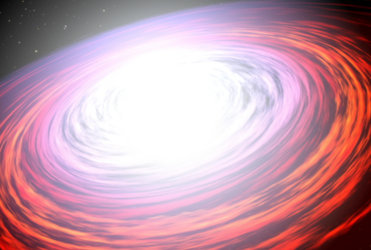
Scientists are convinced that some super-massive black holes must be hiding behind thick clouds of dust. These dusty shrouds allow only the highest energy X-rays to shine through. Once in space, the X-rays combine into a cosmic background of X-rays that permeates the whole of space.
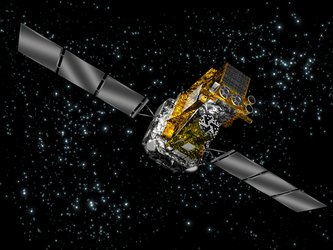
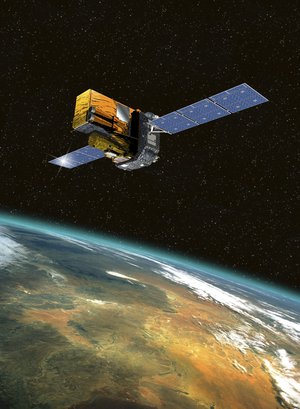
The search for hidden black holes is part of the first census of the highest-energy part of the X-ray sky. Led by Loredana Bassani, IASF, Italy, a team of astronomers published results in The Astrophysical Journal Letters in January this year. They show the fraction of hidden black holes in the nearby Universe to be around 15 percent, using data from ESA’s orbiting gamma-ray observation, the International Gamma Ray Astrophysics Laboratory (Integral).
Now astronomers from NASA Goddard Space Flight Center in Greenbelt, Maryland, and the Integral Science Data Centre near Geneva, Switzerland, have found an even smaller fraction using nearly two years of continuous data, also from Integral. The work shows that there is clearly too few hidden black holes in the nearby Universe to create the observed X-ray background radiation.
"Naturally, it is difficult to find something we know is hiding well and which has eluded detection so far," says Volker Beckmann of NASA Goddard and the University of Maryland, Baltimore County, lead author of the new report to be published in an upcoming issue of The Astrophysical Journal. "Integral is a telescope that should see nearby hidden black holes, but we have come up short," he says.
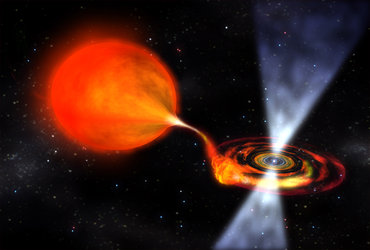
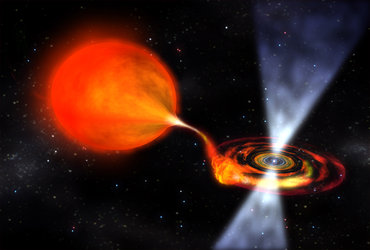
The X-ray sky is thousands to millions of times more energetic than the visible sky familiar to our eyes. Much of the X-ray activity is thought to come from black holes violently sucking in gas from their surroundings.
Recent breakthroughs in X-ray astronomy, including a thorough black hole census taken by NASA's Chandra X-ray Observatory and Rossi X-ray Timing Explorer, have all dealt with lower-energy X-rays. The energy range is roughly 2 000 to 20 000 electron-volts (optical light, in comparison, is about 2 electron-volts). The two Integral surveys are the first glimpse into the largely unexplored higher-energy, or 'hard', X-ray regime of 20 000 to 300 000 electron-volts.
"The X-ray background, this pervasive blanket of X-ray light we see everywhere in the universe, peaks at about 30 000 electron volts, yet we really know next to nothing about what produces this radiation," says Neil Gehrels of NASA Goddard, a co-author.
The theory is that hidden black holes, which scientists call Compton-thick objects, are responsible for the 30 000 electron-volts peak of X-rays in the cosmic X-ray background. Integral is the first satellite sensitive enough to search for them in the local universe.

According to Beckmann, of all the black hole galaxies that Integral detected less than 10 percent were the heavily shrouded 'Compton thick' variety. That has serious implications for explaining where the X-rays in the cosmic X-ray background come from.
"The hidden black holes we have found so far can contribute only a few percent of the power to the cosmic X-ray background," says Bassani. This implies that if hidden black holes make up the bulk of the X-ray background, they must be located much further away in the more distant universe. Why would this be? One reason could be that in the local universe most super-massive black holes have had time to eat or blow away all the gas and dust that once enshrouded them, leaving them revealed.
This would make them less able to produce X-rays because it is the heating of the gas falling into the black hole that generates the X-rays, not the hole itself. So, if the black hole had cleared its surroundings of matter there would be nothing left to produce X-rays.
Conversely, another possibility is that perhaps the hidden black holes are more hidden than astronomers realised. "The fact that we do not see them does not necessarily mean that they are not there, just that we don’t see them. Perhaps they are more deeply hidden than we think and so are therefore below even Integral's detection limit," says Bassani.
Meanwhile, the NASA team is now planning to extend his search for hidden black holes further out into the universe. "This is just the tip of the iceberg. In a few more months we will have a larger survey completed with the Swift mission. Our goal is to push this kind of observation deeper and deeper into the universe to see black hole activity at early epochs. That’s the next great challenge for X-ray and gamma-ray astronomers," concluded Beckmann.
Notes to editors:
The findings appear in The Astrophysical Journal, in an article titled "Integral IBIS Extragalactic survey: Active Galactic Nuclei Selected at 20-100 keV", by L. Bassani et al., published on 10 January 2006 (vol. 636, pp L65-L68).
The other scientific paper on which this story is based is "The Hard X-ray 20-40keV AGN Luminosity Function" by V. Beckmann et al., accepted for publication in a future issue of The Astrophysical Journal. A pre-print of the paper can be downloaded at: arxiv.org/abs/astro-ph/0606687.
For more information:
Loredana Bassani, IASF-CNR, Italy
Email: bassani @ bo.iasf.cnr.it
Volker Beckmann, NASA GSFC and the University of Maryland, USA
Email: beckmann @ milkyway.gsfc.nasa.gov
Christoph Winkler, ESA Integral Project Scientist
Email: cwinkler @ rssd.esa.int