ESAHome
   
Space Science
About Space ScienceESA's 'Cosmic Vision'Science & Technology in-depth
Multimedia
Science imagesScience videosAnimationsDownloadsSounds from spaceRSS feeds
Media centre
Press ReleasesPress kitsESA Television
Resources
Reference sectionGlossaryFAQs
Science missions
Services
HelpLegal disclaimerCommentsSubscribe Bookmark and Share


Article Images
Traces of the martian past in the Terby crater
 
25 January 2008

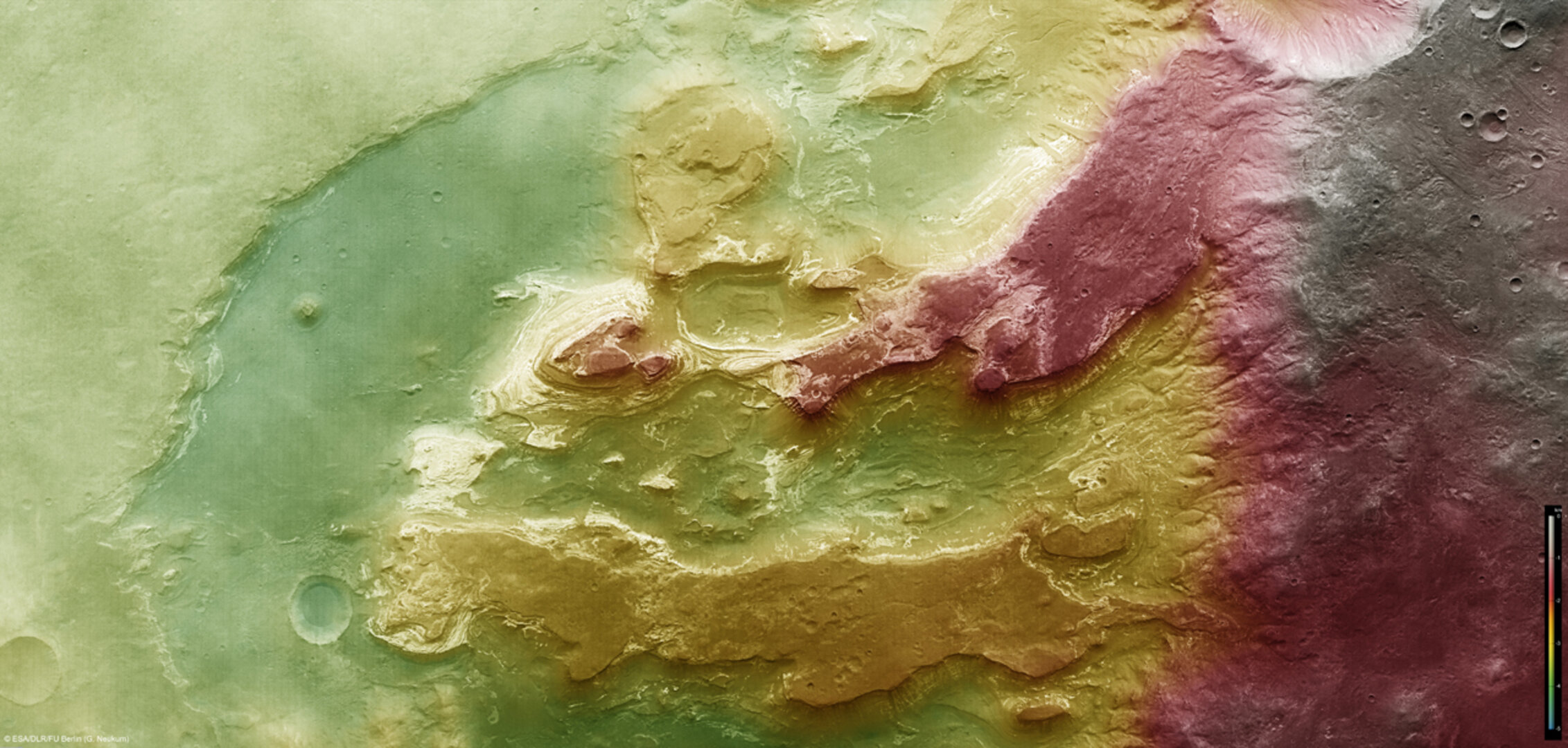
Terby crater in false colour
Download:
 HI-RES JPEG (Size: 729 kb)  HI-RES TIFF (Size: 46 000 kb)
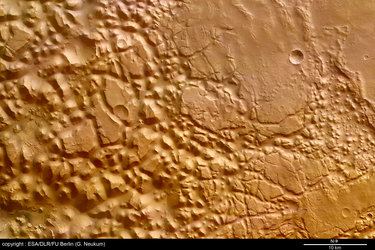
This false-colour image of Terby crater on Mars was derived from three HRSC colour channels and the nadir channel of the High Resolution Stereo Camera (HRSC) on board ESA’s Mars Express orbiter. The Terby crater region is of great scientific interest as sediments there reveal information on the role of water in the history of the planet.

The image data was obtained on 13 April 2007 during orbit 4199, with a ground resolution of approximately 13 m/pixel. The Sun illuminates the scene from the west (from above in the image).

Terby crater lies at approximately 27° south and 74° east. It is located at the northern edge of the Hellas Planitia impact basin in the southern hemisphere of Mars.

The crater, named after the Belgian astronomer Francois J. Terby (1846 – 1911), has a diameter of approximately 170 km. The scene shows a section of a second impact crater in the northern part of Terby crater.

Credits: ESA/DLR/FU Berlin (G. Neukum)


Terby crater context map
Download:
 HI-RES JPG (Size: 277 kb)  HI-RES TIFF (Size: 1346 kb)
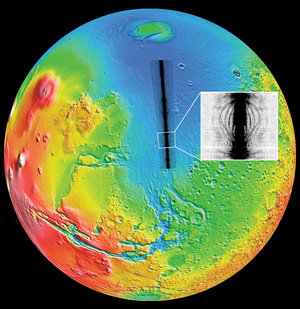
Context map of Terby crater. The region is of great scientific interest as sediments there hold information on the role of water in the history of the planet.

Terby crater lies at approximately 27° south and 74° east. It is located at the northern edge of the Hellas Planitia impact basin in the southern hemisphere of Mars.

Credits: FU Berlin/ MOLA


Terby crater
Download:
 HI-RES JPEG (Size: 924 kb)  HI-RES TIFF (Size: 52 321 kb)
This image of Terby crater was derived from three HRSC colour channels and the nadir channel of the High Resolution Stereo Camera (HRSC) on board ESA’s Mars Express orbiter. The Terby crater region is of great scientific interest as sediments there hold information on the role of water in the history of the planet.

The image data was obtained on 13 April 2007 during orbit 4199, with a ground resolution of approximately 13 m/pixel. The Sun illuminates the scene from the west (from above in the image).

Terby crater lies at approximately 27° south and 74° east. It is located at the northern edge of the Hellas Planitia impact basin in the southern hemisphere of Mars.

The crater, named after the Belgian astronomer Francois J. Terby (1846 – 1911), has a diameter of approximately 170 km. The scene shows a section of a second impact crater in the northern part of Terby crater.

Credits: ESA/DLR/FU Berlin (G. Neukum)


Terby crater: annotated nadir view
Download:
 HI-RES JPEG (Size: 540 kb)  HI-RES TIFF (Size: 21 721 kb)
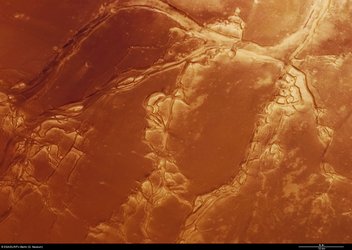
Eye-catching finger-shaped plateaux extend in the north-south direction (1). They rise up to 2000 m above the surrounding terrain. The relatively old crater was filled with sediments in the past, which formed plateaux on erosion.

The flanks of the plateaux clearly exhibit layering of different-coloured material (2). Differences in colour usually indicate changes in the composition of the material and such layering is called ‘bedding’. Bedding structures are typical of sedimentary rock, which has been deposited either by wind or water. Different rock layers erode differently, forming terraces (3).

The valleys (4) exhibit gullies, or channels cut in the ground by running liquid, mainly in the northern part of the image. These gullies and the rock-bedding structure indicate that the region has been affected by water.

Credits: ESA/DLR/FU Berlin (G. Neukum)


Terby crater, perspective view
Download:
 HI-RES JPEG (Size: 1047 kb)  HI-RES TIFF (Size: 25 192 kb)
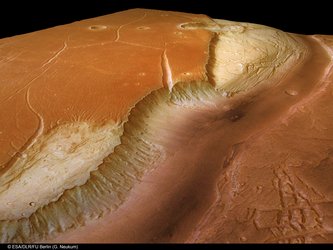
The High Resolution Stereo Camera (HRSC) on board ESA’s Mars Express orbiter imaged the Terby crater on Mars on 13 April 2007 during orbit 4199. The region is of great scientific interest as sediments there hold information on the role of water in the history of the planet.

Eye-catching finger-shaped plateaux extend in the north-south direction. They rise up to 2000 m above the surrounding terrain. The relatively old crater was filled with sediments in the past, which formed plateaux on erosion.

The flanks of the plateaux clearly exhibit layering of different-coloured material. Differences in colour usually indicate changes in the composition of the material and such layering is called ‘bedding’. Bedding structures are typical of sedimentary rock, which has been deposited either by wind or water. Different rock layers erode differently, forming terraces.

The valleys exhibit gullies, or channels cut in the ground by running liquid, mainly in the northern part of the image. These gullies and the rock-bedding structure indicate that the region has been affected by water.

This perspective view was calculated from the digital terrain model derived from the HRSC stereo channels.

Credits: ESA/DLR/FU Berlin (G. Neukum)


A perspective view of Terby crater
Download:
 HI-RES JPEG (Size: 1635 kb)  HI-RES TIFF (Size: 25 250 kb)
The High Resolution Stereo Camera (HRSC) on board ESA’s Mars Express orbiter imaged the Terby crater on Mars on 13 April 2007 during orbit 4199. The region is of great scientific interest as sediments there reveal information on the role of water in the history of the planet.

Eye-catching finger-shaped plateaux extend in the north-south direction. They rise up to 2000 m above the surrounding terrain. The relatively old crater was filled with sediments in the past, which formed plateaux on erosion.

The flanks of the plateaux clearly exhibit layering of different-coloured material. Differences in colour usually indicate changes in the composition of the material and such layering is called ‘bedding’. Bedding structures are typical of sedimentary rock, which has been deposited either by wind or water. Different rock layers erode differently, forming terraces.

The valleys exhibit gullies, or channels cut in the ground by running liquid, mainly in the northern part of the image. These gullies and the rock-bedding structure indicate that the region has been affected by water.

This perspective view was calculated from the digital terrain model derived from the HRSC stereo channels.

Credits: ESA/DLR/FU Berlin (G. Neukum)


Terby crater, nadir view
Download:
 HI-RES JPEG (Size: 569 kb)  HI-RES TIFF (Size: 21 778 kb)
This image of Terby crater was derived from the nadir channel of the High Resolution Stereo Camera (HRSC) on board ESA’s Mars Express orbiter. The Terby crater region is of great scientific interest as sediments there reveal information on the role of water in the history of the planet.

The image data was obtained on 13 April 2007 during orbit 4199, with a ground resolution of approximately 13 m/pixel. The Sun illuminates the scene from the west (from above in the image).

Terby crater lies at approximately 27° south and 74° east. It is located at the northern edge of the Hellas Planitia impact basin in the southern hemisphere of Mars.

The crater, named after the Belgian astronomer Francois J. Terby (1846 – 1911), has a diameter of approximately 170 km. The scene shows a section of a second impact crater in the northern part of Terby crater.

Credits: ESA/DLR/FU Berlin (G. Neukum)


Terby crater, 3D view
Download:
 HI-RES JPEG (Size: 935 kb)  HI-RES TIFF (Size: 46 100 kb)
The High Resolution Stereo Camera (HRSC) on board ESA’s Mars Express orbiter imaged the Terby crater on Mars. The region is of great scientific interest as sediments there reveal information on the role of water in the history of the planet.

The image data was obtained on 13 April 2007 during orbit 4199, with a ground resolution of approximately 13 m/pixel. The Sun illuminates the scene from the west (from above in the image).

Terby crater lies at approximately 27° south and 74° east. It is located at the northern edge of the Hellas Planitia impact basin in the southern hemisphere of Mars.

The crater, named after the Belgian astronomer Francois J. Terby (1846 – 1911), has a diameter of approximately 170 km. The scene shows a section of a second impact crater in the northern part of Terby crater.

This 3D anaglyph image was calculated from the nadir channel and one stereo channel, stereoscopic glasses are required for viewing.

Credits: ESA/DLR/FU Berlin (G. Neukum)


Mars Express image browser
Related articles
Noctis Labyrinthus, labyrinth of the nightHummocky and shallow Maunder craterThe mysterious ridges at the mouth of Tiu VallesImpact Craters in Tyrrhena TerraTectonic signatures at Aeolis MensaeBreathtaking views of Deuteronilus Mensae on MarsThe first hiking maps of MarsCydonia's 'Face on Mars' in 3D animationSpacecraft fleet zeroing in on Martian water reservesMars Express scientists find a different Mars underneathKasei Valles outflow channel systemGranicus and Tinjar VallesChaotic terrain in Iani Chaos
Related links
High Resolution Stereo CameraBehind the lens...


   Copyright 2000 - 2010 © European Space Agency. All rights reserved.