• → European Space Agency

      • Space for Europe
      • Space News
      • Space in Images
      • Space in Videos
    • About Us

      • Welcome to ESA
      • DG's News and Views
      • For Member State Delegations
      • Business with ESA
      • ESA Exhibitions
      • ESA Publications
      • Careers at ESA
    • Our Activities

      • Space News
      • Observing the Earth
      • Human Spaceflight
      • Launchers
      • Navigation
      • Space Science
      • Space Engineering
      • Operations
      • Technology
      • Telecommunications & Integrated Applications
    • For Public

    • For Media

      • Media
      • ESA TV
      • Videos for professionals
      • Photos
    • For Educators

    • For Kids

    • ESA

    • Space Science

    • Our Universe
    • About Space Science
    • ESA's 'Cosmic Vision'
    • Science missions
    • Mission navigator
    • Target groups
    • For Media
    • For Scientists
    • For Kids
    • Multimedia
    • Science images
    • Science videos
    • Animations
    • Downloads
    • Sounds from space
    • Resources
    • Reference section
    • Services
    • FAQs
    • Glossary
    • Help
    • Portal terms of use
    • Comments
    • Follow us
    • RSS feeds
    • ESA Sci on Twitter
    • ESA Space Science Images on Flickr
    • ESA 3D on Flickr

    ESA > Our Activities > Space Science

    Contact for further information

    Notes to editors
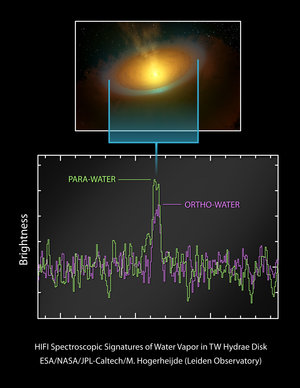
    HIFI is the Heterodyne Instrument for the Far-Infrared spectrometer on the Herschel Space Observatory. It was designed to observe water in a wide variety of objects, and aims to study not only planet-forming discs and star formation, but also galactic evolution. Its capability for highly detailed chemical identification of individual atoms and molecules makes it the instrument of choice for studying chemistry throughout space, particularly around embryonic and dying stars.

    Related publications
    M. Hogerheijde, et al., "Detection of the Water Reservoir in a Forming Planetary System", 2011, Science, Vol. 334 no. 6054 pp. 338-340. DOI: 10.1126/science.1208931

    05 Oct 2011 - Herschel finds first evidence of Earth-like water in a comet

    Contacts

    Markus Bauer
    ESA Science and Robotic Exploration Communication Officer
    Email: markus.bauer@esa.int
    Tel: +31 71 565 6799
    Mob: +31 61 594 3 954

    Michiel Hogerheijde
    Leiden Observatory
    Tel: +31 71 527 5590
    Email: michiel@strw.leidenuniv.nl

    Göran Pilbratt
    ESA Herschel Project Scientist
    Tel: +31 71 565 3621
    Email: gpilbratt@rssd.esa.int

    Rate this

    Views

    Share

    • Currently 0 out of 5 Stars.
    • 1
    • 2
    • 3
    • 4
    • 5
    Rating: 0/5 (0 votes cast)

    Thank you for rating!

    You have already rated this page, you can only rate it once!

    Your rating has been changed, thanks for rating!

    19
    Tweet
    • Herschel: ESA's giant infrared observatory
    • More about
    • Herschel overview
      • Other Herschel First Science Stories
      • Online Showcase of Herschel Images OSHI
      • Herschel on YouTube
      • Inside Herschel
      • Herschel mission objectives
      • Related articles
        • Herschel detects abundant water in planet-forming disc
          • Did Earth's oceans come from comets?
            • Herschel paints new story of galaxy evolution
              • Astronomers searching for oxygen can breathe more easily
                • Enceladus rains water onto Saturn
                  • Raging storms sweep away galactic gas
                    • Herschel links star formation to sonic booms
                      • Herschel finds less dark matter but more stars
                        • Andromeda’s once and future stars
                          • Recipe for water: just add starlight
                            • Herschel and Planck win the French Grand Prix
                              • Herschel finds a hole in space
                                • Herschel reveals the hidden side of star birth
                                  • Herschel takes the temperature of an interstellar cloud
                                    • Tracing the Milky Way’s hidden reservoirs of gas
                                      • Herschel resolves the cosmic infrared fog
                                        • Baby stars in the Rosette cloud
                                          • Inside the dark heart of the Eagle
                                            • Herschel views deep-space pearls on a cosmic string
                                            • Read more
                                              • Observations: Seeing in infrared wavelengths
                                                • Why infrared astronomy is a hot topic
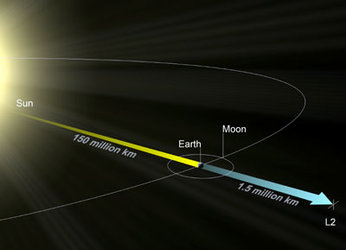
                                                  • L2, the second Lagrangian Point
                                                  • In depth
                                                  • This story in depth
                                                  • Herschel in depth

    Connect with us

    • RSS
    • Youtube
    • Twitter
    • Flickr
    • G+
    • Facebook
    • Livestream
    • Subscribe
    • App Store
    • ESA Science Twitter

    Follow ESA science

    • LATEST ARTICLES
    • · Rare merger reveals secrets of gal…
    • · Watching for hazards: ESA opens as…
    • · ESA astronaut Timothy Peake set fo…
    • · Space drives e-mobility
    • · Proba-V opens its eyes
    • FAQ

    • Jobs at ESA

    • Site Map

    • Contacts

    • Terms and conditions