• → European Space Agency

      • Space for Europe
      • Space News
      • Space in Images
      • Space in Videos
    • About Us

      • Welcome to ESA
      • DG's News and Views
      • For Member State Delegations
      • Business with ESA
      • ESA Exhibitions
      • ESA Publications
      • Careers at ESA
    • Our Activities

      • Space News
      • Observing the Earth
      • Human Spaceflight
      • Launchers
      • Navigation
      • Space Science
      • Space Engineering
      • Operations
      • Technology
      • Telecommunications & Integrated Applications
    • For Public

    • For Media

    • For Educators

    • For Kids

    • ESA

    • Space Science

    • Our Universe
    • About Space Science
    • ESA's 'Cosmic Vision'
    • Science missions
    • Mission navigator
    • Target groups
    • For Media
    • For Scientists
    • For Kids
    • Multimedia
    • Science images
    • Science videos
    • Animations
    • Downloads
    • Sounds from space
    • Resources
    • Reference section
    • Services
    • FAQs
    • Glossary
    • Help
    • Portal terms of use
    • Comments
    • Follow us
    • RSS feeds
    • ESA Sci on Twitter
    • ESA Space Science Images on Flickr
    • ESA 3D on Flickr

    ESA > Our Activities > Space Science

    Extensional tectonics in Tempe Terra

    Extensional tectonics in Tempe Terra

    8 May 2006

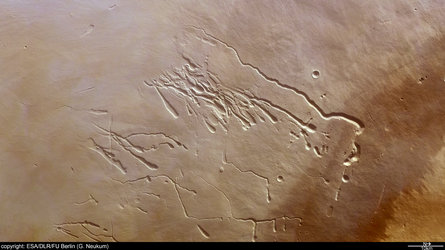
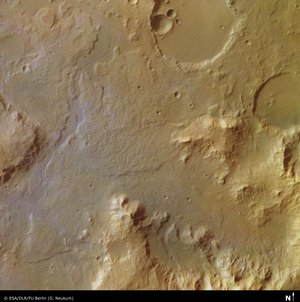
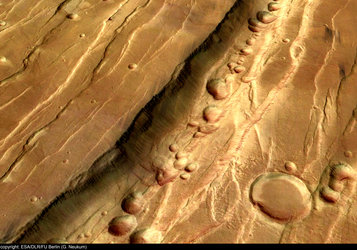
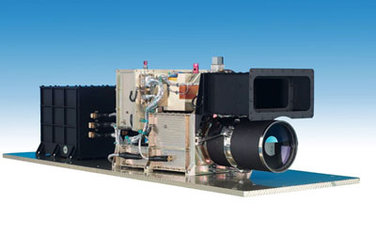
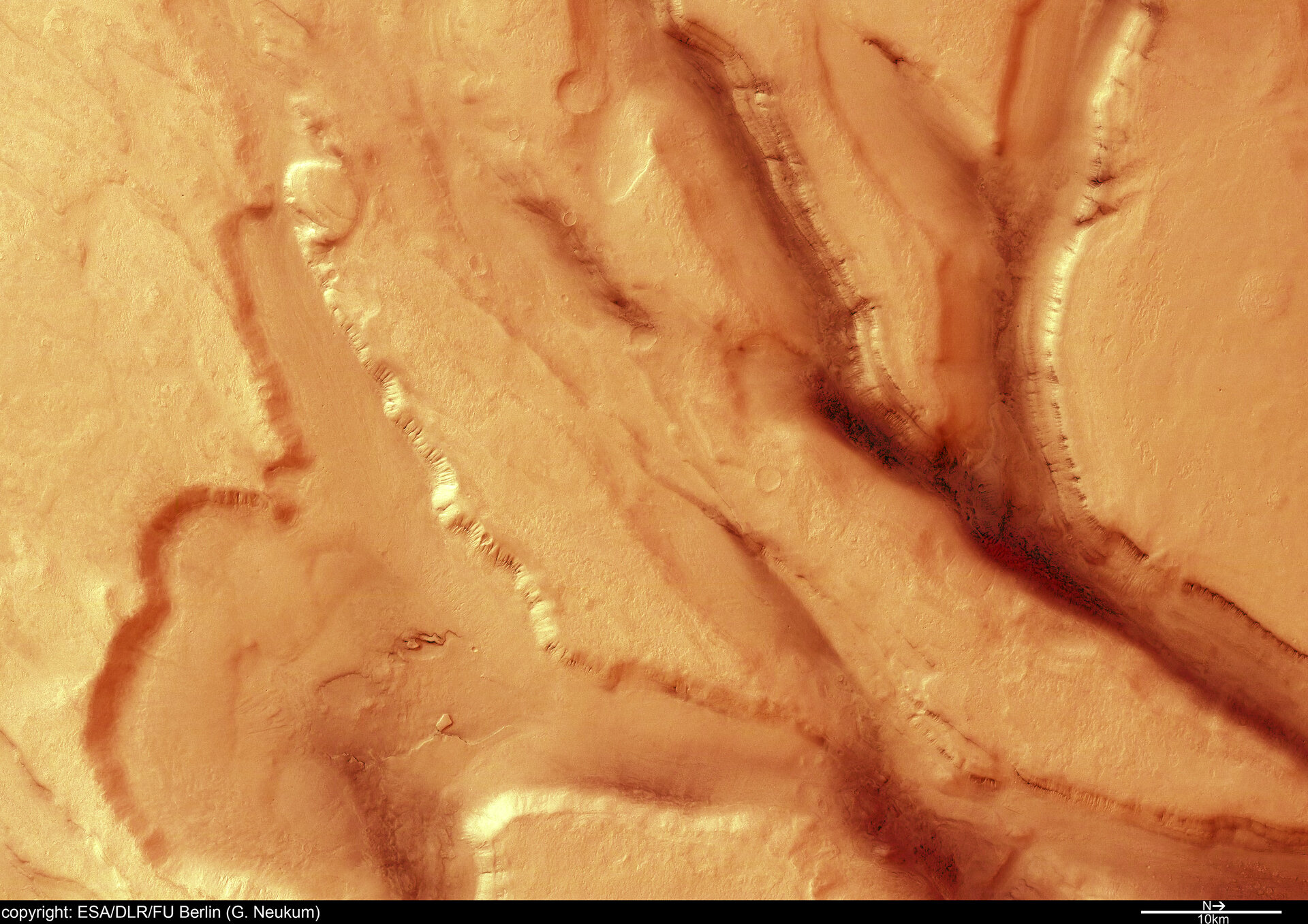
    These images, taken by the High Resolution Stereo Camera (HRSC) on board ESA's Mars Express spacecraft, show the tectonic 'grabens' in Tempe Terra, a geologically complex region that is part of the old Martian highlands.

    The HRSC obtained these images during orbit 1180 on 19 December 2004 with a ground resolution of approximately 16.5 metres per pixel. The data were acquired in the region of Northern Olympus Mons, at approximately 48.5° North and 288.4° East.

    The Tempe Terra region of Mars displays a complex geologic history; the images were taken just west of the Barabashov crater and cover the transition zone between the old Martian highlands to the south and the geologically younger northern lowlands.


    Map showing Tempe Terra in context
    Map showing Tempe Terra in context

    The context map is centred on the region of Mareotis Fossae showing numerous parallel grabens, or depressed blocks of land bordered by parallel faults, running in a Northeast-Southwest orientation. These appear in more detail in the south (left) of the camera images.

    Tectonic processes (extensional stresses, in this case) have led to the development of these grabens. After the tectonic activity, other processes reshaped the landscape. In the scene, the results of weathering and mass transport can be seen. Due to erosion, the surface has been smoothed, giving formerly sharp edges a rounded appearance. Such terrain is called "fretted terrain" and is characteristic for the transition of highland to lowland.

    Black and white nadir view of grabens in Tempe Terra
    Black and white nadir view of grabens in Tempe Terra

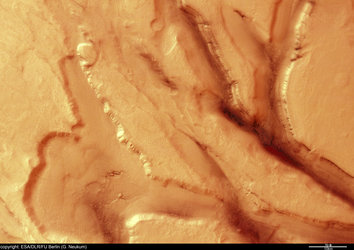
    The valleys and grabens are 5 to 10 kilometres wide and up to 1500 metres deep. Along the graben flanks, the layering of the bedrock is exposed. The lineations on the valley floors are attributed to a slow viscous movement of material, presumably in connection with ice. These lineations and indications of possible ice underneath the surface lead scientists to assume that the structures are rock glaciers or similar phenomena known from alpine regions on Earth.

    The stereo and colour capabilities, and the high-resolution coverage of extended areas, provided by the HRSC camera allow for improved study of the complex geologic evolution of the Red Planet. The Mars Express HRSC camera gives scientists the opportunity to better understand the tectonics of Mars, including processes active in the more recent geologic history.

    3D anaglyph view of grabens in Tempe Terra
    3D anaglyph view of grabens in Tempe Terra

    The colour scene was derived from the three HRSC-colour channels and the nadir channel. The 3D anaglyph image was calculated from the nadir and one stereo channel. Image resolution has been decreased for use on the internet.

    For more information on Mars Express HRSC images, please read our updated FAQ (frequently asked questions).
    Rate this

    Views

    Share

    • Currently 0 out of 5 Stars.
    • 1
    • 2
    • 3
    • 4
    • 5
    Rating: 0/5 (0 votes cast)

    Thank you for rating!

    You have already rated this page, you can only rate it once!

    Your rating has been changed, thanks for rating!

    122
    Tweet
    • Mars Express image browser
    • Recent images
      • Lava tubes on Pavonis Mons
        • Extensional tectonics in Tempe Terra
          • Nanedi Valles system on Mars
            • 'Happy face' crater on Mars
              • The Libya Montes valley on Mars
                • 'Hourglass'-shaped crater - new video and perspectives
                  • Eastern scarp of Olympus Mons
                    • Ausonia Mensa remnant massif
                      • Pits and tectonic grabens in Phlegethon Catena
                        • Claritas Fossae region of Mars
                          • Sulphate deposits in Juventae Chasma
                            • ‘Butterfly’ impact crater in Hesperia Planum
                              • Fly over the Chasma Boreale at Martian north pole
                                • The Biblis Patera volcano
                                • High Resolution Stereo Camera
                                  • Behind the lens...

    Connect with us

    • RSS
    • Youtube
    • Twitter
    • Flickr
    • G+
    • Facebook
    • Livestream
    • Subscribe
    • App Store
    • ESA Science Twitter

    Follow ESA science

    • LATEST ARTICLES
    • · Proba-V opens its eyes
    • · First new Galileo satellite arrive…
    • · Next destination: space
    • · Leak repaired on International Spa…
    • · After Chelyabinsk: European expert…
    • FAQ

    • Jobs at ESA

    • Site Map

    • Contacts

    • Terms and conditions