• → European Space Agency

      • Space for Europe
      • Space News
      • Space in Images
      • Space in Videos
    • About Us

      • Welcome to ESA
      • DG's News and Views
      • For Member State Delegations
      • Business with ESA
      • ESA Exhibitions
      • ESA Publications
      • Careers at ESA
    • Our Activities

      • Space News
      • Observing the Earth
      • Human Spaceflight
      • Launchers
      • Navigation
      • Space Science
      • Space Engineering
      • Operations
      • Technology
      • Telecommunications & Integrated Applications
    • For Public

    • For Media

      • Media
      • ESA TV
      • Videos for professionals
      • Photos
    • For Educators

    • For Kids

    • ESA

    • Launch Special

    • Herschel

    • Planck

    • ESA Science

    • About Herschel

      • Herschel at a glance
      • Science objectives
      • Herschel highlights
      • History of infrared astronomy
    • The infrared Universe

      • Why the infrared?
      • More about the infrared
      • The infrared revolution
    • Spacecraft and telescope

      • Vital stats
      • The largest infrared space telescope
      • Instruments
      • Cutting-edge spacecraft
    • The mission

      • Journey
      • Early operations
      • Operating Herschel
    • Meet the team

      • Herschel Project Scientist: An interview with Göran Pilbratt
      • Herschel and Planck Programme Manager: An interview with Thomas Passvogel
    • Multimedia
    • Herschel images
    • Herschel videos

    ESA > Our Activities > Space Science > Herschel

    Did Earth's oceans come from comets?

    Comet Hartley 2 observed by ESA’s Herschel
    5 October 2011

    ESA's Herschel infrared space observatory has found water in a comet with almost exactly the same composition as Earth's oceans. The discovery revives the idea that our planet's seas could once have been giant icebergs floating through space.

    The origin of Earth's water is hotly debated. Our planet formed at such high temperatures that any original water must have evaporated. Yet today, two-thirds of the surface is covered in water and this must have been delivered from space after Earth cooled down.

    Comets seem a natural explanation: they are giant icebergs travelling through space with orbits that take them across the paths of the planets, making collisions possible. The impact of comet Shoemaker-Levy 9 on Jupiter in 1994 was one such event. But in the early Solar System, when there were larger numbers of comets around, collisions would have been much more common.

    However, until now, astronomers' observations have failed to back up the idea that comets provided Earth's water. The key measurement they make is the level of deuterium – a heavier form of hydrogen – found in water.

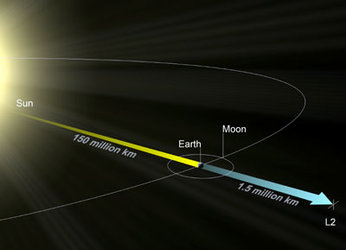
    Comet Hartley 2’s orbit in context
    Comet Hartley 2’s orbit in context

    All the deuterium and hydrogen in the Universe was made just after the Big Bang, about 13.7 billion years ago, fixing the overall ratio between the two kinds of atoms. However, the ratio seen in water can vary from location to location. The chemical reactions involved in making ice in space lead to a higher or lower chance of a deuterium atom replacing one of the two hydrogen atoms in a water molecule, depending on the particular environmental conditions.

    Thus, by comparing the deuterium to hydrogen ratio found in the water in Earth's oceans with that in extraterrestrial objects, astronomers can aim to identify the origin of our water.

    All comets previously studied have shown deuterium levels around twice that of Earth's oceans. If comets of this kind had collided with Earth, they could not have contributed more than a few percent of Earth's water. In fact, astronomers had begun to think that meteorites had to be responsible, even though their water content is much lower.

    Now, however, Herschel has studied comet Hartley 2 using HIFI, the most sensitive instrument so far for detecting water in space, and has shown that at least this one comet does have ocean-like water.

    "Comet Hartley's deuterium-to-hydrogen ratio is almost exactly the same as the water in Earth's oceans," says Paul Hartogh, Max-Planck-Institut für Sonnensystemforschung, Katlenburg-Lindau, Germany, who led the international team of astronomers in this work.
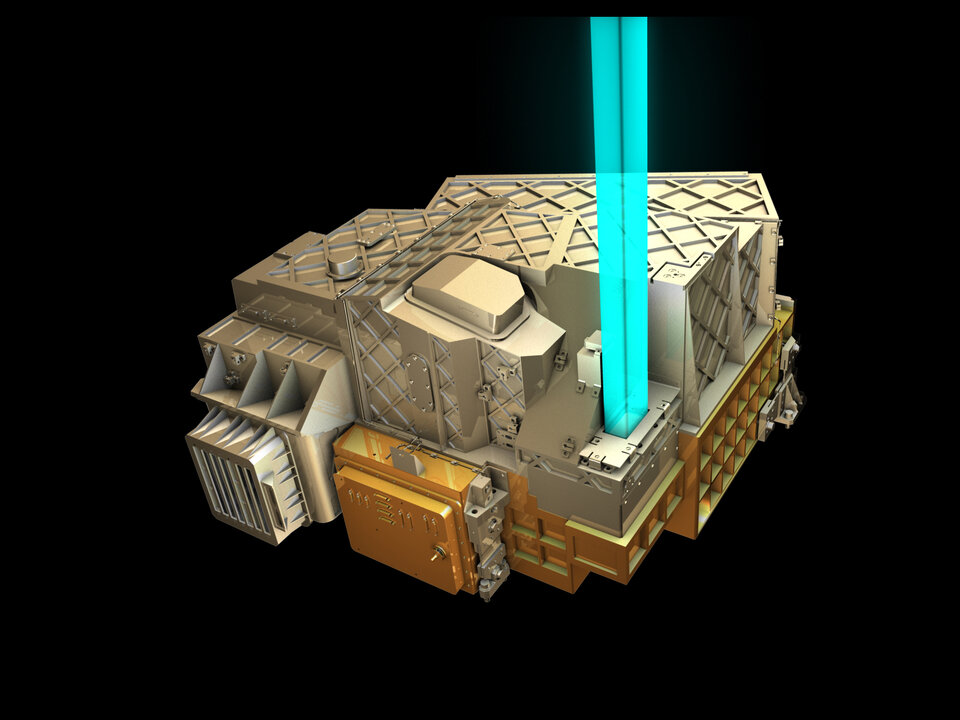

    HIFI
    HIFI

    The key to why comet Hartley 2 is different may be because of where it was born: far beyond Pluto, in a frigid region of the Solar System known as the Kuiper Belt.

    The other comets previously studied by astronomers are all thought to have formed near to Jupiter and Saturn before being thrown out by the gravity of those giant planets, only to return much later from great distances.

    Thus the new observations suggest that perhaps Earth's oceans came from comets after all – but only a specific family of them, born in the outer Solar System. Out there in the deep cold, the deuterium to hydrogen ratio imprinted into water ice might have been quite different from that which arose in the warmer inner Solar System.

    Herschel is now looking at other comets to see whether this picture can be backed up.

    "Thanks to this detection made possible by Herschel, an old, very interesting discussion will be revived and invigorated," says Göran Pilbratt, ESA Herschel Project Scientist.

    "It will be exciting to see where this discovery will take us."

    Contact for further information

    Rate this

    Views

    Share

    • Currently 4 out of 5 Stars.
    • 1
    • 2
    • 3
    • 4
    • 5
    Rating: 4.2/5 (5 votes cast)

    Thank you for rating!

    You have already rated this page, you can only rate it once!

    Your rating has been changed, thanks for rating!

    907
    Tweet
    • Herschel: ESA's giant infrared observatory
    • More about
    • Herschel overview
      • Other Herschel First Science Stories
      • Online Showcase of Herschel Images OSHI
      • Herschel on YouTube
      • Inside Herschel
      • Herschel mission objectives
      • Related articles
        • Did Earth's oceans come from comets?
          • Herschel paints new story of galaxy evolution
            • Astronomers searching for oxygen can breathe more easily
              • Enceladus rains water onto Saturn
                • Raging storms sweep away galactic gas
                  • Herschel links star formation to sonic booms
                    • Herschel finds less dark matter but more stars
                      • Andromeda’s once and future stars
                        • Recipe for water: just add starlight
                          • Herschel and Planck win the French Grand Prix
                            • Herschel finds a hole in space
                              • Herschel reveals the hidden side of star birth
                                • Herschel takes the temperature of an interstellar cloud
                                  • Tracing the Milky Way’s hidden reservoirs of gas
                                    • Herschel resolves the cosmic infrared fog
                                      • Baby stars in the Rosette cloud
                                        • Inside the dark heart of the Eagle
                                          • Herschel views deep-space pearls on a cosmic string
                                          • Read more
                                            • Observations: Seeing in infrared wavelengths
                                              • Why infrared astronomy is a hot topic
                                                • L2, the second Lagrangian Point
                                                • In depth
                                                • This story in depth
                                                • Herschel in depth

    Connect with us

    • RSS
    • Youtube
    • Twitter
    • Flickr
    • G+
    • Facebook
    • Livestream
    • Subscribe
    • App Store
    • LATEST ARTICLES
    • · Rare merger reveals secrets of gal…
    • · Watching for hazards: ESA opens as…
    • · ESA astronaut Timothy Peake set fo…
    • · Space drives e-mobility
    • · Proba-V opens its eyes
    • FAQ

    • Jobs at ESA

    • Site Map

    • Contacts

    • Terms and conditions